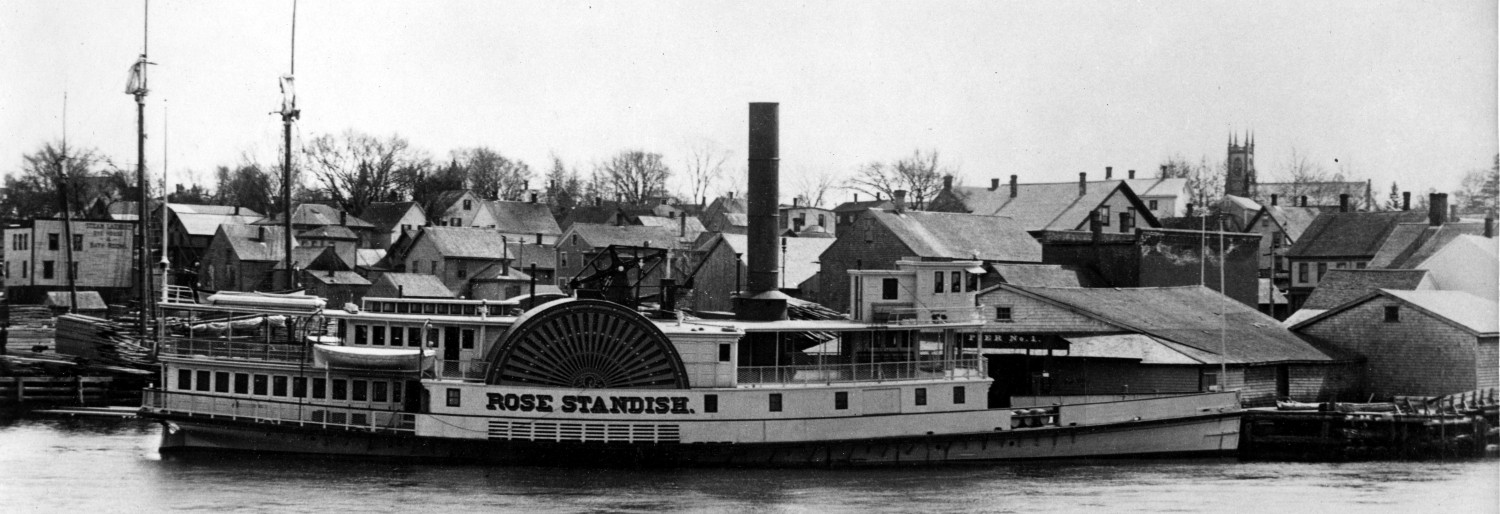
[This article is in two parts, one about the veteran front and center, and the other about the man near him who was tied to the alleged serpent.]

Fred Cochran (not Sewall Quimby)
Last week I wrote an article about Civil War doctors which included the above photo. I identified the one-legged man in the photo as Sewall Quimby. One of the recipients of my emails is a fellow from Bangor who happens to have local connections named William Allen, aka Peccavi. Peccavi has a sixth sense when it comes to ferreting out mistakes I have made in my writings and his suspicions were aroused by the one-legged man. On not the slightest evidence he went down the rabbit hole and discovered many salient facts about Mr. Quimby which belied my claim that Quimby had lost a leg in the Civil War. For instance, he found Mr. Sewall Quimby had a lengthy career as a lumberman in his native Wesley after the war and engaged in other activities unbecoming a man with one leg. After reporting his suspicion to me I did some additional research and found that Sewall Quimby had moved to Milltown Maine in the late 1800s, worked in the mills and engaged in other activities inconsistent with those of a man who had lost a leg.
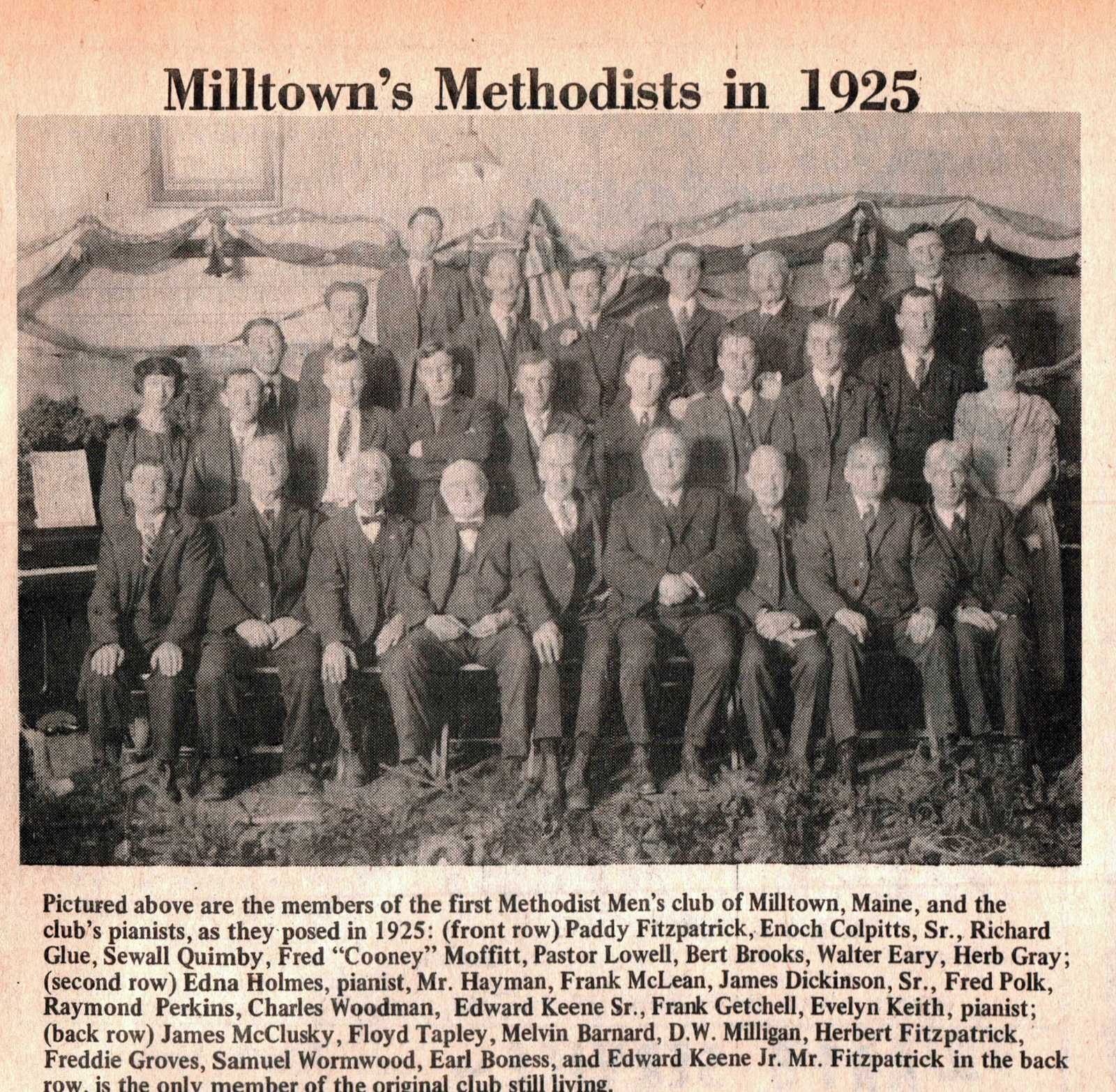
Sewall Quimby, fourth the left front row
Eventually I found the above photo. Sewall Quimby is forth from the left in the front row and is clearly equipped with two legs. This led to a search for the true identity of the one-legged veteran. With the assistance of Sharon Howland, our genealogy expert, I can now say with complete certainty the disabled veteran in the photograph above is Fred Cochran. As to the Great Land Serpent you’ll have to read on to be enlightened.
Fred Cochran is unquestionably the one-legged veteran in the photo at the cemetery.
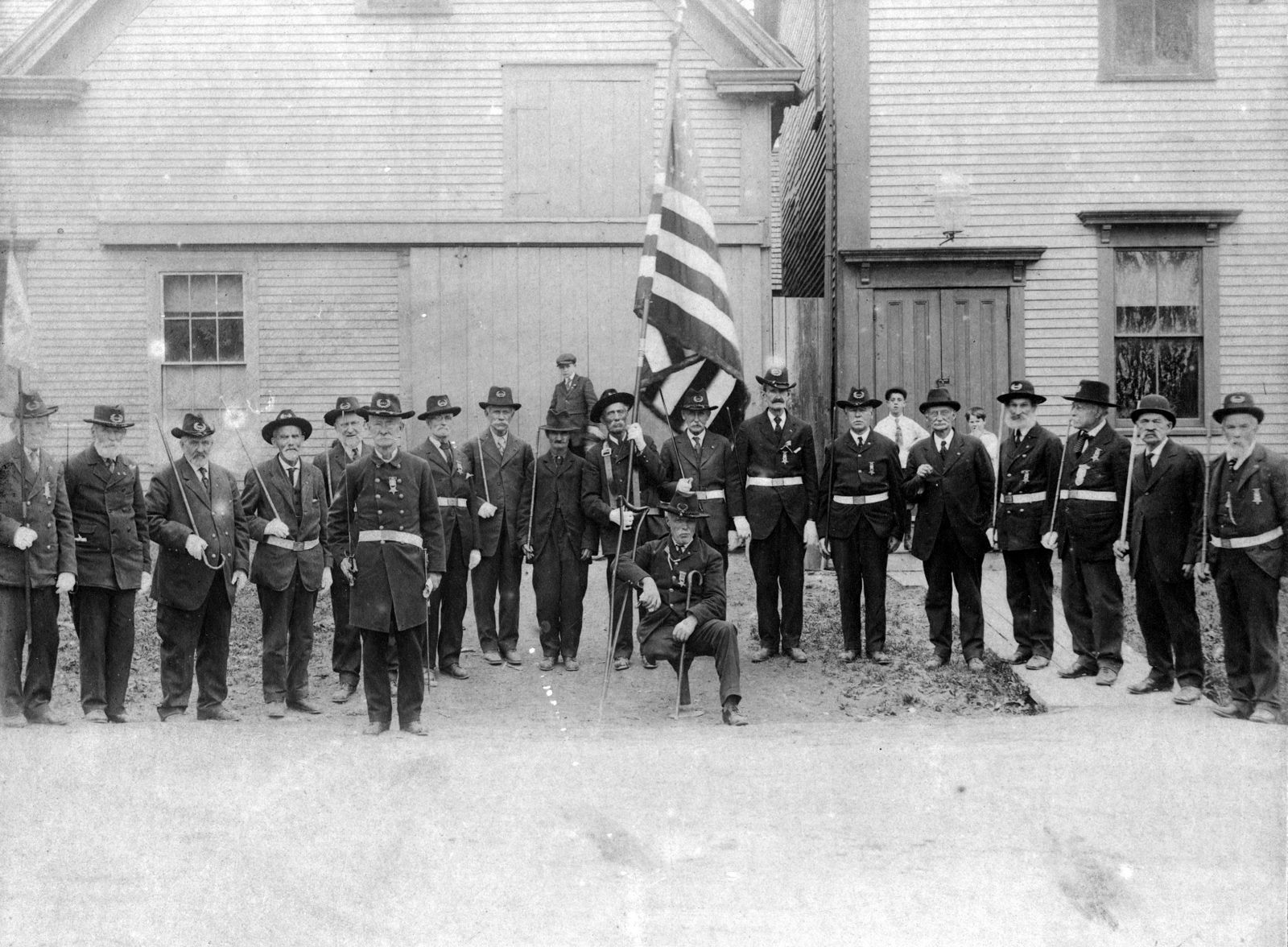
Fred Cochran with vets at GAR Hall Calais Lowell Street
There is very little known about Fred. Why he used an alias is a mystery although he may have been too young to enlist and used a false name. We do know he was one of the last surviving veterans of the Civil War and was active after the war in the Grand Army of the Republic (GAR) along with Sewall Quimby, who was for many years the commander of the post. From what we know he lived in Calais all his life although he would occasionally travel to Canada, perhaps to visit relatives. St. John Daily Sun March 19, 1885:
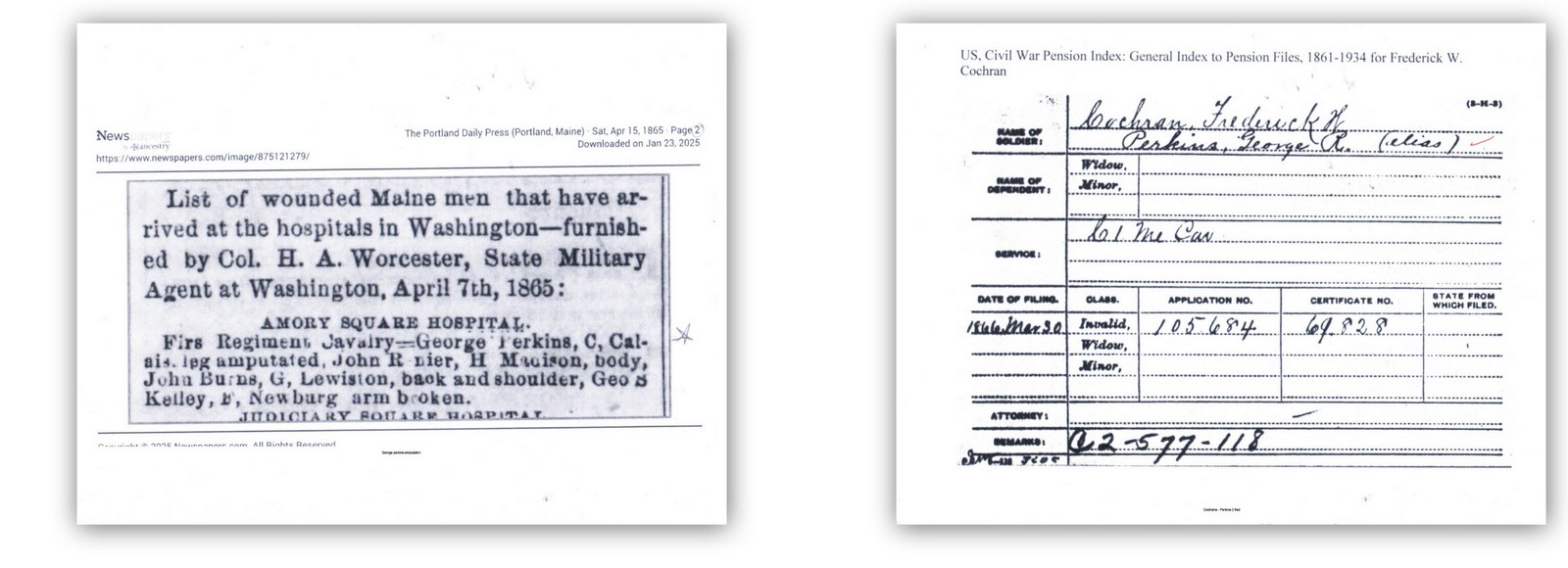
Centreville (Carleton Co.) March 17 – Frederic COCHRAN of Calais, Maine has been spending the winter in the village, boarding at Balloch’s Hotel. He enlisted in the war in the U.S. in 1862 and in a battle in Virginia lost his right leg. He receives a pension and in spite of his loss takes the world easy and seems to enjoy life. He is young, being only about 18 when he lost his limb.
His parents were both Canadian but they had moved to Calais before the Civil War. In 1860 his father William Cochran and mother Mary, both Canadians, were living in Calais with Frederick and his siblings. Frederick is said to be 13, which is consistent with his being just 18 when his leg was amputated at Armory Square Hospital in Washington D.C. on April 15, 1865. The 1920 census finds him at 70 single and living in Calais but in 1930 at 83 he is married and “living in Calais, Maine with housekeeper and widow Nettie, born Canada.” His home was on Garfield Street.
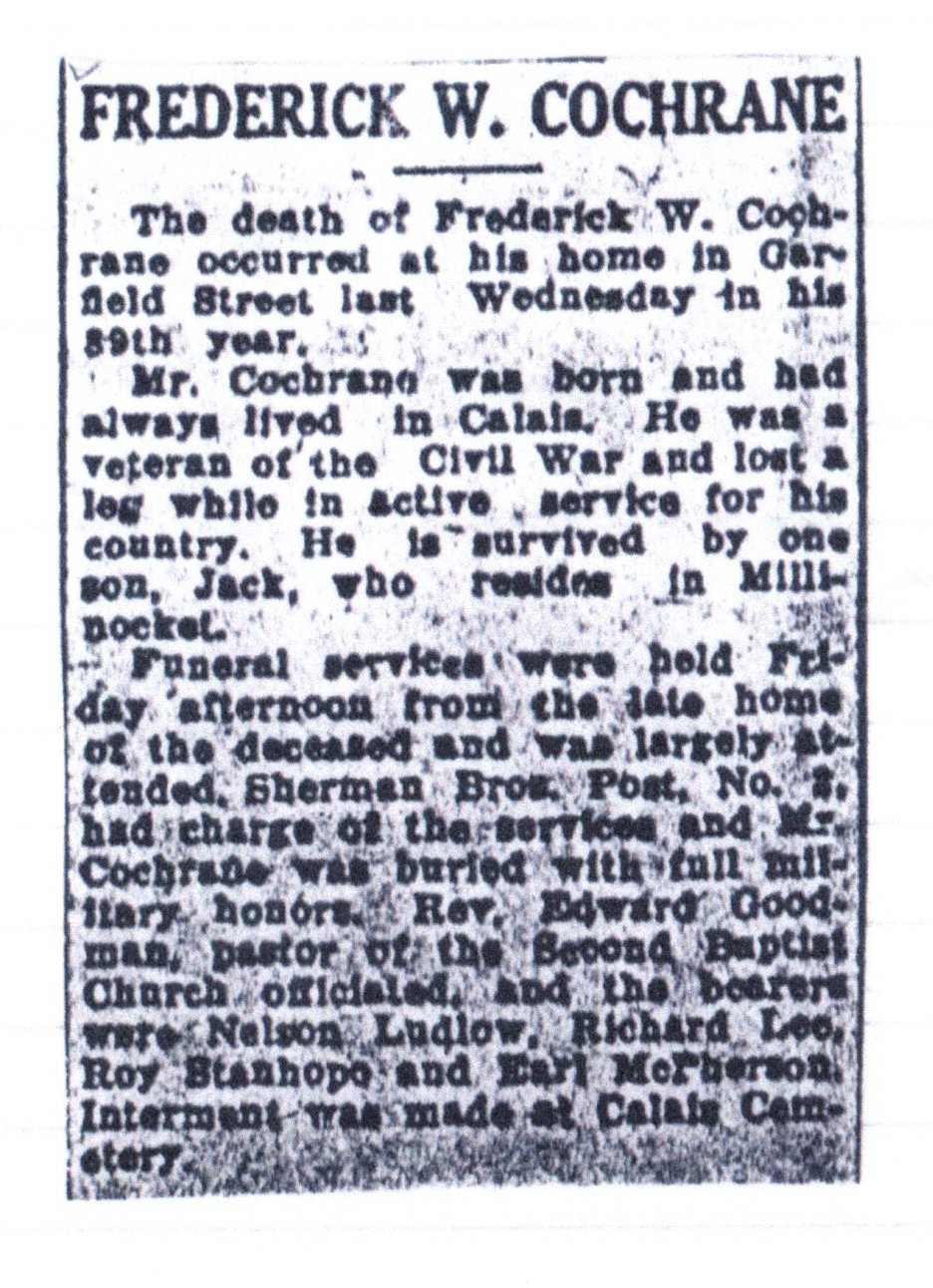
He died in November 1936 and was one of the last surviving soldiers from the Civil War. The last surviving Civil War veteran from Milltown Maine was Sewall Quimby who had died in December 1934.
As to the Great Land Serpent, it is Sewall Quimby who was standing next to Frederick in the cemetery photo who features in that story.
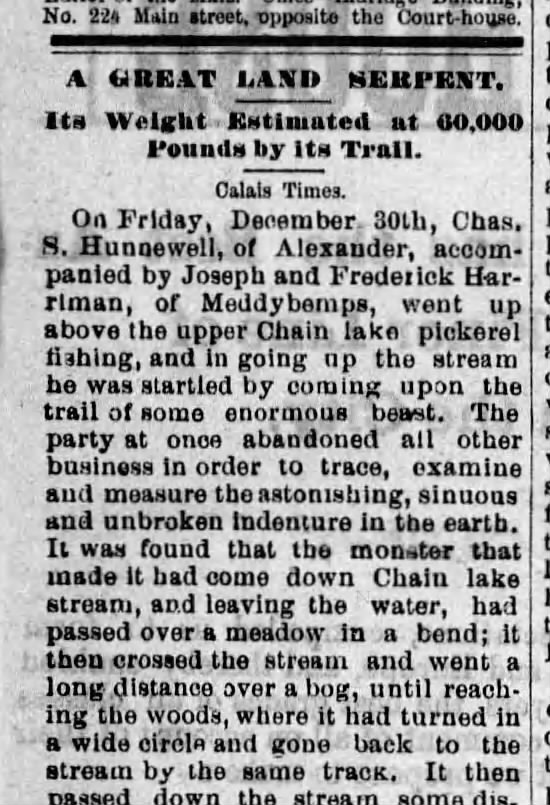
This Calais Times article was republished throughout the country
In February 1882 newspapers throughout the country published an article first published by the Calais Times claiming a 60000-pound land serpent was on the loose near the Chain Lakes in Wesley.
This is from Stockton California Evening News, February 8, 1882.
GREAT LAND SERPENT. Its Weight Estimated at 60,000 Pounds by its Trail.
Calais Times. On Friday, December. 30th 1881
Chas. S. Hunnewell, of Alexander, accompanied by Joseph and Frederick Harriman, of Meddybemps, went up above the upper Chain Lake pickerel fishing, and in going up the stream he was startled by coming upon the trail of some enormous beast. The party at once abandoned all other business in order to trace, examine and measure the astonishing, sinuous and unbroken indenture in the earth. It was found that the monster that had made it had come down Chain lake stream, and leaving the water, had passed over a meadow in a bend; it then crossed the stream and went a long distance over a bog, until reaching the woods, where it had turned in a wide circle and gone back to the stream by the same track. It then passed down the stream some distance and entered a large floating bog on the other side. In this bog the trail ended in overflowing water, from which no indications exist that the serpent returned. The total length of the track is from one-fourth to one-third of a mile. The path is sinuous, similar to that made by a snake, and is from four to four and a half feet wide and measuring from the top of the furrows of earth two and a half to three feet deep, according to the firmness of the meadow and bogs. The distance between the curves is, by actual measurement, thirty feet, and as every snake makes three curves in moving, the total length of this creature must not be less than ninety feet, and allowing for the bend of the body and the erect portion seen by Mr. Hall, probably over one hundred feet. Where the monster circled in turning, buried logs and brush are thrown some feet, and at other places in the course obstacles are thrown out of the way, apparently to make an easier passage for the long sweep of body.
Saturday, the 31st, Mr. Hunnewell went to the camp of Sewell and Hiram Quimby, who are lumbering in that vicinity, and Hiram Quimby returned with him to the bogs. Mr. Quimby, who had entertained the liveliest doubt of Mr. Hall’s story and expressed utter disbelief in the existence of sea serpents and such, is said to have been rooted to the earth with amazement and awe when he viewed the track to which he was led. He stated that in his judgment the animal that could make so deep an impression on the earth must have weighed at least 60,000 pounds. Subsequently Sewell Quimby and all the camp crew examined the trail, and on Sunday many people from Wesley visited the spot.
The Quimbys, well-known in Calais as reliable and truthful men, give about the same particulars. As Mr. Hunnewell has stated, and other parties vary but little in their descriptions. The track at present is covered with snow, but all say that neither the storms of this Winter nor the rains of next Spring can obliterate it. It must remain a good part of next summer, and all who are interested enough in the great mysteries of Nature, or desire to be convinced of the existence of Mr. Hall’s monster, can examine the trail themselves. The spot is only about ten miles from Wesley Corner.
However, by March of 1882 according to John Dudley, eminent local historian, it appears Sewell Quimby was not on board with the story and attempted to discount the presence of the serpent. In an Alexander/Charlotte newsletter published a few years ago John says of the sea serpent story:
At this point, some readers might believe that this is one of those wild stories that Terry Holst requested. True doubters, members of the Flat Earth Society, may stop reading now. Those who feel the need for a reality check, read on.
The March 21, 1882, issue of the Machias Union has an article entitled CHAIN LAKE SNAKE. The article is, in fact, a letter from one Sewell S. Quimby of Wesley in which he attempts to refute the existence of this monster. Sewell (1840) and his wife Lizzie (1846) lived in Wesley. Nearby lived his parents, David (1802) and Pheby (1810) and also his brother Hiram (1831), his wife Deborah (1837) and their daughter Annie (1873). The Quimby family had a sawmill on Chain Lake Stream according to the 1881 Atlas, right on the Airline. Here is Sewell’s letter.
“Mr. Editor: As I was returning home Saturday night I heard a man say with great earnestness that he had seen the man that saw the great snake, and that they were going to lease the ground around Chain Lakes for a hunting ground; that they were already having great chains made, huge traps constructed, harpoons, lances, spears, gaffs and barbs in readiness when the spring opened, and were going to capture if possible the monster of the mighty deep, now landlocked in the small fresh water ponds of the Machias Chain Lakes.
“Just a little later I heard another person say, with the same vim, they had seen a man that saw the man that said he saw the great snake…. Hall and Libby were on the shore of Chain Lake … they heard a noise…and saw what they took to be a man and a skiff, but soon became convinced it was a serpent … its smallest part was as large as a pork barrel. He says when last seen in the outlet, it had left the water and passed a distant point of land covered with granite boulders.”
Mr. Quimby refutes the above statements thus: On that very day that Hall and Libby were at Chain Lake, Quimby was also at Lake. He had gone to the head of the lake for some boards and other supplies for a camp, including a barrel stove that he placed on the bow of the skiff. He had rowed the skiff down lake and to the outlet where there are no granite boulders. If Hall saw granite boulders where there are none, well; he likely saw a monster where there was none.
Quimby continues, “In January, one Hunnewell of Alexander came to our camp with a big story that he had seen the trail of the huge creature, four feet wide, three feet deep and a quarter mile long. Logs had been turned out of his track and he had torn things up awfully. Mr. H. was also very much excited.”
We know, as did Sewell Quimby, that people from Alexander would never utter an untruth. Upon investigation, Quimby found the place in a swamp where Hunnewell had seen the trail. Quimby estimated it to be between 3 and 4 feet wide and 2 ½ to 3 feet deep. The trail was sinuous, making 3 or 4 bends. It was in two places, each 3 rods long, and looked a little particular. All this Quimby attributed to the freezing and thawing of the swamp.
John Dudley continues:
These lake creatures by whatever name and in whatever water shed likely are harmless. So, while you are on the lakes or prowling in the swamps, keep your eyes and your mind open. With a few good pictures, we might get the Pocomoonshine Lake Monster listed on the federal endangered species list. And while we are at it, we still need stories to share and are looking especially for stories about the Indian Devil. The Passamaquoddy call this creature lunk soos; it is sometimes called a catamount, mountain lion, or panther.
Of two things we are now certain- the one-legged man in the cemetery photograph was Fred Cochran and the Great Land Serpent of Wesley has remained in its lair for 140 years, having caused such a commotion the one time it ventured out.