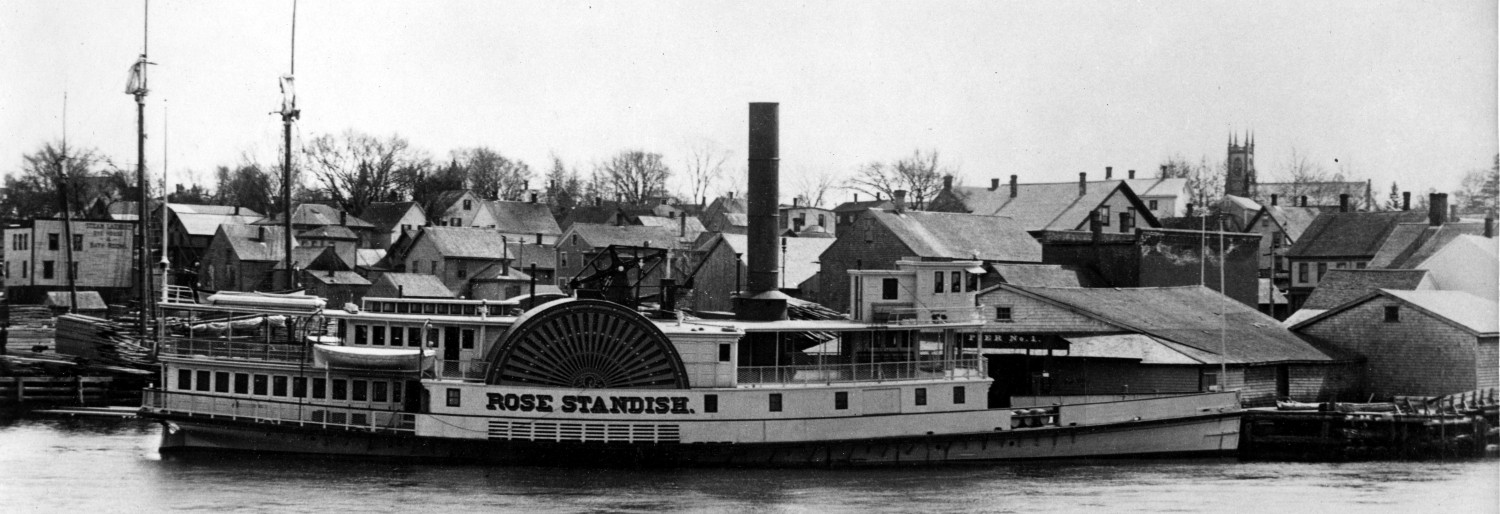
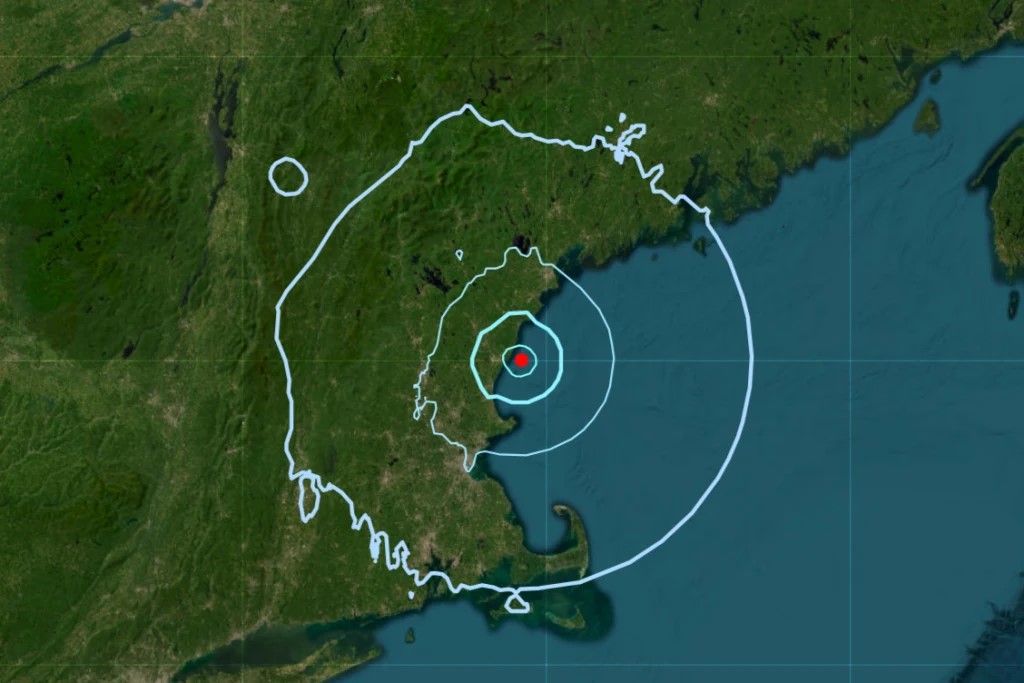
Recent earthquake epicenter York Harbor Maine
[Written February 8, 2025] The news broadcasts last week were all aflutter about the earthquake which shook New England. The epicenter was York Maine. “Earthquake rocks Boston Area”, “Maine Earthquake felt in Western Massachusetts” were typical of the hyperbolic rhetoric which introduced the reporting of the rather bland details of the actual quake which at 3.8 on the Richter Scale is classified as “light-often felt but only causes minor damage.” There are half a million such quakes worldwide every year. I thought it might be interesting to research whether Downeast ever experienced a quake in the “moderate” to “great” categories of the Richter scale.
Earthquakes were the subject of many local newspaper articles over the past two centuries, many containing detailed accounts of vast devastation, loss of life and the horrible suffering of earthquake survivors. Such disasters were extremely newsworthy in a time when most had little interest in any news which was not local. Reports were brought home by seamen who saw the aftermath of earthquakes in the earthquake prone areas of Central and South America. More terrifying still were earthquakes at sea which swamped vessels. Then there was a headline from the Cleveland Weekly Reader on March 5, 1854 which came as a great shock to me, President of the St. Croix Historical Society:
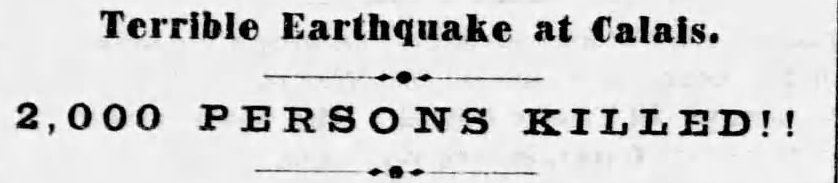
What other cataclysmic events had escaped my notice? Two thousand dead! In Calais! Other newspaper reports from Europe led me to believe that the March, 1854 quake had occurred in Calais, France but more research determined that there had been no such quake in Calais, France in 1854 or at any time in its history. Bizarrely the only report of a serious earthquake in 1854 was in December of that year, in Japan. And the report was of 2000 dead.
Mystery unsolved, I did find two possibilities of serious earthquakes locally in 1817 and 1904.
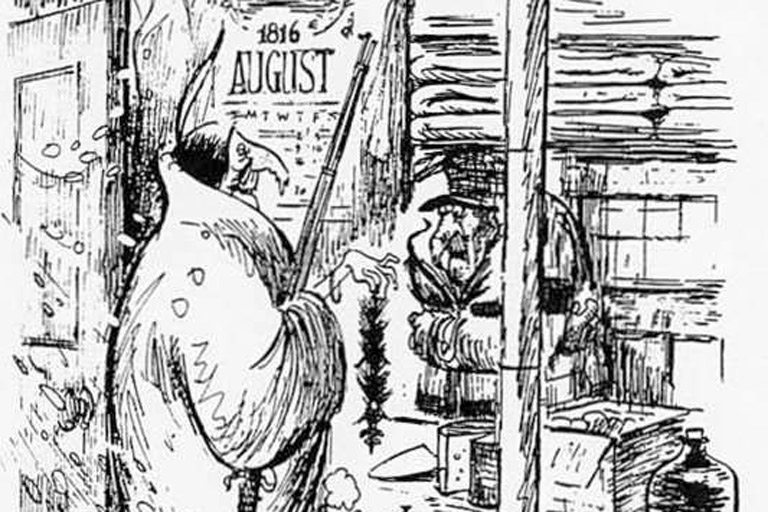
From a Canadian history-Year without summer 1816
The first of the two Downeast earthquakes which may possibly have reached a Richter scale warranting a Moderate rating or better occurred in 1817. 1817 followed “the year without summer” about which I have written previously when Downeast experienced snow and frost throughout the summer killing all the crops. According to Knowlton’s history in 1816:
There came dangerously near being a famine, and there was considerable suffering, even among the hardy settlers who could eat anything and everything. To vary the monotony of this chain of misfortunes there happened in 1817 a severe earthquake which shook things up in a rigorous and impartial fashion, but did no great damage, and this was the parting kick of the demon of bad luck, for the people gathered a goodly harvest in the fall of 1817.
The description by Knowlton of a “severe earthquake” does indicate it was more than a minor event. The fact that it did no great damage is not conclusive as in 1817 there were few structures to damage. Much of the population of the St. Croix Valley still lived in log cabins along the river and the frame houses in town were probably well built and quite new. As Downeast was still the frontier with few people and connected with the outside world only by sea, the severity of earthquake of 1817 locally remains a mystery. National papers did however report on a severe earthquake in Halifax and Digby in 1817.
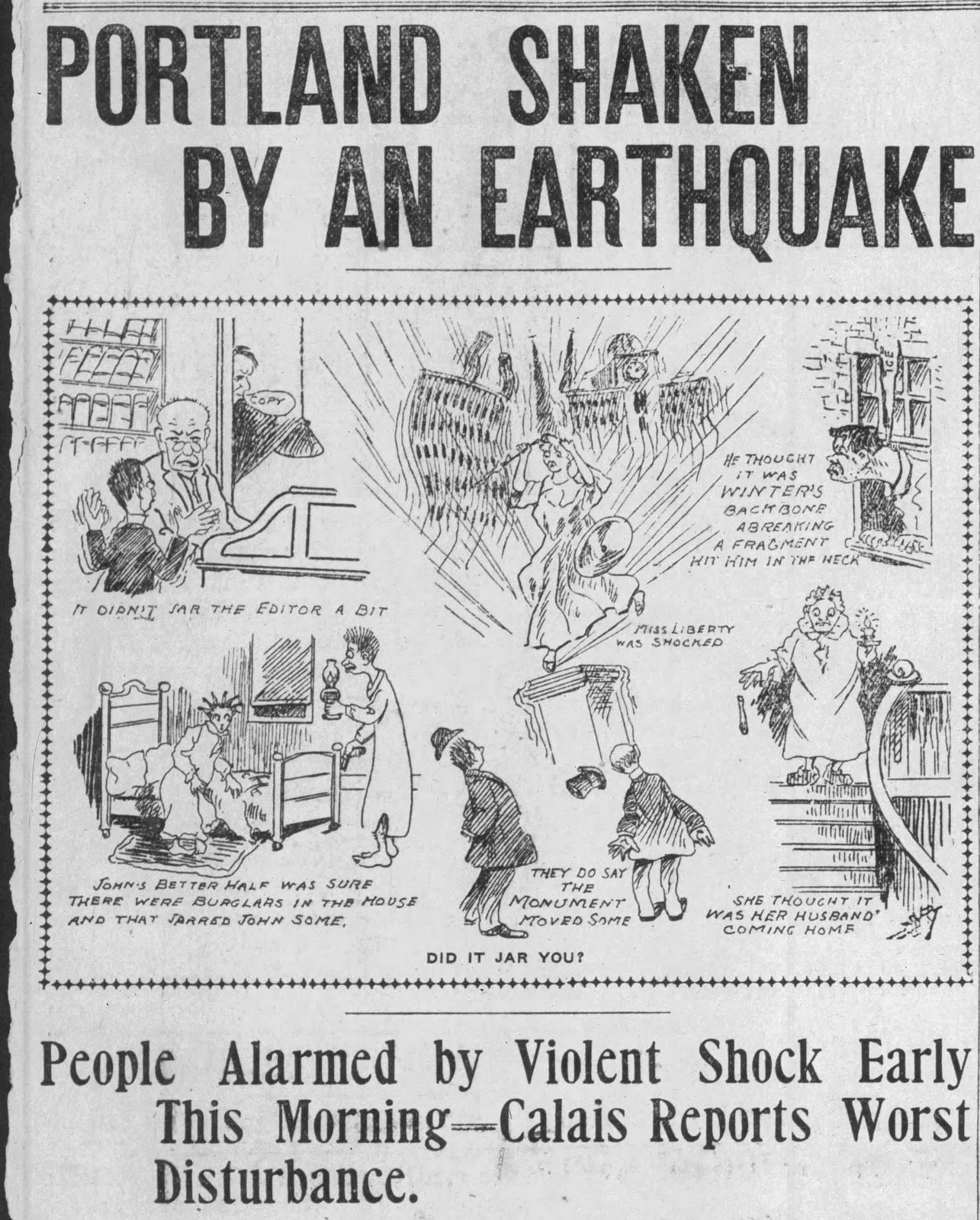
Calais at epicenter of 1904 earthquake
The earthquake of 1904 was one of two Maine earthquakes officially considered a significant earthquake and according to most reports Calais was the epicenter. Eastport also claims that distinction, but neither claim can be proven as New England at the time had no seismographs to measure the epicenter or severity of the quake. The other significant quake was in 1973 on the Maine-New Hampshire-Quebec border. The 1817 earthquake is not considered significant, its epicenter was in Nova Scotia and Downeast may not have felt its full force.
In Calais the 1904 quake was said by the Kennebec Journal to have caused buildings to rock, pictures to shake off the walls and chimneys to fall. The heaviest shock was preceded by terrific rumblings.
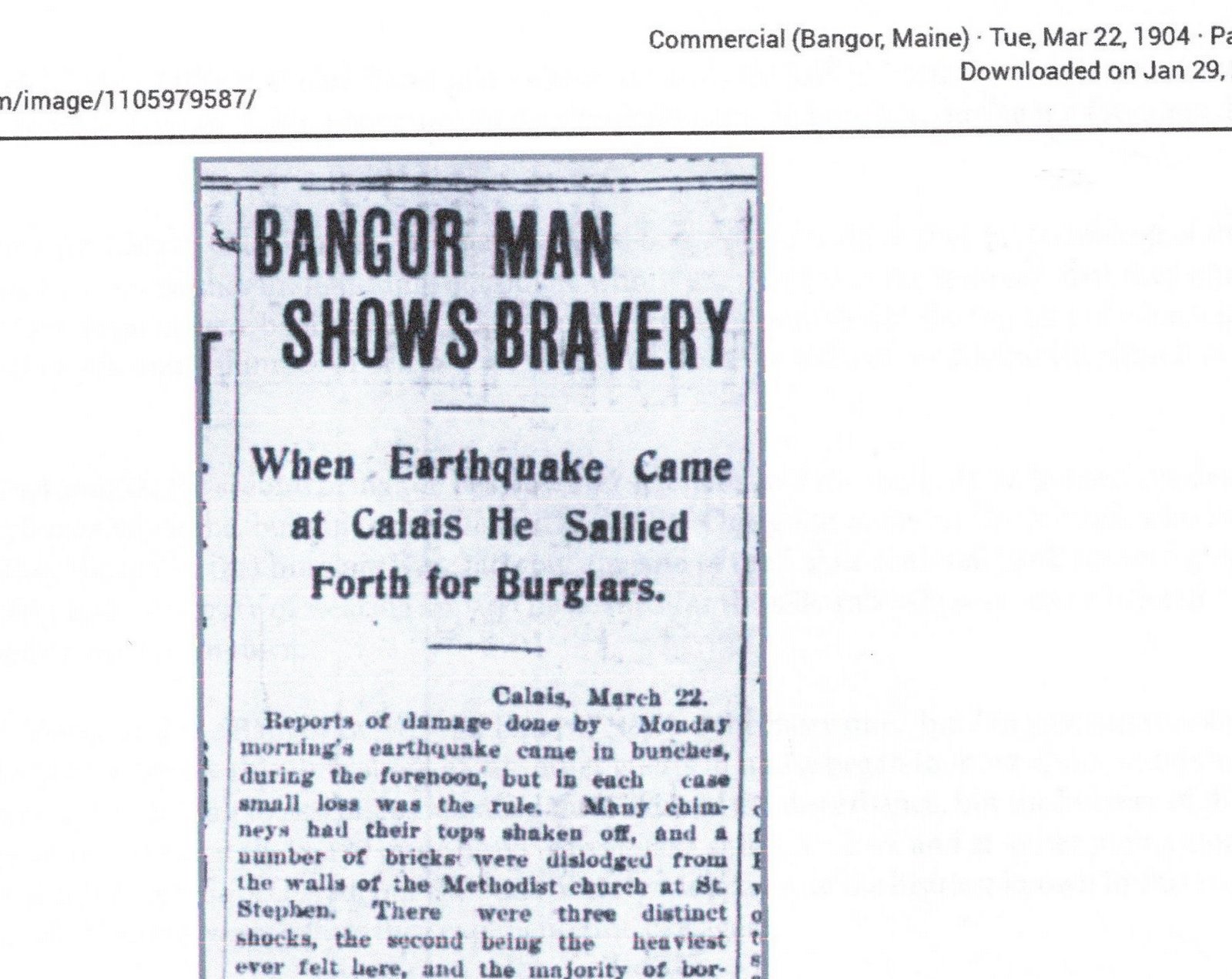
The Bangor Commercial reported on the misplaced bravery of a Bangor man visiting Calais:
Bravery Bangor Commercial March 22, 1904:
BANGOR MAN SHOWS BRAVERY:
When: Earthquake Came at Calais He Sallied Forth for Burglars
Calais, March 22.
Reports of damage done by Monday morning’s earthquake came in bunches, during the forenoon, but in each case small lows were the rule. Many chimneys had their tops shaken off, and a number of bricks were dislodged from the walls of the Methodist church at St. Stephen. There were three distinct shocks, the second being the heaviest ever felt here, and the majority of border residents dressed themselves in a hurry when the buildings commenced to quiver.
One guest at the St. Croix hotel, who lives in Bangor, thought when the quake came that burglars were blowing the safe of the Calais National Bank across the street, and grabbing his revolver and a quantity of wearing apparel he bustled for the sidewalk where he met a belated pedestrian making good speed down town.
What’s all the racket?” ‘demanded the Bangor brave.
D— -d if I know,” replied the hasty one, “but I’m going home, and he did not stop for further parley.
By the this time about all the other guests in the house began to move about and the third shock which came as they began to assemble explained the nature of the disturbance; but the bravery of the Bangorean was duly acknowledged by all. In 1869 quite heavy earthquake shock was felt here and at other points along the coast, and in 1898 a slight tremor occurred, but the shock of early Monday was the heaviest known in this section and borderites hope it will be many years before they experience the like again.
During the early part of Sunday night, a heavy gale was in progress, but at the time of the disturbance Monday morning there was a perfect calm. Some people claim that the trembling of the earth was accompanied by vivid flashes of lightning but others who were aroused at the time say they must have been mistaken. Many women were badly frightened, and not a few men trembled at the thought of what might happen.
In Eastport the Eastport Sentinel published several articles on the earthquake.
March 23, 1904:
The shock was quite heavy in the village, and judging from what is heard on the street, some of the people were much alarmed. Shortly after one o’clock on Monday morning last, earthquake shocks were felt in this city and surrounding towns; the first shock being of considerable severity, the second, —and as some claim, third —which followed in quick succession, being of a much milder nature. Various reports of damage done are prevalent, and in most cases probably exaggerated; but it has been ascertained for a fact that bricks were thrown from several chimneys about the city, and pictures and bric-a-brac shaken from the walls and shelves in several houses.
Among the surrounding islands the first shock is said to have been even more severe than at this place, throwing down chimneys and shaking stove pipes from their positions. Many residents were greatly terrorized by the unusual occurrence. Report also has it that a great brilliancy illuminated the eastern and western horizon during the visitation, and that the wind, which had been blowing fiercely for hours, completely subsided before the coming on of the shock, beginning again directly after it was over.
It is now about thirty years since anything of the kind has been experienced in this vicinity, and never one so severe as that which visited us on Monday morning.
At 1.30 Monday morning many of our citizens tumbled hastily out of bed, many of them doubtless thinking the day of Judgment had arrived and that ten cent piece put in the contribution box Sunday evening looked very small indeed, and they wished they had made it a quarter when they found the house shaking and dishes rattling from an earthquake shock that made things lively tor a few seconds. No particular damage has been reported in the village but reports from the western portion of the town of old winter and remained quietly in bed.
Reporting from Dennysville and Edmunds:
Quite a heavy earthquake shock was felt here about 1 a.m. Monday morning; the rumble and quake seemed to come from the southeast and pass off to the northwest, and was the heaviest the writer ever experienced, and caused quite a rattle and shake-up for a minute, and the writer’s dwelling appeared to be just in the track of the quake. Several very low rumblings were noticed, but these appeared to be more to the northward. We have no hankering after earthquakes and feel pleased to have so few to report. However, it settled all prospects of a big thaw for the present, and one seemed imminent. A good smart earthquake shock may be a good thing in extreme Southern latitudes to awaken the people from that lethargic state apt to be experienced in warm climates, but not needed in our New England clime, especially during the present winter, for we had to be awake and active to keep warm.
Dennysville and Edmunds:
The earthquake caused quite an excitement up this way among the nervous and sensitive ones, but that was nothing strange, for in this section a visitor of that kind is only heard from at long intervals, and coming as it always does without previous warning, these timid ones are entirely unprepared and therefore scared.
Now in more southern latitudes where these quakings are of weekly occurrence, the inhabitants simply turn over and go to sleep again and wait for another quake. (We have this statement from one who dwells within the well-known earthquake circle). But here in staid, sober and snow-covered New England, a little jar and rattle in the middle of the night is of sufficient importance to keep many wakeful for a long time.
From a Charlotte history:
The “earthquake.” Mar. 21st was plainly felt here and startled a good many. Some of the nervous ones are predicting and looking for another of more magnitude. Hope they’ll get disappointed, for one dose is enough of that kind.

1904 Earthquake is one of two to be officially significant
With the exception of the 1973 quake along the largely uninhabited border of Maine and Quebec, it appears only the 1904 earthquake centered in Calais was of a severity to be considered a “damaging earthquake”. The list however of local earthquakes reported in the newspapers is long, dozens over the years such as the 1925 Woodland quake which caused “spectators at a local pool room to become stricken with terror as they watched balls roll to one end of the table” and at the St. Croix mill “pile of groundwood were shaken over, much to the disgust of the workers.”
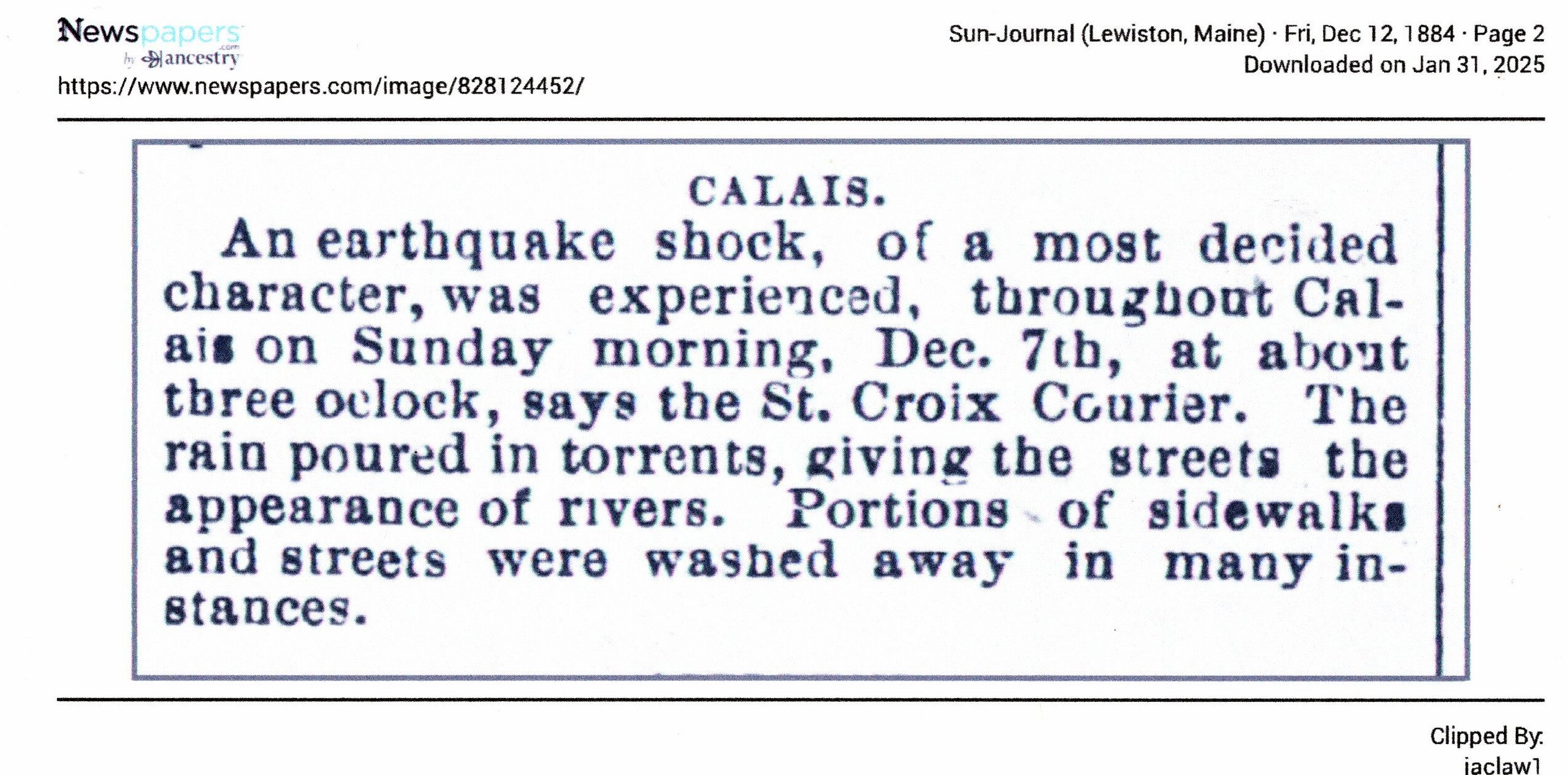
Typical of local earthquakes making the news was one in Calais in 1884 and another 100 years later.

Almost all local earthquakes, however, were like the 1984 quake and the most common reaction in recent years was to fear the furnace had exploded. However, a 1982 article had raised some concerns about the nuclear plant at Point Lepreau New Brunswick. As the Point Lepreau nuclear plant was set to go online the region was struck by a 5.9 magnitude earthquake. Point Lepreau was engineered to withstand a 6.2 magnitude earthquake. The engineers assured the public the plant was safe and thus far they have proven to be correct.