Civil War battlefield surgery required little expertise
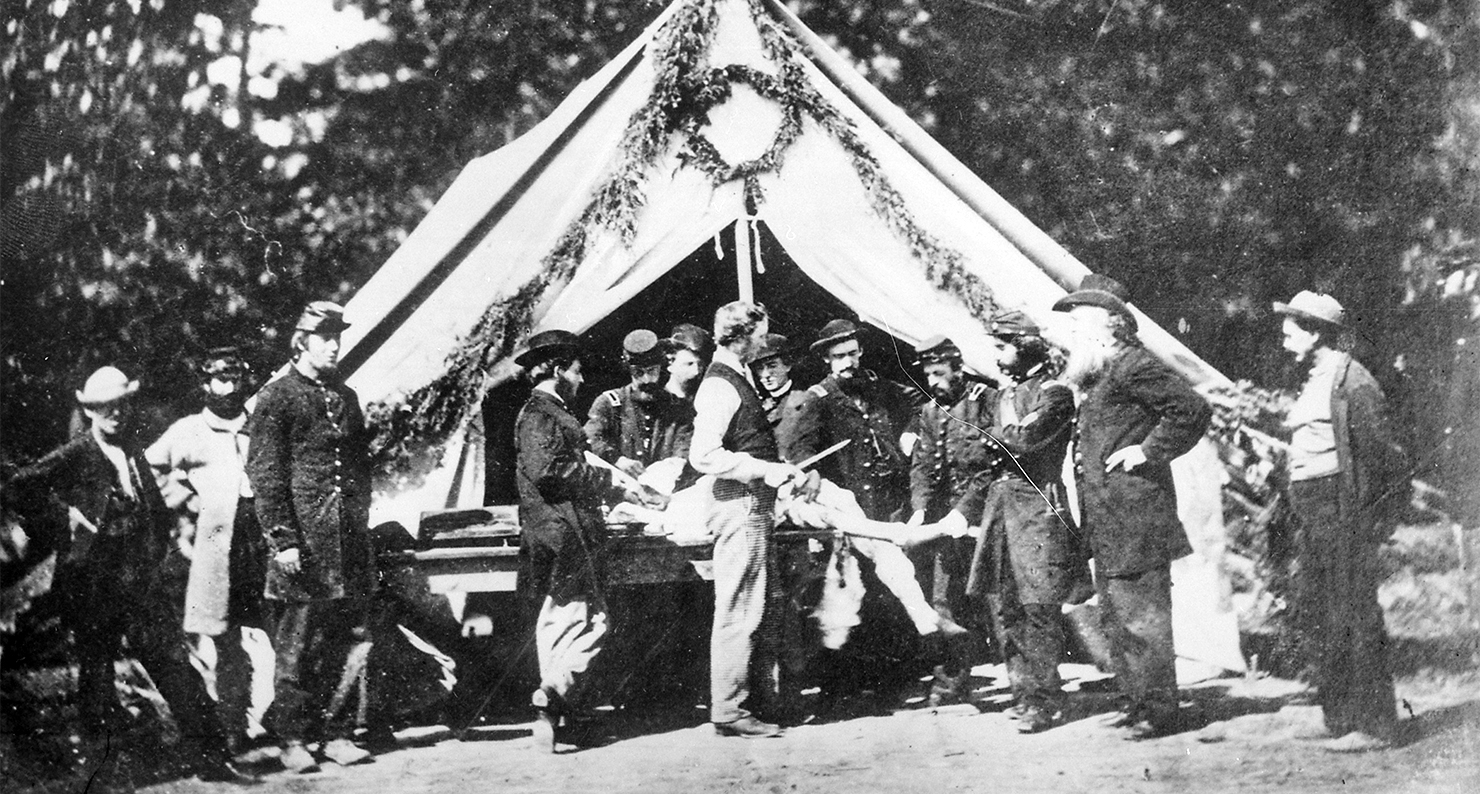
Civil War surgeons practiced their profession under dangerous, brutal conditions, sometimes without anesthesia and often without sleep for days on end. The standard procedure for any serious wound to a limb was amputation. According to Lapham’s Quarterly:
With limited knowledge and even more limited resources, doctors and surgeons often turned to amputation when a soldier suffered any kind of significant wound. Before the war’s end, some 60,000 men would have a limb removed. Tillie Pierce Alleman, a fifteen-year-old girl whose recollections of Gettysburg during the battle would be published in 1889, observed a grisly scene outside a local home:
To the south of the house, and just outside of the yard, I noticed a pile of limbs higher than the fence. It was a ghastly sight! Gazing upon these, too often the trophies of the amputating bench, I could have no other feeling, than that the whole scene was one of cruel butchery.
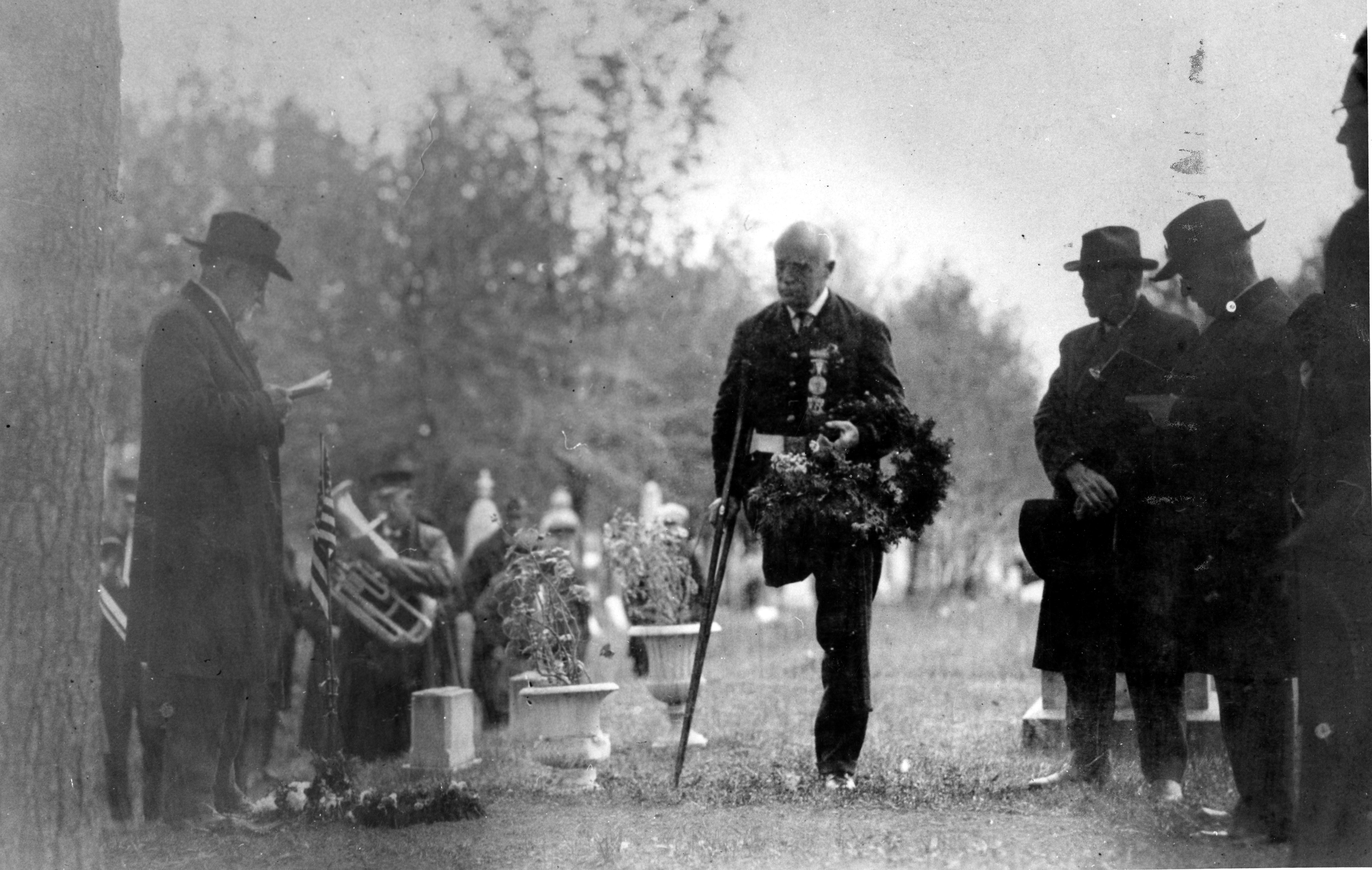
After the war amputees such as Fred Cochran were a common sight in Calais [note: read the follow up to this photo here: The Great Wesley Land Serpent]
Locally there were two doctors who served in the Civil War. One was Dr. William T. Black of Eastport, surgeon of the 1st Louisiana Volunteers and the other Dr. Robert Thomson of St. Stephen. Where and when Dr. Thomson served is unknown. In fact, it is not certain where he was trained as a doctor or if he served in war. His name and image, however, were emblazoned on thousands of bottles of Pepsin Compound, cough medicine and most notably Thomson’s Sarsaparilla sold throughout United States and Canada in the late 1800s.
About Dr. Black, we know a good deal thanks to the research done by historian Wayne Wilcox of Eastport. According to an article written by Wayne Wilcox, Dr. Black was born in St. Martin’s N.B. in 1830. He attended medical school at Pennsylvania Medical College in the 1850s and returned to New Brunswick to practice medicine. He married Frances Cutts of Eastport in 1857, lived in Perry briefly before moving to St. John N.B. When the Civil War began, he moved to Calais and enlisted in the 12th Regiment of Infantry of Maine Volunteers.
This regiment was sent to fight not in Virginia, Pennsylvania and Maryland where the famous battles of Antietam, Gettysburg, the Wilderness and Fredericksburg were fought but in January 1862 to Louisiana to contest control of the Mississippi River. While several important battles were fought in this theater, fierce engagements involvinghundreds ofthousands of troops like those in Virginia and Pennsylvania were few. However, aninfantryman was often more likely to survive in the North than in Louisiana. The death rate in the deep South from malaria, dysentery and other tropical diseases was very high for Northerners not accustomed to the heat and humidity. According to Ken Ross “many in the 12th died of disease and Private Charles Preston of Eastport died off Ship’s Island while trying to swim away from a shark.” Wayne Wilcox tells us dysentery nearly killed Dr. Black.
After a year of service Dr. Black stayed with the 12th Maine until August 11, 1862, when he resigned to accept a three-year post as surgeon on August 18 in the “1st Regiment Louisiana Volunteer Infantry,” a new Union regiment organized at New Orleans between July and August 1862.
Dr. Black remained the surgeon for the 1st Regiment for almost a year before he became ill. Sometime in April, Dr. Black contracted chronic dysentery and was unable to perform his duties. Dysentery was very common among soldiers during the Civil War, and many died from its effects. On April 29, 1863, Black was given a surgeon’s certificate of disability and granted a leave of absence for 20 days, with permission for an extension for another 20 days if necessary. Black was unable to travel north because of his illness; by early May, his condition had worsened. As soon as he arrived in New Orleans, he was admitted to the hospital and was unable to leave his bed. On May 10, 1863, he requested that his leave be extended. Dr. Black’s condition improved enough for him to travel home.
He arrived in Eastport on Friday, May 17, 1863. The local paper made note of Dr. Black’s arrival: “The severe marches and consequent exposure had caused the loss of his health, and a change of climate and rest was needed. The paper also made mention that the doctor brought with him two “beautiful horses.”
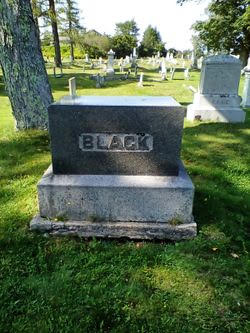
William Black’s Grave Eastport
Dr. Black soon moved to St. Stephen and practiced medicine into his 80s. He died at 82 in his home on the River Road Calais where he had moved late in life. He was for many years the St. Stephen Town Physician, a position which involved responsibility for the town’s “Pest House”. This was an important responsibility in the days before vaccines when cholera, diphtheria and typhoid fever could kill dozens in the span of a few days. Anyone in town showing any signs of such diseases was confined to the local pest house to prevent infection of the larger community. Calais’s pest house was in Milltown near Salmon Falls.
A selection of articles from St. Stephen’s Courier in the late 1800s are illustrative of the types of medical issues Dr. Black and other doctors handled in this era after the Civil War.
Courier 1865:
On Wednesday evening, Dr. Black and his lady were driving, the carriage was upset at the corner of Union and Marks Streets, breaking the shafts and some portions of the harness. Both Dr. and Mrs. Black were thrown out and sustained partial injury. The street at that part is exceedingly dangerous, and the only wonder is that accidents of a serious kind do not frequently occur. We would direct the attention of the Supervisor to it, as a horse and carriage can scarcely pass it after night without accident.
Courier January 6, 1866:
A lad at the Cove, named James Atcheson, shot himself through the right thigh, on Tuesday, by the accidental discharge of his gun. He was attended by Dr. Black.
Courier January 28, 1869
Dreadful Tragedy at Milltown
A tragedy of an appalling nature and heart rending in its consequence was enacted at Milltown on Monday afternoon, 26th inst., at about 2:30 p.m. It appears that some two years since Stephen Inness, the principal actor in this scene of blood, became deranged, the point on which his madness was most apparent being an idea that his sister, Adelaide, should live with him all her life. He seems to have wished that nothing should separate them and at times he was so violent in urging this point that the poor young lady was forced to appear to accede to all sorts of proposals, from him respecting their future life.
Latterly she became engaged to a young gentleman of Milltown, and this state of affairs suspected by the brother, he was so exasperated that his family, fearing danger at his hands, and acting upon the advice of Dr. Black, had him sent to the Lunatic Asylum in St. John. The superintendent of the Asylum seems to have considered this action, on the part of the family, unnecessary and, after some correspondence with them, discharged his patient who went to Eastport. He wrote while there, a little more than a week ago, to his family and sister, informing them that he was going away from them and would trouble them no more, and this was the last they heard or knew of him until he appeared, on Monday afternoon, at the residence of his mother and sister.
The two ladies were alone in the house at the time and the ill-fated girl left the sitting room, in which she and her mother were, and went into the kitchen where she met her brother, who in his stocking feet and armed with an axe, attacked her. She ran back to the sitting room, followed by the madman, and received the first fatal blow upon the left side of the head, into which the weapon entered to the handle. She fell forward upon the stove when another blow descended crashing through the skull and brain, and yet a third into the shoulder almost severing the joint. Leaving her there, quivering as death enfolded her in its untimely embrace, the suicide’s work commenced. Having broken the axe handle by the last blow, he drew a sheath knife and stabbed himself twice in the heart, once in the bowels, and then in the head until he fell upon the kitchen floor. The poor mother escaped and gave the alarm which soon brought many to the scene. Life lingered yet in both bodies, but soon the stillness of death came, and with it a gloom which will not soon be dispelled from that formerly happy and joyous home
Courier 1872:
The Small Pox:
There are two additional cases of smallpox reported at the Ledge in the same house in which the other case occurred. We understand some of the magistrates have appointed Dr. Black to attend these patients and have sent Mrs. Duggan to nurse them.
Courier July 31, 1873
A man shot in a bar room
About four o’clock on Sunday afternoon a man named Patrick Whalen was shot on the premises of Isaac Kennedy in the knee by Archibald Johnson, both belonging to Calais. It appears that Johnson had been fooling with the gun and perhaps was not aware that it was loaded. The shot took effect in Whalen’s right knee and left hand. The leg was amputated about eleven o’clock on the same evening by Dr. Black assisted by Dr. Vose. Kennedy was fined $20 and costs before the Police magistrate on Monday for selling liquor on Sunday.
Courier June 24, 1875:
Another Case of Small-Pox
William McGuire who has been employed as a clerk in a bar room in St. Stephen experienced symptoms of smallpox last week, and on Sunday went to his home on the Board Road, about 11 miles from St. Stephen. Dr. Ross was called and pronounced the disease small pox, when the case was reported by Thos. Cottrell, Esq., to Dr. Black, the Town Physician, who immediately communicated with the Government by telegraph.
The case of young Meredith at the pest house in the rear of the town is progressing favorable. The time of incubation since the first case was reported having expired, it is hoped that there will be no further cases.
Courier November 19, 1877
Serious Accidents – Last Thursday the carriage of Henry Osburn, Esq., occupied by Mrs. Osburn and Miss Debbie, the latter driving, came in contact with another vehicle on Marks Street. The horse, becoming frightened, cleared the carriage and ran to Milltown. Mrs. Osburn escaped unhurt, but Miss Dibblee was thrown out and it was, at first, feared that her injuries were serious. She was carried into the house of Mr. Moses McGowan where she was attended by Dr. Bernstadt. We are glad to learn that her injuries were only slight and that she has quite recovered from them.
About the same hour a similar accident occurred on Water Street, nearly opposite Smith’s Bookstore. A horse driven by Mrs. A. Catharine, who had another lady in the carriage with her, took fright, and shied to the side of the street, upsetting the carriage and throwing its occupants out. Mrs. Catherine was badly cut in the face, and was attended by Dr. Black. The other lady escaped uninjured.
Courier November 6, 1878
Accident—Miss Barbara Carmichael, teacher, was thrown out of a carriage while driving at the Rolling Dam on Hallowe’en, her head striking against a stone and making a deep skull wound on the left side above the temple and a slight wound on the right side. Dr. Black attended. The young lady is in a fair way of recovery but will be scarred for life.
Courier 1879:
Accident of the Railway.—As a daughter of Mr. William Noble and a daughter of Mr. Andrew Forsyth, each about 14 years of age, were returning from picking berries out the Valley Road on Tuesday afternoon, they met Mr. Nicholson, one of the section men with a lorry and asked him for a ride, which he readily gave them. They were proceeding along at rather a rapid rate, when an engine from St. Stephen came rushing around a curve within a few yards of them. Mr. Nicholson shouted to the girls to jump and at the same moment the engine collided with the lorry and broke into splinters, one of the pieces striking Miss Noble and inflicting a severe flesh wound in her arm. The wound was dressed by Dr. Black. We are glad to know that the injuries are not serious.
1880:
Amputations — During the last three weeks Dr. Black performed three amputations. Mr. Brown on the Ledge Road, a gentleman over 70 years of age, had an arm cut off. Mr. Brown lost his other arm some years ago. Mr. John Montgomery of Rolling Dam had his thigh amputated, and Miss Hill of Lower Calais a leg. All are doing well.
1880:
On Thursday the 17th inst., the body of a male infant was found in the woods at Meredith Settlement. An autopsy was held by Dr. Black, and an inquest held by Dr. Myshrall, the coroner when the jury rendered the verdict: “That we, the jury impaneled to investigate the death of Rachael Meredith’s child, who is proven to have died in the woods on the 16th inst., are of the opinion that said child came to his death by exposure in consequence of inhuman treatment on the part of the mother at the time of his birth; therefore we consider her guilty of infanticide, and that Lydia Ann Meredith, her mother, is an accessory before the fact.” Both were committed and held on bail to answer before the proper tribunal.

Sarsaparilla Building, corner Main and North Calais
As with Dr. Black we have no photograph of the other local Civil War surgeon, Dr. Robert Thomson although his image has adorned one of the largest buildings on Calais’ Main Street for 135 years. As a native of St. Stephen and one who never lived in Calais this, like much else about Dr. Thomson is distinctly odd. His father, the Reverend Skiffington Thomson, was one of the best known and influential clergymen who ever lived in the St. Croix Valley but his son Robert caused hardly a ripple on the surface of medical practice in St. Croix Valley until a decade after his death in January 1883. It was only in 1893 that he became famous for Thomson’s Sarsaparilla which according to the claim in large script below his image on the Sarsaparilla building on Main Street in Calais claims “Cures When Others Fail!” The building and Thomson’s image remain one of the most prominent landmarks on the Calais Main Street.

Products sold by Thomson’s Medicine Company
The Thomson Medicine Company also sold patent medicines other than Sarsaparilla although Sarsaparilla seems to have been sold far and wide in both the United States and Canada. The products were manufactured and bottled on the third floor of The Sarsaparilla building.
The history of Dr. Thomson and the Medicine Company is set out in a 1900 publication titled “Representative Businessmen of Calais”. While the authors managed to misspell his name, the history is consistent with earlier newspaper accounts of Dr. Thomson’s life.
1900 business directory:
THE DR. THOMPSON MEDICINE COMPANY,
Proprietors of the Great English Remedy, Dr. Thompson’s Sarsaparilla, and Other Famous Proprietary Medicines—-Laboratories, Calais, Me., and St. Stephen, N. B.
In reviewing the enterprise, the name of which heads this sketch, some reference to the life of the eminent doctor, whose name has become a household word, is certainly most proper and interesting.
Dr. Thompson attained remarkable success in the practice of his profession. Graduated from Bellevue College, New York, with high honors, he returned to St. Stephen, N. B., and at once took a leading place among the practitioners of the community. After several years of active and most beneficent work, his health failed, and he was compelled to go South. While there, the American Civil War broke out and, being somewhat recuperated, he accepted a commission as surgeon. Then followed two years of service in the camps and on the field ministering to the sick and wounded.
Returning to St. Stephen he again resumed his practice with greater success and more far-reaching good to the community.
The formulae from which his famous remedies are made were the result of many years of careful and earnest research and application. In his practice the doctor had a wide field in which to test their efficacy and prove their worth. The results were such that a demand was made for these standard remedies that was unprecedented, and their manufacture began on a large scale.
The Dr. Thompson Sarsaparilla has a name that is almost world-wide. It is certainly the best preparation of its kind and has accomplished more good than any remedy ever put on the market.
Besides the Compound Extract Sarsaparilla, Dr. Thompson’s Pills, Instant Pain Relief, Salve, Vegetable Cough ‘Cure, and other remedies are equally famous, and have carried blessings and benefits innumerable to thousands of households.
Not only has the name of Dr. Thompson become a household word, through the remedies referred to, but the standard flavoring extracts made by the company at their laboratories are famous. The Vanilla and Lemon Extracts are noted for their purity and strength and have a large sale throughout the country.
Much of this history is questionable. Thanks to the miracle of Google the complete history of Bellevue Medical School in New York, one of the first medical schools in the country and from which Dr Thomson is said to have graduated with honors is now available. The school’s first class began study in the fall of 1861, after the Civil War had begun so it is impossible for Dr. Thomson to have graduated from Bellevue, returned to St. Stephen to practice medicine for several years, then journeyed south for his health and serve as a surgeon in the Civil War. Further Ken Ross spent several years researching his marvelous book on local men who served in the Civil War and found not a trace of Dr. Thomson.
More tellingly, he died in 1883, a decade before the Thomson Medicine Company began selling sarsaparilla or anything else. In his favor, however, there is mention in an historical work on popular medicines of “Dr. Thomson’s Sarsaparilla, Dr Robert Thomson developer” and his company. There was even a ” triumphal march”, whatever that may be, composed by Walter W. Gillman of Calais praising Dr Thomson’s Sarsaparilla of which we have a copy. We are not sure where it was performed or when, but we do know Gillman was a local boy who lived with his parents in the 1890s on Main Street. In the Calais directory of 1897, he is listed as a medical student so apparently composing “triumphal marches” was only a sideline.
The company is also mentioned in the Calais Business directory of 1897 and newspaper articles associated with the company say W.A. Murchie, a scion of the Murchie family which had extensive business interests on both sides of the border, is chief officer. All of the other officers are from Calais. This leads us to speculate that some local businessmen obtained or appropriated the right to Dr Thomson’s formulae after his death, formed the company and perhaps created the legend of Dr Thomson to impress the buying public with the efficaciousness of the products.
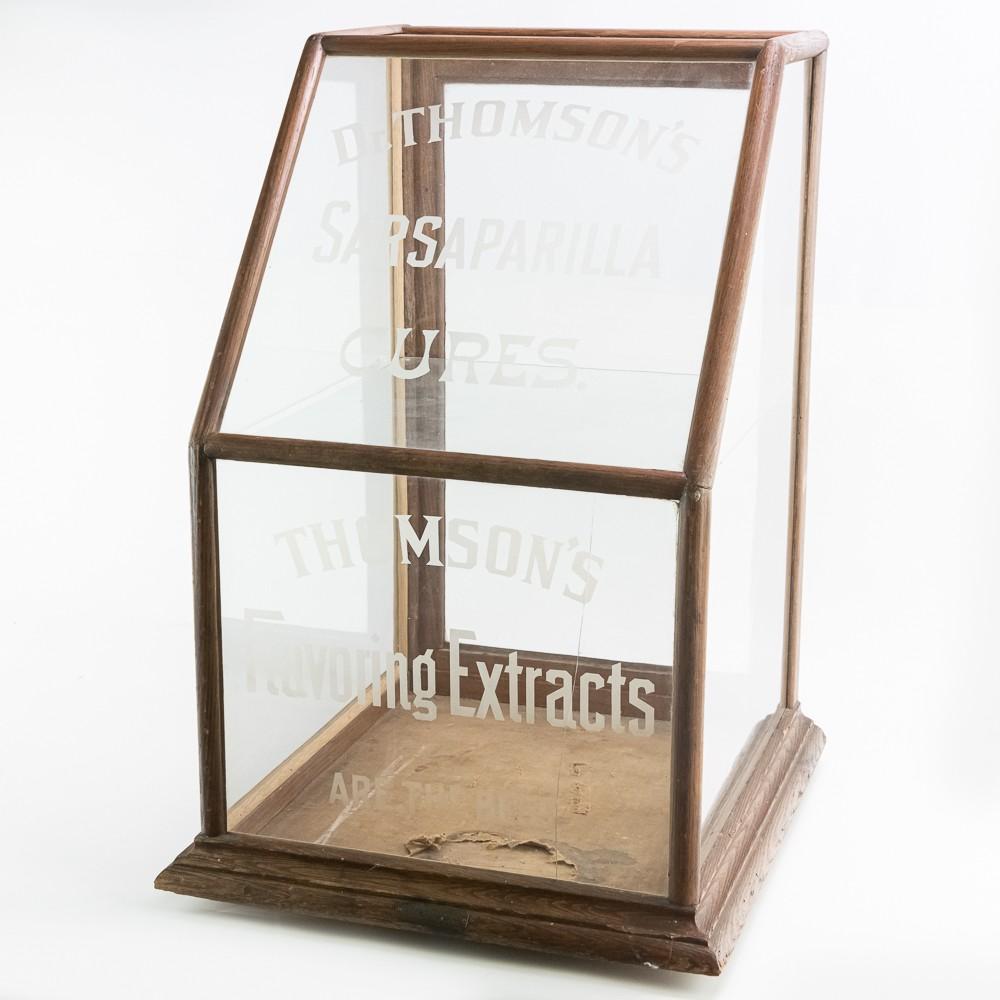
A display case recently sold on Ebay from Indiana
Dr.Tompson’s Sarsaparilla Cures
Thomson’s Flavoring Extracts
Are the Best
There is no question Thomson Sarsaparilla was initially a national success. The formula for this amazing remedy is not known but it is very likely it contained alcohol and perhaps opium which were the active ingredients in many patent medicines. Before the 1906 federal law restricted such drugs in patent medicine the McAllister’s and Lord’s drug stores on Main Street Calais sold cocaine toothache drops.

Local Drug stores carried many such products
On January 1, 1901, the Bangor Commercial reported the Dr. Thomson Medicine Company would be sold “at a bargain price to the right man” Apparently the “right man” never appeared, and the company went out of business. Sarsaparilla laced with questionable additives remained a cure all for several years. Hood’s sarsaparilla became the national best seller. For those unfamiliar with sarsaparilla Hood explained in a 1908 ad in the Kennebec Journal that Sarsaparilla is made of Zarza roots from the Amazonian swamps of Brazil.
“Fearful swamps they are. Smelly black mud-mosquitoes in the millions-snakes and crabs-heat poison, orchids, fever.
And here the natives camp for weeks at a time gathering Zarza roots for the sarsaparilla trade. The vine runs along the ground, roots are located and half of them are taken, the remaining half covered with soil again so that they will sprout for next year.
It is because sarsaparilla, like quinine, grows in fever soil that it is good for fever.
While many today claim that sarsaparilla is a powerful antioxidant the scientific jury is still out. Some studies claim positive results for easing arthritic pain and fighting infections. As sarsaparilla remains unregulated, a local entrepreneur could conceivably resurrect the Thomson Medicine Company and rent the now vacant space on the third floor of the Sarsaparilla Building on Main Street in Calais. Founded nearly 150 years ago the new business could point to Thomson’s proven track record of curing nearly every malady.