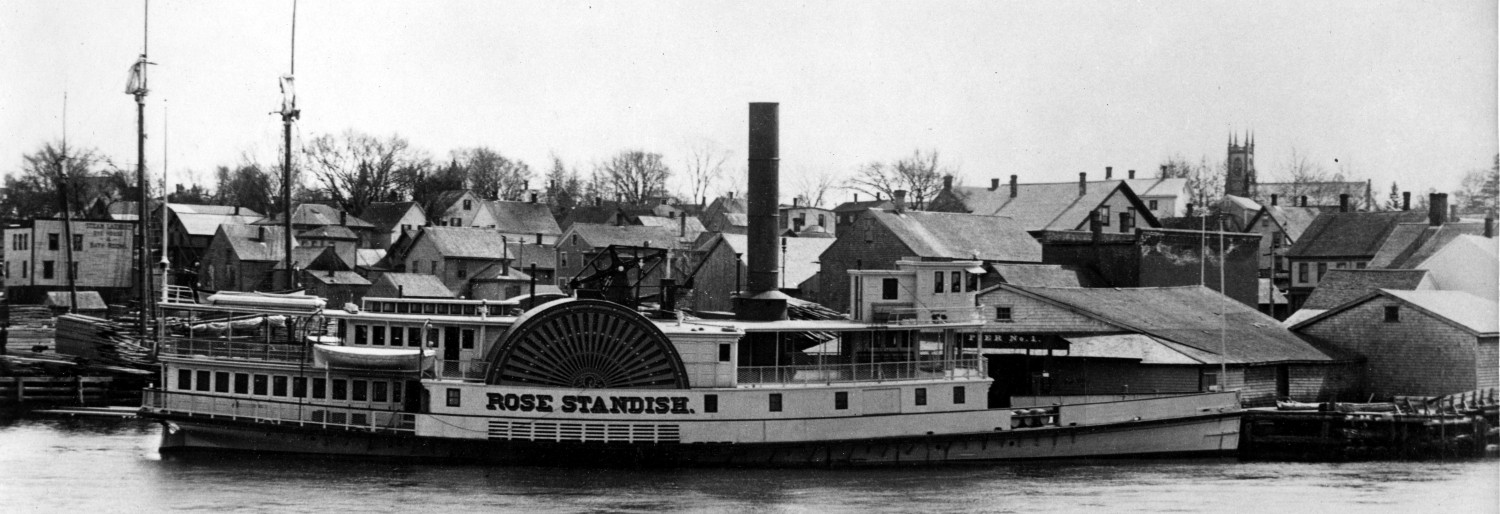

Riots said to be instigated by the Irish in New York about 1850
In the late 1840s, the four towns, Calais, St. Stephen and the two Milltowns, were just beginning to become prosperous from shipbuilding and lumbering but remained basically frontier towns on the fringes of the economy and society of the United States and Canada. Smuggling remained a major industry as did refusal to accept the authority of either national government. Not a few arrived here because the ability to emigrate to a foreign country on a moment’s notice was a necessity, not a luxury. Although a constable was appointed yearly the towns had no police force. The position of constable was largely a political sinecure rather than a serious attempt to control lawlessness. When the “law” was needed special deputies were appointed or in cases of emergency, ad hoc “Citizens Committees” formed to deal with the situation. Downeast remained a somewhat milder version of the Wild West. It was not mere coincidence that the first person hanged in the District of Maine was a Robbinston counterfeiter who shot a specially appointed Deputy Sheriff sent to arrest him. As Calais had no graveyard at the time the Deputy is buried in the small graveyard beside the Kirk-McColl Church in St. Stephen.
Irish emigration to America beginning in 1819 added a combustible social and religious element to the Downeast community. Many ships from Ireland arrived in Eastport and immigrants often left the ship there rather than continue on to Boston or New York. In the beginning they were welcome.
Eastport Sentinel 1819:
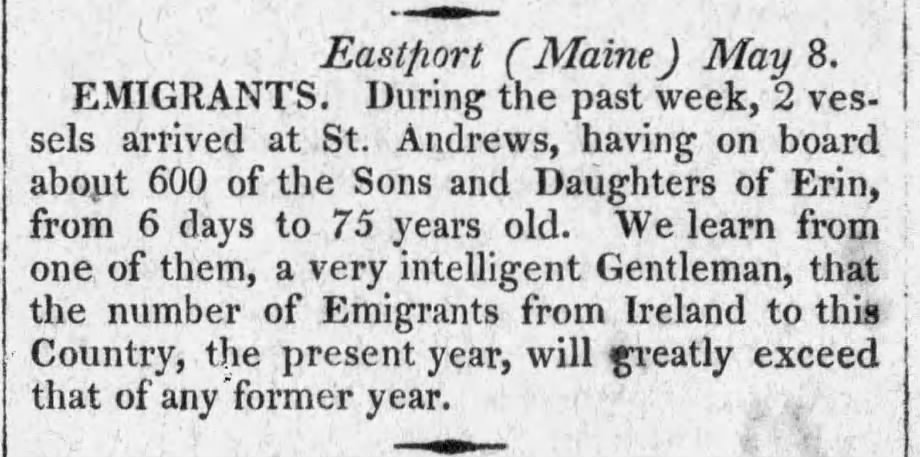
Irish immigrants were welcomed Downeast in 1819
By 1820 some skepticism was evident:
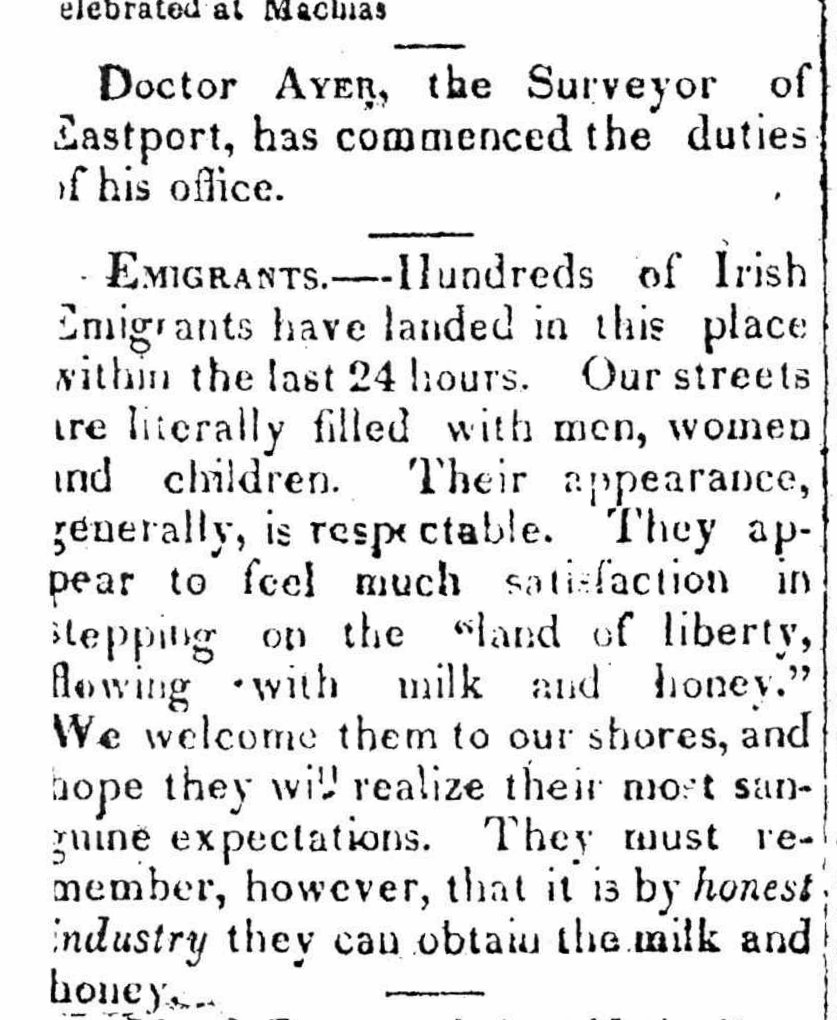
Eastport Sentinel 1820
In 1821 reports such as that below in the Sentinel of July 28 showed the relationship between the new immigrants and the original settlers of the St. Croix Valley was deteriorating and reached the point in Eastport where the town enacted ordinances levying fines against ship’s captains who “dumped” immigrants in the town.
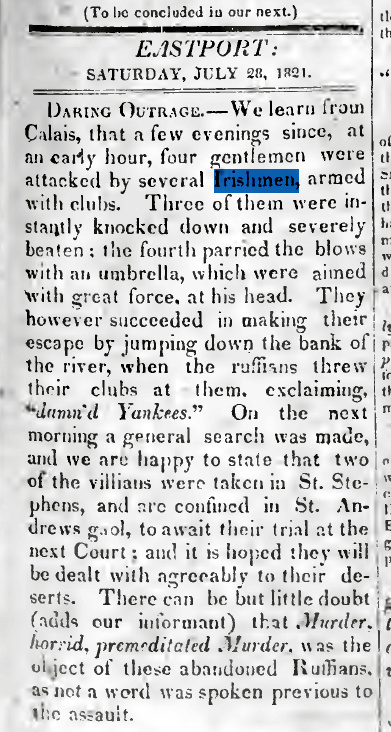
Eastport Sentinel 1821
I recently came across a number of articles written in the late 1880s by a correspondent to the Calais Times newspaper, a local newspaper which competed with the Calais Advertiser for a couple of decades at the end of the century. He is identified in the paper only as a “Former Resident” and his articles paint an amusing but quite accurate picture of life in the St. Croix Valley two hundred years ago. The articles are the recollections of a precocious teenager who grew up in the 1830s and 1840s, first in Milltown N.B. and later in Calais, witnessing much, forgetting nothing, and writing with style.
By the time the “Former Resident” had become a teenager the “Irish” were seen by some as a bad influence on society, drinking too much and being too ready with their fists when in their cups. This was probably unfair for as we will see later the native Protestant English and Scotch had a severe problem with alcohol long before the arrival of the Irish. A major irritant was religion, the Puritan ethic being strong and differences between the Catholic Irish and Protestant religious beliefs irreconcilable.
Riots were common locally in the first half of the 19th century and they usually began with a clash between a “New Brunswicker” and an Irishmen or an American and an Irishmen. Rioting at the time was a criminal offense legally defined as a violent confrontation involving five or more people. As calling the police was not an option, the “riot” usually ended with the exhaustion of the participants or the intervention of more responsible citizens.

Robinson’s Store, King and Union Street St. Stephen
The “Former Resident” describes a “riot” in St. Stephen in about 1846. The intervention of a participant’s wife nearly resulted in his death. After describing a local character known as Willie and the sale of his business the, “Beat.” The “Former Resident” continues:
“Willie,” with the profits derived from the “Beat,” built a brick building a little below the old stand, to which he removed many years ago. From the staging about the building before it was finished, I, with several other boys, witnessed a fearful riot. A large number of people had gathered into St. Stephen that day for some purpose which l cannot recall, when directly in front of “Willie’s” a fight took place between an Irishmen and a New Brunswicker. Friends on both sides interposed, and in about half an hour the whole street, from Hill & Robinson’s corner to the wharf, was packed by a mass of men, whacking away at each other with fists, clubs, and brick bats. The particular cause of the riot did not then or afterwards appear. Friends saw friends engaged, and in endeavors to rescue them, got hit, and their anger thus aroused, they struck out lustily also. I also witnessed another incident of the fight. I saw “Mose” Hanson take a man named Daley, a burly butcher, by the throat, and at that moment a surge of the crowd threw both men down. They fell directly in front of Daley’s door. Mrs. Daley rushed out to the assistance of her husband, and, with a fiat-iron she held in her hand, struck Hanson a terrible blow on the head. He still had his hold on Daley’s throat. The blow stunned him, and as he lost consciousness his vice-like grasp tightened, and before his hand could be loosened, Daley was almost choked to death. It was comparatively a long time before the man showed signs of life. The wife had thus nearly caused the death of her husband.
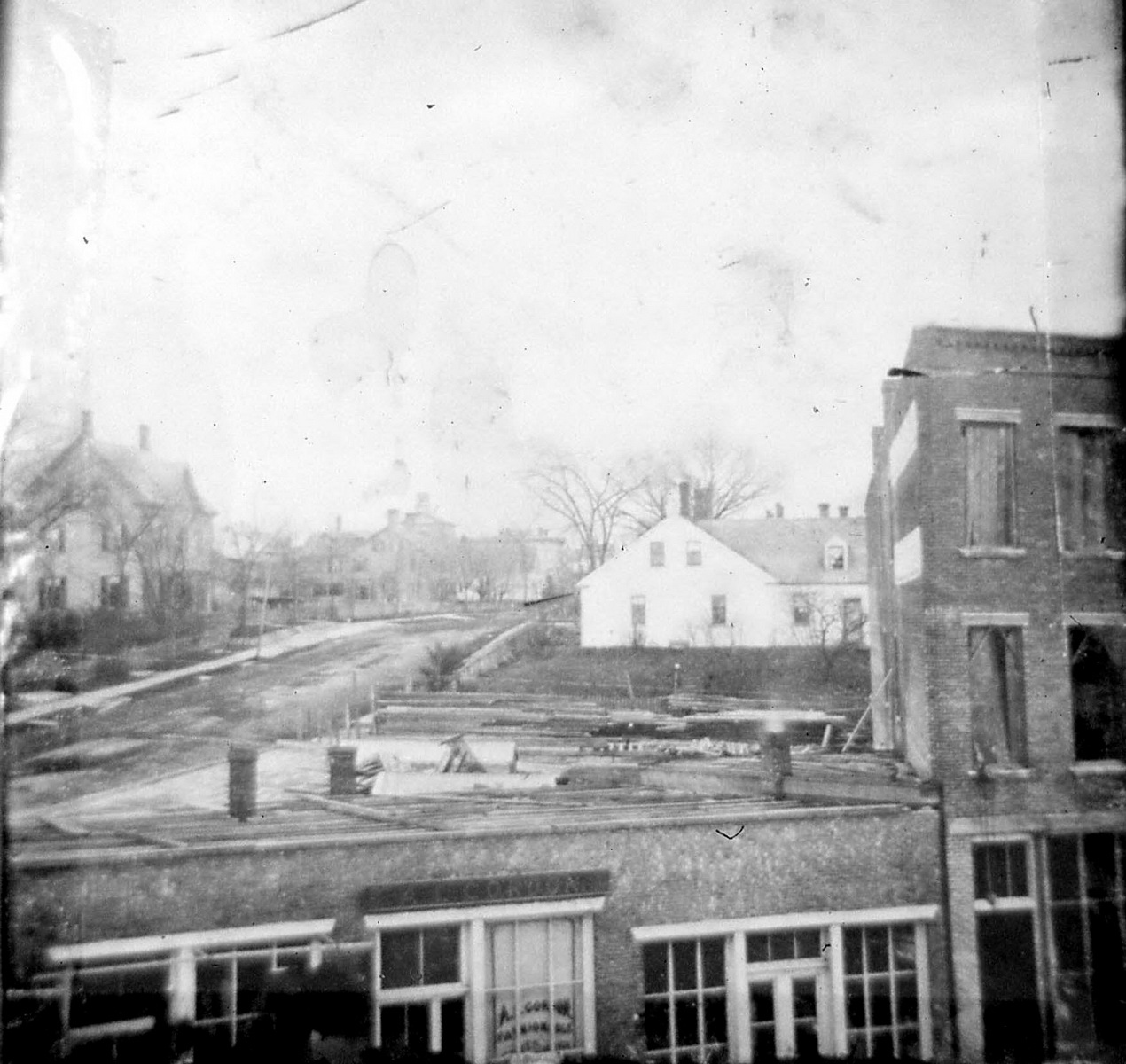
Pool’s Corner, Main and North Streets about 1890
Our “Former Resident” also described a riot in 1847 at Pool’s Corner shown above. The one-story building in the foreground was owned by Pool for many years and was demolished and is now the 3-story brick block that once housed the Merrill Bank. The white house was once the Bottling Plant and the house at 9 O’clock is still standing at the corner of the alley leading from North Street to the City Building.
I, in a former paper, mentioned a riot I witnessed in St. Stephen. About the time of year of the ox-roast I saw a similar riot in Calais. It commenced in much the same manner as that in St. Stephen. An Irishman and an American got into a row. Several Irishmen came to help their fellow countrymen; other Calais citizens came to assist or rescue the American. The fight commenced directly at Pool’s corner and soon assumed alarming proportions. The crowd surged towards the head of Salem Street and became densely packed between Goodnow’s and the Kalish building. With a number of other boys, I climbed up on the building (since known as Kalish’s) and from that “coigne of vantage” witnessed the battle for an hour or more. A great many rushed up from the foot of Salem Street armed with sticks or shillelaghs, and it was a sickening sight to see stout men go down under the blows on the head with the sticks.
After a while the respectable citizens, who undertook to put down the riot, succeeded. Among the most conspicuous in this good work were Gen. Rendol Whidden and his son-in-law, Mr. Albert Reed. Both gentlemen were then fine specimens of able manhood. I recall their appearance that afternoon, with their coats off and their sleeves rolled up for action. They were a host in themselves. Just after the dispersion of the rioters, I saw the General and Mr. Reed, one on each side, take one fellow-who had been particularly troublesome and conspicuous by the collar and march him up to the toll bridge, and when at the entrance of the bridge, with a vigorous impetus; they started him on his way to St. Stephen with a stern admonition not to step foot in Calais. When they first got hold of him, the man showed signs of opposition, but he soon found that he was in the hands of giants and determined ones at that.
I recollect an incident of the march to the bridge which caused much amusement to us boys. We had descended from our safe perch and proceeded the crowd which followed the General, Mr. Reed, and their prisoner. Just opposite Mrs. Arnold’s, near Drugan’s, we observed a newly imported son of the Emerald Isle coming towards us. He was a short man, having a high-crowned beaver hat, and wearing knee-breeches, and an old-fashioned dress coat, (much too large for him) with brass buttons, and the narrow coattails behind reaching nearly to the ground. A couple of dozen of us boys rushed at him yelling at the top of our voices. The Milesian stopped, astonished at our movements, and apparently frightened at the approaching crowd, stooped down and grasped a big stone, then straightened himself up, and, poising the stone in his hand above his head for a moment, threw it as far as he could towards us boys; then turned and ran for dear life, He made such good time that the tails of his coat almost stood out at right angles from his body. Soon he passed like a shot from a catapult through the bridge; and I am sure he omitted paying toll to the astonished Mr. McCullough.
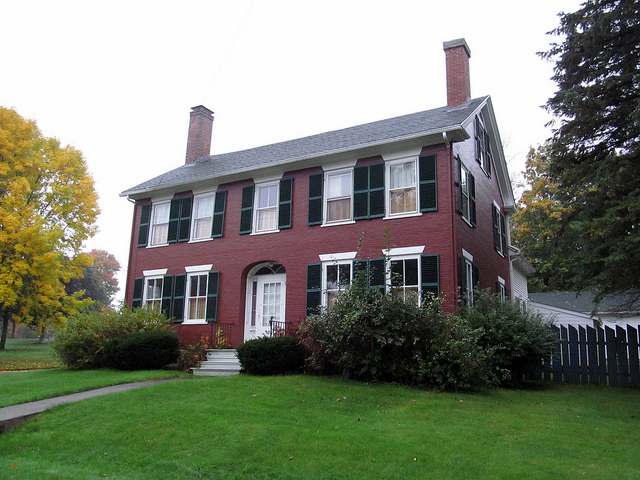
The brick house at the corner of Main and Germain, recently the Kendall home.
General Whidden was also the main character in a drama which played out after enactment of the Maine Liquor Law in 1846-the first attempt at prohibition in the United States. The temperance movement, driven by women from fundamentalist Protestant churches, felt their families and faith were threatened by newcomers, especially the Irish. In fact, the rampant abuse of alcohol in the country began long before the Irish emigration to the United States. In the 1790s farmers who were settling on the fertile plains to the west of the Appalachian Mountains found themselves with huge surpluses of grain which were cheaper to ship back east as alcohol than grain. America became a nation of boozers. This led to the Whiskey Rebellion of 1794 when the Feds began to tax the whiskey. By the early 1800s the average American male was consuming three times as much alcohol a year as we do today which was hardly the fault of the Irish. Nonetheless the Catholic Irish were an easy scapegoat for fire and brimstone Protestant preachers whose female congregants couldn’t keep their husbands sober. To them it was the voracious appetite of the Irish for alcohol that kept the bootleggers in business. Their success in enacting the “Liquor Law” boomeranged spectacularly as the booze, now more expensive, kept flowing across the St. Croix from New Brunswick and the prime beneficiaries of the illegal trade were the local Irish who lived in “Irishtown” which bordered the river.
The “Former Resident” continues:
A few years after the event just narrated, Gen. Rendol Whidden was conspicuous as a good citizen and a brave man in another affair, which caused much excitement in town. It was in the early days of the “Maine Law.” A Mr. Michael Barret, who lived and had a shop very near Goodnow’s building, imported to Calais, in a vessel from Boston, some 2,000 gallons of various kinds of liquors, contrary to the provisions of the law. This having come to the notice of the town authorities, Mr. Samuel Valentine, who was then City Marshall, was instructed to seize the liquors. He did so before they were landed from the vessel, which lay at Pike’s wharf, and sealed up the hatches, subject to legal proceedings. The next day it became known that Barret, with the assistance of a Mr. Houston, had removed the liquors in the night, and had stored them in the cellar of Houston’s residence, on Main Street, next to the Ames building at the corner of Germain Street.
There was much excitement throughout the town as the news spread ; and when, sometime during the day, Mr. Valentine summoned the citizens to recapture the contraband goods, nearly all the shopkeepers locked up and joined the concourse of some hundreds of persons who proceeded down street towards Houston’s, the whole being headed by General Rendol Whidden. When opposite the place, the crowd stopped for a moment. Houston was seen standing on his cellar hatch, which opened out to the yard between his place and Ames with a cocked pistol in each band. Houston was a large, muscular man, of much determination of character. He was known to be fearless, and when roused, dangerous. For a moment, as I have said, the citizens hesitated to enter the yard. I shall never forget, however, the noble and courageous appearance of Gen. Whidden as he flung open the large gate and marched up to Houston, coolly and deliberately, as if on parade, looking the desperate man in the eye; and when within arms-length he knocked up both pistols in the air. In a moment after Houston was on his back and disarmed, then commenced a desperate struggle, Houston endeavored to free himself from those who had him. Finding his efforts futile, becalmed down, and said that he would go in and open the cellar hatch.
The General and others followed him to a back entrance to the house, and the moment Houston got in he shut the door, or at least tried to do so, but the General, or one of the other citizens, was too quick for him, and thrust a log in between the door and the jamb, thus preventing it shutting. Houston thereupon rushed out, furious with rage, and endeavored again to repulse the determined invaders. He was again thrown down and foamed at the mouth through the violence of his desperate struggles. A length of cord was obtained, and the man was bound hand and foot and conveyed on his own common truck to the lock-up, near the High School.
During all this, I was mounted on one of the big posts of the gate. Houston was a constable, and I had often seen him arresting desperate men, whom he generally handled “without gloves,” and I had also often seen him taking them on his own truck to the look-up. I was sorry that he had rendered himself liable to be treated as he had treated others, especially as he had been hitherto looked upon as a respectable citizen.
The hatch was soon opened, and amid cheers the citizens speedily rolled out and loaded on trucks the casks of liquor, which were conveyed to prison, and after due trial the whole was condemned to be destroyed. The day for the destruction was noted in the history of Calais. The casks were then rolled to the grating (at the corner) of the sewer leading from Hill’s brick block to the shore. Several hundred citizens were assembled, and when the moment for the, destruction of the poisonous liquids arrived, Mr. James S. Hall, who for years was a prominent temperance man, was so enthusiastic as to endeavor with an axe to drive in the heads of the casks, when the Marshal, or some one of the other authority, stopped him, as only the liquors, and not casks, were condemned to be destroyed and an action for damages to the packages might be instituted. The bungs were therefore knocked out, and it took some time to empty the 2,000 gallons into the sewer. Some merriment was created as the liquors poured out to the sound of “good, good, good,” but the citizens were at not to be turned from their purpose by the self-vaunted qualities of the stuff condemned.
After perhaps one-half of the liquors had run out, the affair became monotonous, but at this stage the proceedings were broken by the intelligence that some Irish women and children were dipping up the compound at the shore end of the sewer, or (it was in the spring of the year, and the ice had not all disappeared) and a hundred or more rushed down, and found that the report was correct, and they kicked the kettles and other receptacles to smithereens, and scattered the economical, if not fastidious, gatherers of the delectable liquid. The first few hundred gallons had washed out the sewer pretty well, and the remainder was pouring out at the shore in a fairly pure state, barring that it was somewhat mixed- wine, brandy, gin and rum-and had gathered other ingredients on its passage through the sewer. Possibly the whole process through which the article was passed might prove conducive to its consumption by the devotees of Bacchus.
(From the Calais Times April 25, 1884)
It can be said with some confidence that many of the men who joined the crowd that day to assist General Whidden and Constable Valentine were good customers of the bootlegger Houston and watched with sadness as the illegal hootch flowed down North Street to the river.