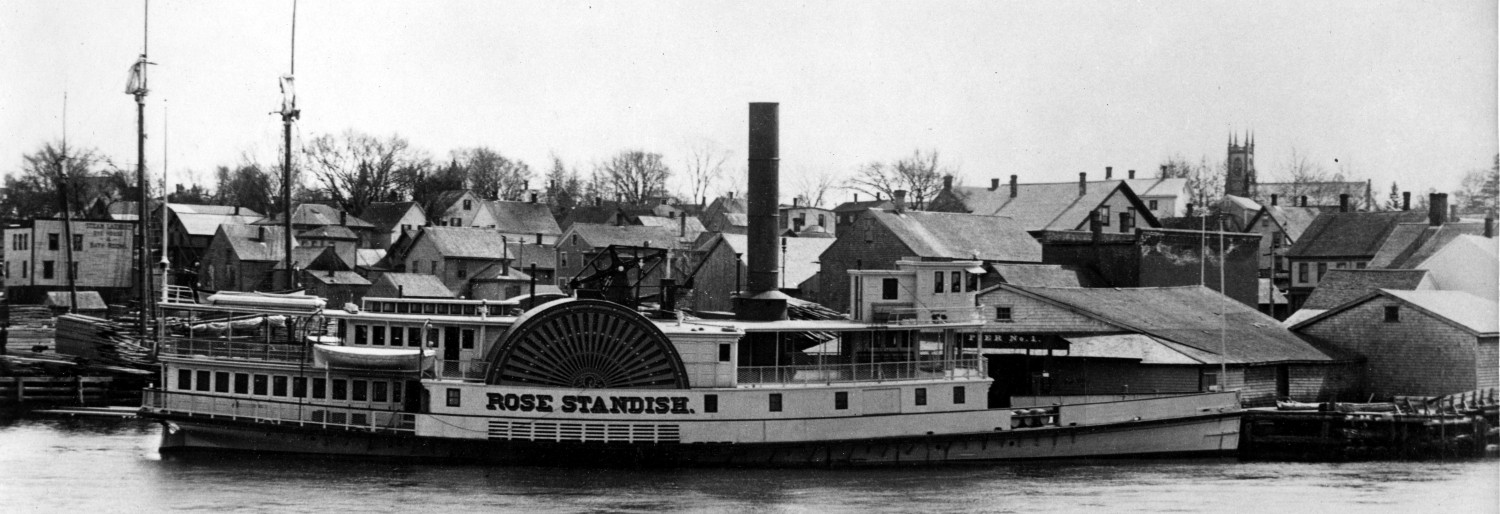
1942 marked the beginning of U.S. involvement as a combatant in World War II, a war which was just then going very badly for the Allies- the Germans had conquered continental Europe and Hitler still had hopes for a cross channel invasion of England, the only nation standing in Germany’s way of complete domination of Europe. Soviet forces in Russia were falling back against Germany’s onslaught in the Caucasus. Rommel’s Afrika Corps was sweeping across northern Africa and the Japanese had taken the Philippines, rolled down the Malay Peninsula, bombed Australia and attacked Burma in an offensive whose ultimate goal was England’s crown colonial jewel- India.
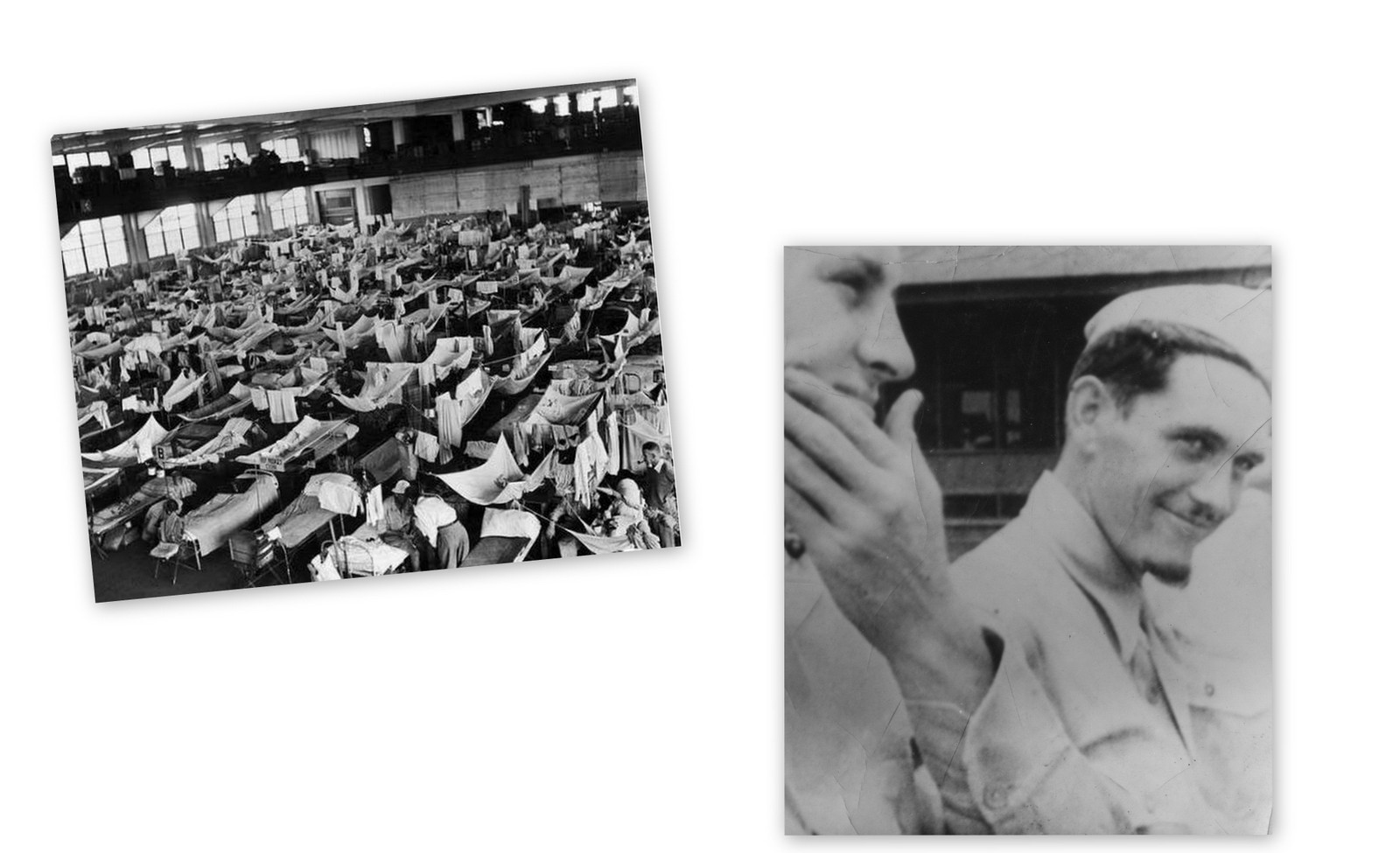
Santo Tomas internment camp Manila Doc Foster
Our neighbors across the river had experienced the loss of dozens of its young men in the early years of the war and not a few from the Calais area had enlisted in the Canadian forces in violation of the neutrality laws but not until the Japanese attack on Pearl Harbor and the Philippines did the reality of the sacrifices soon to be required of this country become apparent on the U.S. side. Much concern was expressed in the papers over local men serving in the Pacific and justly so. Norman Glidden’s family in Princeton expressed “grave concern” over Norman’s safety and Malcolm “Doc” Foster’s family was only to receive word over a year later that he had been captured and survived the Bataan Death March.
The Advertiser reported after the December 7, 1941 Japanese attack on Pearl Harbor and the Philippines:
Several local boys are in the Philippines and Hawaii but we have been unable to learn that any news regarding them has been received here as yet. Bert Mowatt, Curly Kent, Malcolm Foster, a Logan boy, Charlie Carver, and doubtless there are others who are in the war struck areas.
There was also concern for Jane Todd’s daughter Betsy. She had married Vicente Gepte, a 1937 graduate of West Point and an officer in the Philippine Army. Returning to the Philippines in 1940 the family settled in Manila. Their only child Linda was born in the Philippines and Lt. Gepte served in the Philippine military. When the Japanese overran the islands in early 1942 Lt. Gepte was captured and sent to a POW camp. Whether Betsy and Linda remained free in Manila we don’t know but subsequent events indicate they did as they were rejoined by Vincente after he was freed from the POW camp. The Japanese soon had reason to regret releasing Captain Gepte as he proved a fearless and dedicated patriot and joined the resistance. He was recaptured and beheaded. Betsy and the child Linda spent the remainder of the war in the Santo Tomas internment camp in Manila.
The sinking of the British destroyer HMS Trinidad is a good indication of how badly the war was going in the early months of 1942- a torpedo fired by the Trinidad at a German submarine during Russian convoy duty experienced a gyro problem, turned on the ship and struck the Trinidad causing severe damage and the loss of 31 sailors. By the end of the year, however, the tide was beginning to turn. In August 1942 there were 28 Allied nations at war with Germany, Italy and Japan, the Axis Powers. Cuba became number 29 on August 27, 1942 and given the problem sugar rationing was causing in the U.S., this may have been more significant than it at first appears. By the end of the year the Battle of Midway and the marine’s success at Guadalcanal had significantly changed the balance of power in the Pacific, Rommel was being pushed back in Africa and, most significantly, the Russians were inflicting enormous casualties on the Germans at Stalingrad and during the 1942 winter offensive on the Eastern Front.
In the United States 1942 saw the adoption of the shameful policy of internment of American citizens of Japanese descent. Nonexistent threats ginned up by the media led to Congressional demands to “lock up” tens of thousands of loyal citizens- an act which was upheld by a spineless Supreme Court. It represented a failure at all levels of our democracy. Even Roosevelt’s most ardent supporters admit the internment was a blemish on his otherwise courageous and effective leadership of the country during the war. In sports many athletes, including baseball’s Bob Feller and Ted Williams, enlisted early in 1942 and the professional leagues began to use teenagers, wizened retired ballplayers and men who failed the draft physical to fill out the rosters. The Academy award for best picture was given to “How Green is My Valley” and Bing Crosby recorded White Christmas.

Calais World War One hero in the national news for reenlisting
In the St Croix Valley, the news in 1942 was all war news, especially about the draft and rationing. Dozens of men enlisted before being drafted including the indomitable Percy Fox, a hero of World War1 and the Battle of Belleau Woods where he won the Croix de Guerre for heroism. Percy enlisted on January 2, 1942, less than a month after Pearl Harbor. In 1944 he was awarded the Silver Cross for his service in North Africa. Many, of course, were drafted; an article in the Calais Advertiser on March 4, 1942, announced a third national draft lottery of 9 million men. The Advertiser regularly reported on men in the service, December 2, 1942, mentions Don Mitchell, Jack Chisholm, Frank Fenderson, Ollie Clark and Herbie Johnson.
A sampling of headlines in the Advertiser:
12/31/41: A and P pledges no price gouging
1/7/42: Sugar rationing-hoarders evil
2/21/42: People may as well get accustomed to rationing
2/4/42: All Calais training for Civil Defense
3/4/42: March 17th 9 million to be drafted
4/8/42: Coke asks all to conserve sugar
5/13/42 Lick the Axis by saving scrap metal
6/22/42: Some stores fail blackout drill
10/21/42: Observation posts essential
11/25/42: Coffee rationing begins
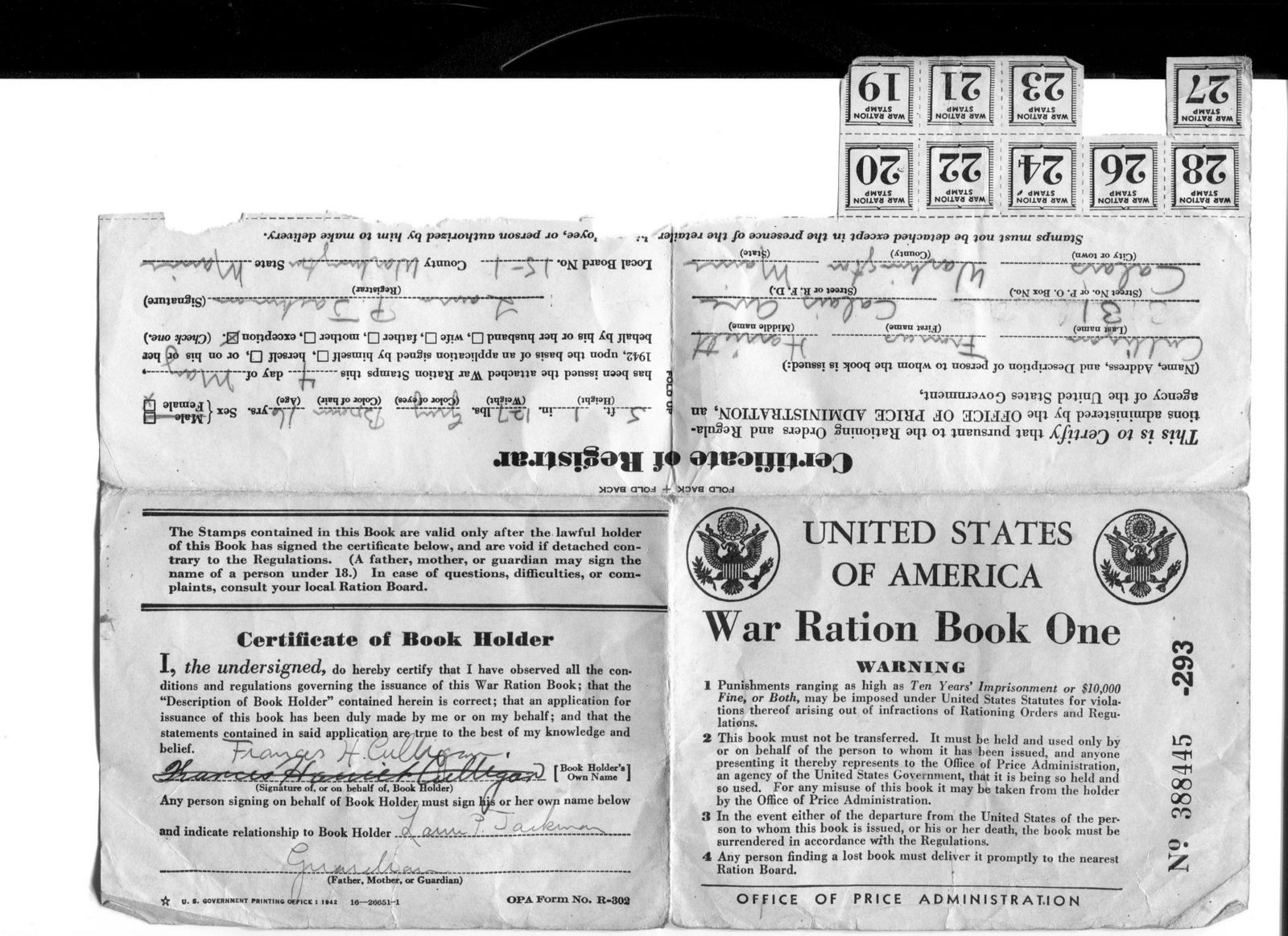
Frances Culligan’s ration book 1942
Rationing was big news- sugar was on the list early, coffee, which sold for 20 cents a pound in those days, wasn’t rationed until December 1942. Jane Parker donuts were 12 cents a dozen. Hoarding was illegal and widely condemned in the papers. By March 1942 a rationing board was operating- Dead River was given the right in March to buy one truck tire and tube and Martin Russell of Robbinston was allowed 4 truck tires.

For unknown reasons Calais was on the list of 19 places in Maine “Likely to be raided by enemy bombers “. As a result air raid shelters were set up in Customs, Unobskey’s Store, The Ford Garage, Penney’s, Fishman’s Stewart Furniture, Grant’s, the State Theatre and the hallway of the National Bank Building. Observation watchtowers were set up on many high points in town and manned continually. The one above was between Chandler and Pleasant Streets on the “Rocks” during WW2. From the left: Merton Scribner, Herb Smith and Chester McCracken. It is a puzzle who was going to bomb Calais. The Germans had no aircraft carriers and the Japanese were unlikely to circumnavigate the globe with the few carriers they had to strike the East Coast when West Coast was closer to home, even if the Japanese carriers had such range which they did not. Much can be put down to war hysteria which was especially strong in the early days of the war.
The St. Croix Courier reported in late 1941 and early 1942 on the difficulty in manning the observation towers. Many were skeptical about the need for them at all.
December 18, 1941:
A Headache
Calais – Air raid observation officers here have been notified that their posts must be manned continuously, 24 hours a day, starting Wednesday for the duration of the war. Volunteers for this service have not been numerous and now the gas ration bugaboo bobs up to add to the headaches of Chief P.T. McCurdy and his aides in the district that comes under his jurisdiction. McCurdy has five posts, only one of which is in Calais proper. The other four are in Meddybemps, at Bald Mountain, near the Doc Thomas farm on the River road and at Mill Cove. Naturally it’s going to take cars and gas for observers to reach these posts and to date no provision has been made to take care of them. How this emergency is to be met locally, lacking authority to draft cars, gas and the required number of observers presents a nice problem. Looks as if the army should step in about this time and take the situation in hand.
There were also false alarms of parachutists dropping into the forests Downeast and if one believed the rumors submarines were constantly on the prowl in the Passamaquoddy Bay.
St. Croix Courier April 23, 1942:
CALAIS
Better Play Safe
A submarine alarm late Saturday night had coastal towns in this corner of Maine on the alert. The Army Intelligence bureau advised property owners along the coast of the possible presence of one or more enemy subs in the vicinity. A plane patrol from Bangor was reported extending its vigilance to the suspected danger zone. But nothing happened and nobody knows for certain whether there really was a sub offshore or if it was just another false alarm.

Women’s Motor Corps at Calais ball diamond 1942, ready to transport casualties to aid stations
St. Stephen and Charlotte County also conducted regular blackout drills during 1942 and emergency drills simulating an aerial attack. The Calais Women’s Motor Corp shown above at the Calais ball diamond was ready if Calais was bombed to transport casualties to the several emergency medical centers established in the area. Mass casualty drills and black out drills were regular occurrences during the war even though the longest range bomber possessed by the Germans in 1942 had a maximum range of 6000 kilometers which is almost exactly the distance from Berlin to Downeast Maine. If the winds were favorable the Germans could conceivably have bombed the St. Croix Valley but the bomber would almost immediately run out of fuel and crash. It is likely the Luftwaffe had more important targets closer to home although it should be said that had Germany wanted to make a symbolic strike on the U.S. mainland the closest target was the Lubec-Eastport area.
The loss of local doctors was of great concern to the St. Stephen community in 1942.
St. Croix Courier November 19, 1942:
May lose two doctors
The scarcity of medical men which has already affected some communities severely is likely to be far more keenly felt in St. Stephen and Milltown before many months go by if present prospects are borne out by developments. Dr. H.C. Mitchell, who has done much toward establishing a successful practice since locating here last summer, is making plans to leave before Christmas to enter the armed forces, and Dr. H.S. Everett is also considering donning the uniform again.
Thelma Eye Brooks of the Calais Academy Class of 1942 had this to say about those early years of the war:
Canada entered World War II on Sunday, September 10, 1939. I always remember this date; it was my birthday. Restrictions were imposed at the border. The Canadians had to have passports to cross the bridge. We had to show birth certificates to prove we were United States citizens. My birth certificate was worn so bad by the end of the War that it fell into 8 pieces. Prior to this time crossing the border had been rather free and with little formality.
With many of the St. Stephen men enlisting in the service the border baseball teams began to feel the crunch and some teams had to disband. The indoor ice skating rink in St. Stephen became the local headquarters for the Carleton-York Regiment. The former shoe factory in St. Stephen became a barracks for the troops stationed in the area.
By living on the border our lives were involved with World War II long before other parts of the country. Then during our senior year, on Sunday, December 7th, our lives were fully involved with the War, when the U.S. declared war against Japan. Several members of our class did not wait for graduation to enlist in the services. Some of those were: Ellery Higgins, Jim Hickey, Jack Phelan, George & John Bassett, Ralph Dubay and Phil Chisholm. Many other classmates enlisted after graduation.
The war created many changes in our lives. Just a month after Pearl Harbor, tire rationing went into effect. This caused at least one business, Dead River Oil Co., had to lay off five employees. These five left immediately for Conn to find work. Later applications had to be filled out in order to purchase tires and tubes, the names of those allotted tires were published in the paper.
By January 7, 1942, only two pounds of sugar could be purchased at one time and only if at least $1. 00 additional purchases were made. By April everyone had to sign up for sugar ration coupons. Each person received a war ration book containing 38 stamps. Each stamp represented a two-week allotment of one pound of sugar.
Job opportunities were opening up but not in Calais. The March 11th, 1942, Advertiser had an article saying there was a great demand for girls over 18 years old to apply for typist’s jobs in Washington, D.C., starting salary $120.00 per month. Several of our classmates took some of these jobs after graduation.
In February 1942 we were asked to save empty tubes of shaving cream and toothpaste. They were made of valuable material necessary for the War Effort. Sugarless recipes began to appear in the papers and magazines. Shortly after the WPA banned the use of copper in zippers, hooks & eyes, snap fasteners, grippers and a wide variety of buttons & buckles.
Many graduates of her Calais Academy Class of 1942 served in the war but miraculously only one was killed, Ralph W. Dubay. A radio operator in the Air Force, he was killed in a plane crash in Sian, China soon after the war ended. Several young men from the U.S. side did die in the war but the toll across the river in the St. Stephen area was over 70, an incredible sacrifice for such a small community.
As noted by Thelma Brooks, crossing the border became more difficult during the war and this was a severe hardship to the many cross border families. It created tension between local authorities on both sides of the border and their national governments which failed to understand the unique nature of our “International Community.” St. Stephen’s St. Croix Courier felt the U.S. authorities were sometimes being a bit heavy handed on Canadians visiting the Calais area.
July 1942:
Calais
Over Zealous
Those jeeps seen racing around the roads in this neck of the woods are manned by soldiers patrolling the coastal area. The boys are taking their job seriously, too. For a few nights they made things warm for Canadian motorists seen outside the town limits. Not knowing about conditions here on the border nor realizing that all cars are subjected to a careful investigation at the bridge before they enter from Canada the soldiers were stopping and questioning the occupants of these “ foreign” automobiles. They were probably following instructions to the letter but in one or two cases they threw a bad scare into people whose passports were in order and who had a perfect right to be where they were.
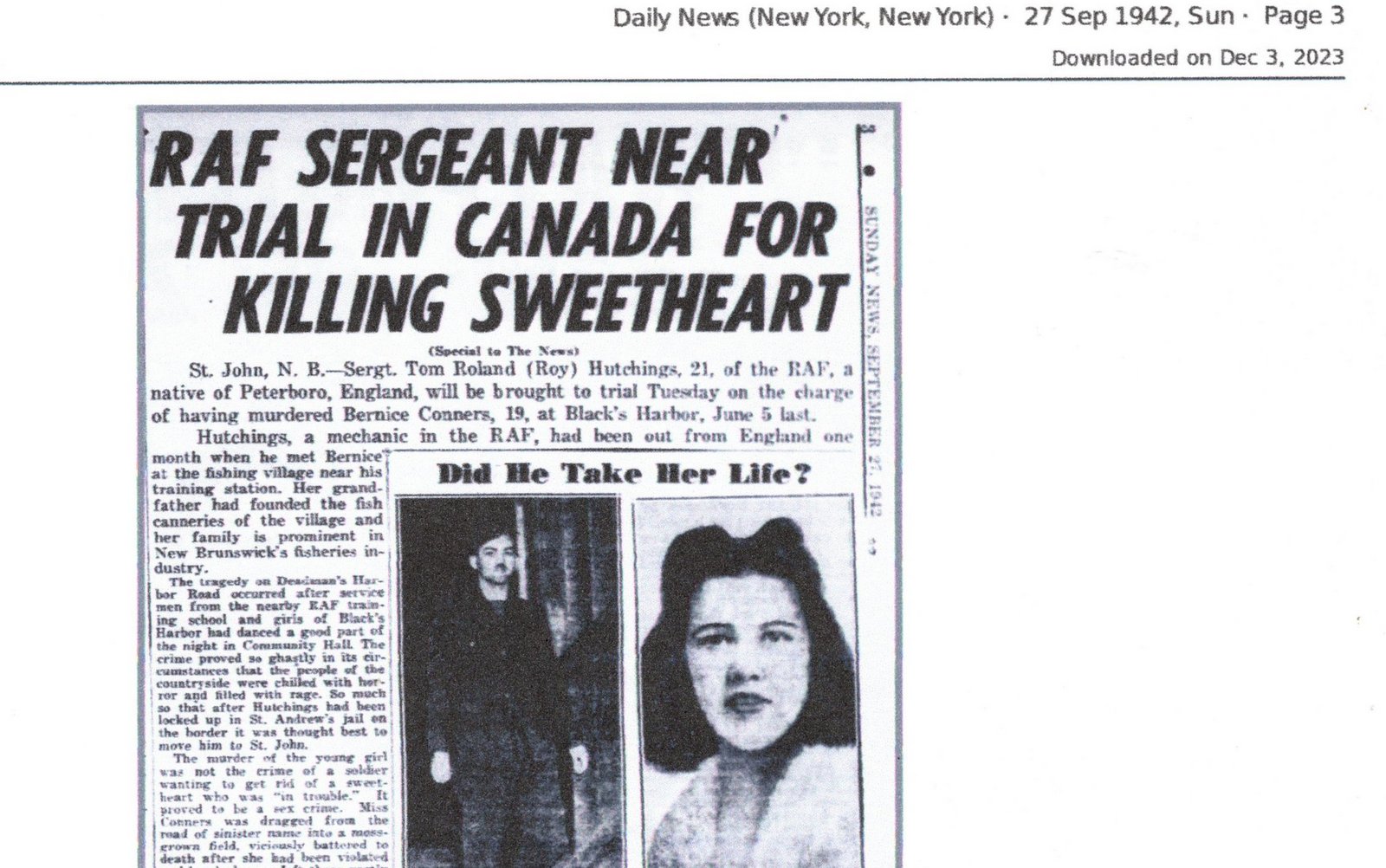
December 1942 headline New York Daily News
1942 concluded with renewed hope for the allied cause although it would be two years and eight months before the war ended in the Pacific.1942 ended locally with the hanging of an English Sergeant stationed at the Pennfield airbase for the murder of a Black’s Harbor woman. The case caused an international sensation. The accused was 21 years old Tom Roland Hutchings, 21 of Peterboro, England who met the victim at a dance in Black’s Harbor. As Calais-Stephen was the unofficial R and R center for airmen at Pennfield, it is very likely he was a regular visitor to this area.
The evidence against Hutchings was circumstantial but found sufficient by the jury to return a verdict of guilty with a recommendation for mercy. The government in Ottawa refused to act on the recommendation and Hutchings was hanged on December 16, 1942. It was the last hanging in New Brunswick.
December 17, 1942
Hutchings Hanged Yesterday For Murder Bernice Connors
Tom Roland Hutchings of Peterboro England, paid the penalty for the murder of Bernice Connors at Black’s Harbour last June when he was hanged at St. Andrews early yesterday morning. He went to his death calmly, preserving to the end the silence and poise which had characterized his conduct since he was arrested at the Pennfield air station last summer while serving as a sergeant armourer with the Royal Air Force. The sentence of death was carried out at 1.50 a.m. Wednesday morning, and he was pronounced dead at 2.02 o’clock.
Thus, the book was closed on one of the most gruesome crimes in the history of Charlotte County. The body of Bernice Connors, covered with moss to form an inconspicuous mound, was discovered on Sunday, June 7, near the Deadman’s Harbor road in Black’s Harbor, not far from the Community dance hall where she had attended a dance the previous Friday evening. She was not seen alive after that night. The body was about 300 yards from the hall in a field.
The execution was the first to take place in Charlotte County in 65 years. The only spectators were the official group. The scene was screened from outside view by a temporary fence and a covering over the top.