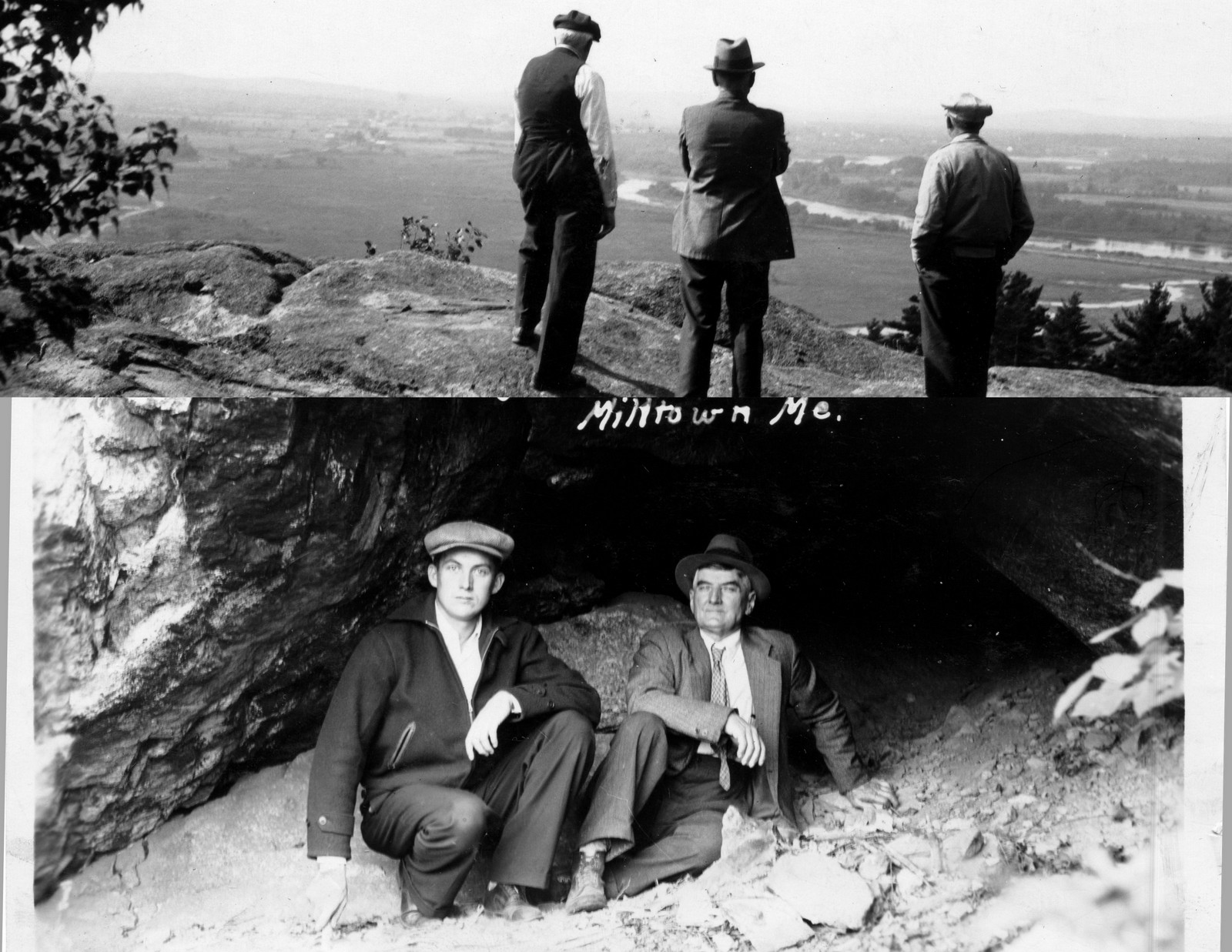
Top: Ned Lamb and friends look out over Maguerrewock; Bottom: The mouth of the cave
The fellows looking out over Maguerrewock marsh and stream with the Baring and the St. Croix River in the distance are perhaps contemplating the riches beneath their feet in Maguerrewock cave which according to an article in the Calais Advertiser in 1900 contains deposits of gold of “the same color and appearance as the gold “diggings of California. This article was submitted to the Advertiser by an unnamed source:
While excavating near Maguerrewock Mountain a man dislodged a piece of peculiar rock which bears small indications of gold. The place where the discovery was made is quite near Maguerrewock cave. Strange to write the interior of this marvelous cave is little known to the very people who have lived near it for years. This may be accounted for by the fact that the entrance is very difficult, being a small passage about eighteen inches high, quite long and devious. The surprising and interesting sights which greet the eyes of the adventurer who braves the horrors of the long passage will abundantly repay him on his final entrance. The walls are irregular and angular as nature formed them, but high up above the reach of the men of our day and age, are strange characters and quaint figures cut in the rock. These novel figures are all in relief and not rudimentary, but well defined and clear. Their great distance from the floor and other indications, show that men of Cyclopean stature were once indigenous to this region of wonders. Of all the travelers who have visited this strange cavern, none yet can account for the dazzling light illuminating the interior both day and night and which is almost blinding by its brilliancy and power. Some have attributed it to the phosphorescent properties of the rock. But whatever the cause, it is a weird and awesome sight. More people have visited the place since the discovery of gold than for some years. The earth and rock is of the same color and appearance as in the gold “diggings” in California. A stranger has visited the place in the interest of a wealthy mining syndicate but the men at work are so strict in regard to the find, that it was with difficulty he could learn any of the particulars. The gentleman who owns the land is quite elated. It is known among a few that he has refused a large sum of money for the land in the vicinity of the cave. The men are digging in the vicinity of the cave industriously for material for the highways yet are casting about sharply for nuggets. Later developments clearly show that there is considerable money in the discovery.
The editor of the Advertiser is more than a bit skeptical noting:
We feel obliged to point out for the historical record that there is not a scintilla of evidence to support any part of the above article but we hesitate to discount it entirely until some brave and very wiry adventurer makes one last attempt to break through to the magnificent cavern at the end of the “small passage about 18 inches high, quite long and devious.”
The “small passage” referred to by the editor is a local myth which claims a narrow passage extends from the mouth of the cave to Robbinston but as no one has been able to go but a few feet into the mouth of the cave, the skeptics have the advantage.
On the other hand the gents looking out over the St. Croix may be pondering the gold in the river itself because there is no question there is gold to be found in the St. Croix. The Maine State Geological Survey which can be viewed online lists the St. Croix in Baileyville as one of nine Maine rivers in which gold prospecting is allowed. According to historian Charles Francis old tourist maps of Maine show gold panning sites along the St. Croix in Baileyville and this area is listed in a number of books for amateur prospectors who “love nothing better than exploring creek beds and washes with a pan and geologist’s hammer.” In the 1800’s Forty-Niners such as James Beverly of Gorham moved to Woodland to prospect for gold and sea captain William Howard of St. Stephen came across the line believing he would find the “mother lode” on the American side. Howard Lake and Howard Lake Mountain bear his name and many of his descendants still live in the area. Neither Beverly nor Howard got rich from mining gold although there were tales of gold being found in both Nash’s and what became Howard Lake.
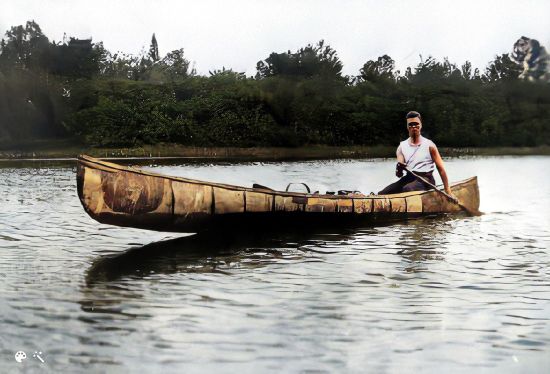
Franklin Roosevelt on Passamaquoddy Bay- perhaps in search of buried treasure
Further extracting gold from the rocky earth is both time consuming and laborious as hundreds of locals found when they went to California in 1850 and later the Klondike in 1900. It is far easier to get rich by finding gold and other treasure hidden by pirates and other disreputable characters such as Captain Kidd or “Black Sam” Bellamy. Here there is a deep trove of tales of Downeasters digging furiously on rocky islands, sandy beaches and in remote inlets where pirates hid from their pursuers. One of the most avid treasure hunters in Passamaquoddy Bay was Franklin Delano Roosevelt.
As a young man he spent his summers on the bay. He was fascinated by stories of the pirate Captain Kidd, the daring escapes from his pursuers which led him to hide among the islands of the bay and, of course, the burying of his treasure on the islands of Passamaquoddy Bay and the Bay of Fundy. Roosevelt and a friend sailed his boat the “New Moon” to Dark Harbor on Grand Manan to search for Kidd’s treasure as had many others The legend that Kidd’s ship the been stranded at Herring Cove, Campobello and a great iron pot of gold was buried in the sand guarded by the spirit of a murdered accomplice surely did not escape his notice.
However, Roosevelt was most captivated by the treasure claimed to have been buried by Kidd on Oak Island in Nova Scotia. He, along with John Wayne, Errol Flynn and other notables invested large sums of money in the Statesman Mining Company which landed heavy equipment on the island to dig for treasure on an island already pockmarked by holes and trenches dug by earlier treasure hunters. It was, of course, a scam but even while President he remained interested in the project.

Roosevelt smoking pipe on Oak Island, early 1900s
It wasn’t only Roosevelt who believed fabulous hoards of gold and silver were buried Downeast. Many locals were convinced the treasure of Captain Kidd was buried locally and, if not Kidd’s treasure, perhaps that of John Hogg Paine who lived in Upper Mills, New Brunswick, just across the bridge from Baring. Paine arrived in Upper Mills in the early 1850’s and soon established a reputation as a curmudgeon- rich, secretive, unpleasant and perhaps fleeing his past as a pirate. When he died in 1866 the townsfolks were surprised to find he had only enough money for his burial. It was assumed he had buried his treasure but none was ever found. The articles below from the Advertiser, the first in 1909 and the second from 1914 speak to the local fascination with both Hogg’s and Kidd’s treasure.
Calais Advertiser 1909: Thirty or forty years ago it was the general belief among a certain class at any rate that there were large sums of money and jewels buried along the banks of the St. Croix even extending up as far as the Union dam. Now while it is said on authority that Capt. Kidd never even saw the St. Croix river the fact remains that for many years about the middle of the 19th century digging and excavating was carried on extensively all along the banks of “Todd’s Grove”. The writer has seen hole after hole that had been dug in a vain search for gold.
Whether any was ever found or not is doubtful. Still there are old people living today who will declare to you that certain parties now dead and gone did succeed in finding large amounts of gold. In fact, they would be ready to swear to it. Personally we do not believe that one cent ever was found that had been buried. In the case of the late John Hogg Paine there is no doubt that he was possessed of considerable wealth and it is said that instead of keeping it in a bank he buried it. This may be but if Paine had any money he brought it with him. Certainly he never dug any of Capt. Kidd’s . That the belief in Kidd’s treasure is in existence today is evidenced by the fact that digging has been resumed along the banks of the river at Todd’s Grove. Of course the work is carried on secretly at night and to judge by the amount of digging already done one would say that the parties are entitled to success. We venture to assert however that buck sawing wood at 78 cents a cord would bring in more ready cash than will ever be realized from digging for Capt. Kidd’s buried treasure.
Calais Advertiser 1914:
Forty years ago, the craze over buried gold was at its height. Whether any was ever buried in this locality is purely problematic. That Capt. Kidd ever came up the St Croix is to be doubted. Notwithstanding this doubt, the whole country from St Stephen to Eastport has been dug over again and again. Some wonderful stories of scenes transacted: during these searching periods have been related. On the islands of the St Croix these old digging parties saw some fearful rights. Probably they were so panic stricken that they really thought they saw things such as full-rigged ships rushing towards the Island, then the clanking of chains as they roared thru the hawser holes. We have heard sober reliable men tell of these things as actual facts. However notwithstanding all these cases we have yet to hear of one authentic case in which gold or other buried treasure was ever found. Even below the Union mills on the steep banks running down as far as the F. H. Todd residence digging took place for years. The gold supposed to be buried on these banks was not Capt. Kidd’s but was secreted there by John Hogg Paine an old recluse who came to the Union about 1850 or 52 and said to have been an ex-pirate. He was said to have buried pots of gold out in Alward’s pasture also but if he did it remains there to this day. Two boys, one of whom is now living In St. John, told the writer that they both saw Paine one evening dig a hole in the ground and bury an iron pot in it. One of the boys told his father about it and they went out the next day and dug up the pot — one of those old round-bellied iron pots with three long legs on it but the pot was empty. Paine died about 1866 leaving money enough to pay his funeral expenses and the secret of his buried treasures if he had any died with him.
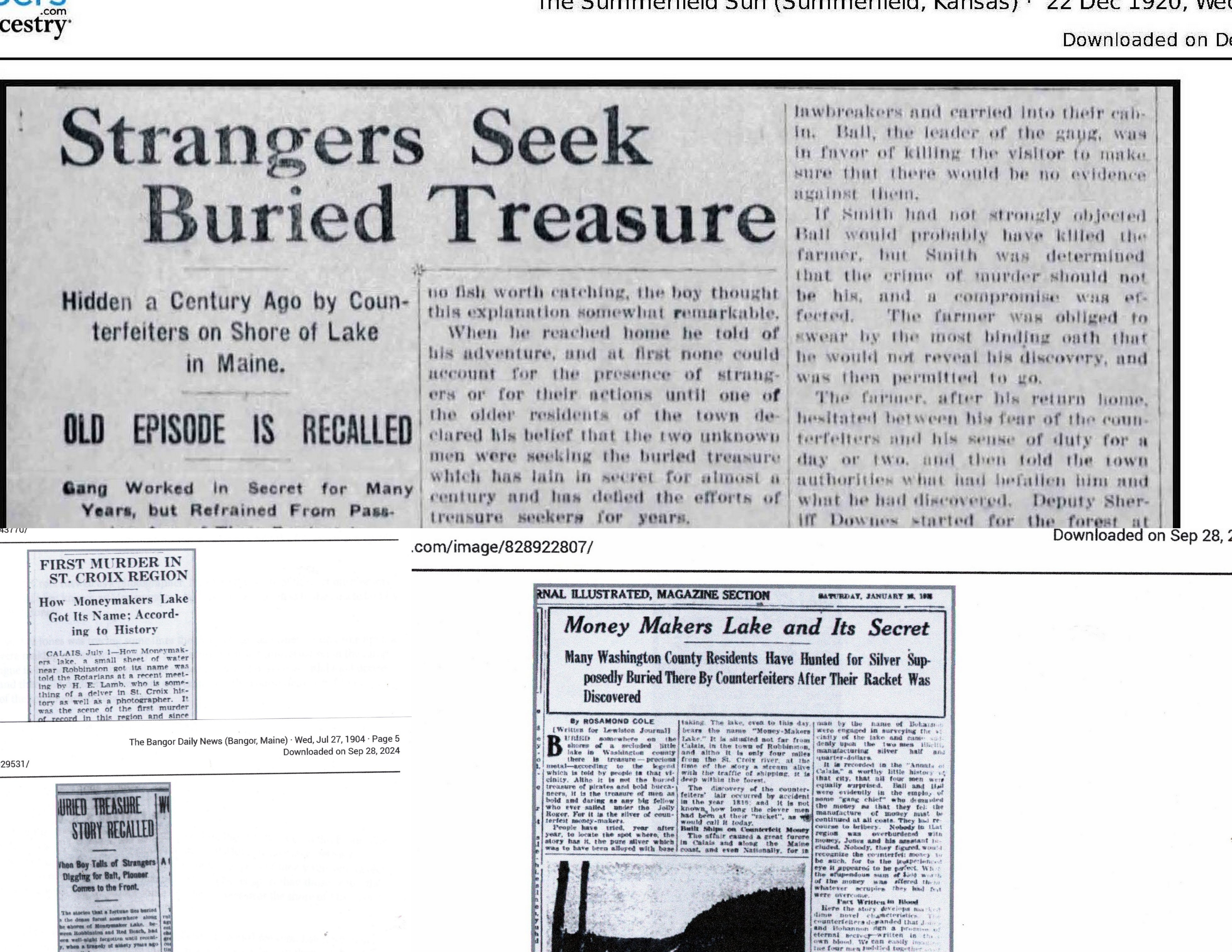
Untold numbers of have searched for a cache of gold and silver said to buried near the lake
The legend of Moneymaker is over two centuries old
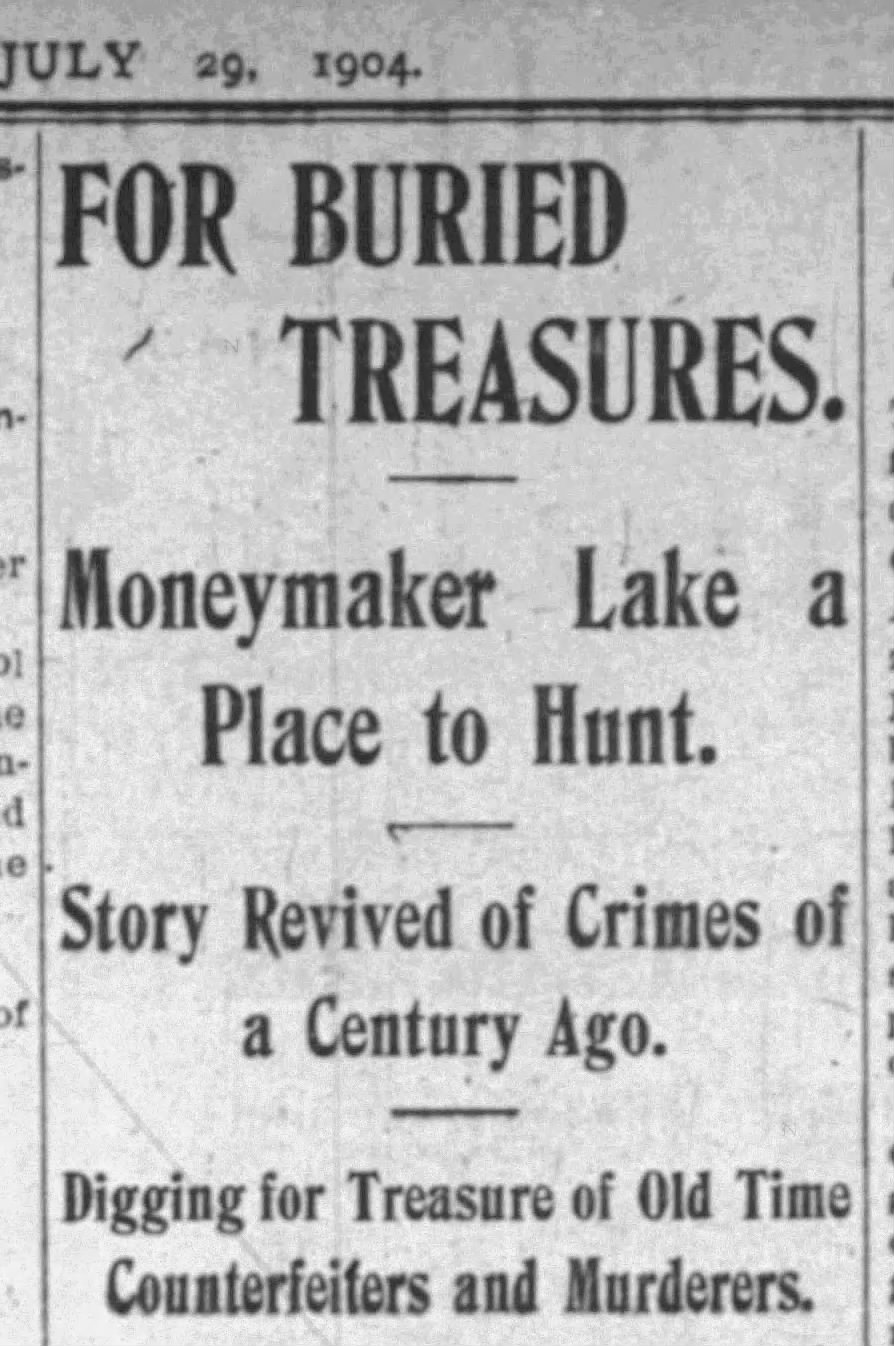
Locally we have our own Captain Kidd- Ebenezer Ball, the counterfeiter who with his confederates was caught counterfeiting at Moneymaker Lake in the early 1800’s and hanged for killing a deputy who tried to arrest him. There have been many articles written over the last 200 years about Ball and there has also been an enduring interest in the purported treasure which Ball is said to have buried on the shores of Moneymaker Lake in Robbinston. Not a trance has been found although not for want to trying. Over the years reports of mysterious strangers digging on the shore of the lake or relatives of Ball’s confederates suddenly appearing in town and acting suspiciously were common. Once a group from Nova Scotia claiming to be descendants of one of Ball’s confederates arrived with a “faded, crumpled map, crudely marked” but apparently found nothing. According to Red Beach historian Fred Keene who was born in 1876 and grew up very near Moneymaker the trail leading to the lake is called “Counterfeiter’s Trail.

The type of coin Ball would have been counterfeiting
When a small boy Keene’s grandfather would often show visitors counterfeit coins which he claimed were made by Ball, quarter and half dollars which looked like real money except for the milling on the edges. Of course as boys Keene and his friends often searched for the spot where the treasure was buried and one day found a spot which they were sure was the hidden treasure trove. Unfortunately it was dark so they marked the spot with stakes with the intention of returning but the next day “was good hay day, so were the next and next. On the fourth day we expected to go and see what was there but fate in the shape of a forest fire, kindled by some careless fisherman, had swept the west side of the lake and obliterated not only the stakes, but trees and landmarks, and so altered the landscape that hours of search failed to give any clue.” Perhaps it was the ghost of Ball rather than a fisherman who set the blaze.
Writing about money buried at Moneymaker, Robbinston historian Harriett Burke says there was a grave marked by a pole on the shore of the lake and “the grave is filled with water. We were always cautioned not to go near that pole. When you are walking through the woods and get so you can see the pole, it starts swaying. We always call it the haunted grave.”
In fact, there was almost certainly nothing to find. Ball was actually free for months after the shooting of Sheriff Downes, living just a couple miles from the lake. He would have had plenty of opportunity to remove valuable or incriminating evidence from the scene of the crime.
Sad to say there is no buried treasure to be found Downeast, certainly not Captain Kidd’s. He was never in Passamaquoddy Bay and wasn’t even much of a pirate. For those interested in an account describing Captain Kidd’s life on the high sea I have attached a rather long newspaper article from the early 1900’s which relates in some length Kidd’s rather undistinguished life as a pirate. It also raises questions as to whether his hanging was even justified.
I’ll end with some short articles from St. Stephen’s St. Croix Courier describing buried treasure and get rich schemes reported in the paper over the years.
November 2, 1878
HIDDEN TREASURE
Money Eighty Years Buried!
It is stated that Mr. Joseph Farthing found the other day on his farm, Oak Bay Road, a small tin box which had evidently been turned up with the plough, and on opening it, he discovered a letter written in the year 1798, stating that a considerable amount of money was buried in a certain place, the exact locality of which was carefully pointed out. The letter is signed “Alexander McAlpine” and states that the writer had been thirty-five years in the country, and being then about to die he made this disposition of his money, one-half of which was to be paid to a certain named person, if living, and the balance to be retained by the finder, who was instructed to see that the testator’s remains were properly cared for. If the money is discovered it will be quite a lucky find for Mr. Farthing.
1908:
A. Stewart of Charlotte county anticipates he will soon be the possessor of barrels of money and will be able to give John D. Rockefeller a close run for the honor of being the richest man in the world. The hidden treasure of the pirates who infested the seas hundreds of years ago has been discovered by Mr. Stewart, according to a statement which he made in the crown land office here on Saturday in the presence of Surveyor General Grimmer and Deputy Surveyor General Loggie, and it is only a matter of a few days when he will have it in his possession.
According to his story there lies buried in a cave somewhere on the rock-bound coast of the county of Charlotte six barrels of gold coins and rubies of priceless value. Mr. Stewart left for home on Saturday evening confident that he will, in the course of a few days, be a multimillionaire. It is expected that out of gratitude to the Surveyor General he will pay off the debt of the province.
Courier August 26, 1886
The prominent citizens have, for some time, been in search of buried treasure near the Ledge. One night last week they had divers at work, but they are no wealthier now than they were before. The Courier is in possession of interesting facts concerning these operations and will probably place them before the public at an early date.
1894:
A party of men arrived in Lepreau here on Sunday searching for gold, which has caused quite an excitement in town. A lady here has been dreaming of buried treasure, not once, but three times. The men will begin operations at once. It is to be hoped they may discover something.
June 14, 1900
At last, the search for Capt. Kidd’s gold at Oak Island has been abandoned. The plant is advertised to be sold at the sheriff’s auction. Thus, it is that experience teaches. Thousands of dollars have been invested in Oak Island, but no treasure has been found. Today the famous pirate may rest secure knowing that his buried treasure, if he really did bury it, is safe in the arms of mother earth
October 5,1866
We understand there have been parties digging recently at Pirate Cove, Charlotte County for the treasures said to have been hidden by Captain Kidd, on some part of the coast.
1883 courier
There are many persons who believe that beneath the soil of some of the Islands of Charlotte, the untold treasures of Captain Kidd lie securely hid. The romantic interest which attaches to this belief is enhanced by the recent discovery at Seal Cove, Grand Manan, of ore and large lumps of half-worked metal which, it is thought, are the relics of what once formed the stock-in-trade of one Wheeler who, late in the last century, practised the counterfeiters’ art in that vicinity. Mr. W.B. McLaughlin, of Seal Cove, has in his possession a small French coin, bearing date 1724, which was unearthed at the Cove by Mr. Russel. It is much corroded, and Mr. McLaughlin thinks it was used by Wheeler as a model to coin from.
And finally from the St. Andrews Beacon 1892:
Between where the fort stood and the shore there are a number of depressions in the soil, some of them quite deep, but all now over-grown with grass. These depressions, the Beacon was informed by Mr. Russell, have been caused by excavations that were made by curiosity seekers or by seekers after hidden treasure, years ago. Some of the excavators were rewarded by finding various implements of war that had been used by De Monts’ party, or by Indians, but the great majority of them had their labor for nothing. There is no record of any treasure being found but there are people who believe that somewhere in that neighborhood the redoubtable Captain Kidd dropped some of his ill-gotten wealth, and weird, uncanny tales are still told of treasure seekers who were driven from their labor at midnight by terrible-looking goblins.
-Beacon, June 9, 1892