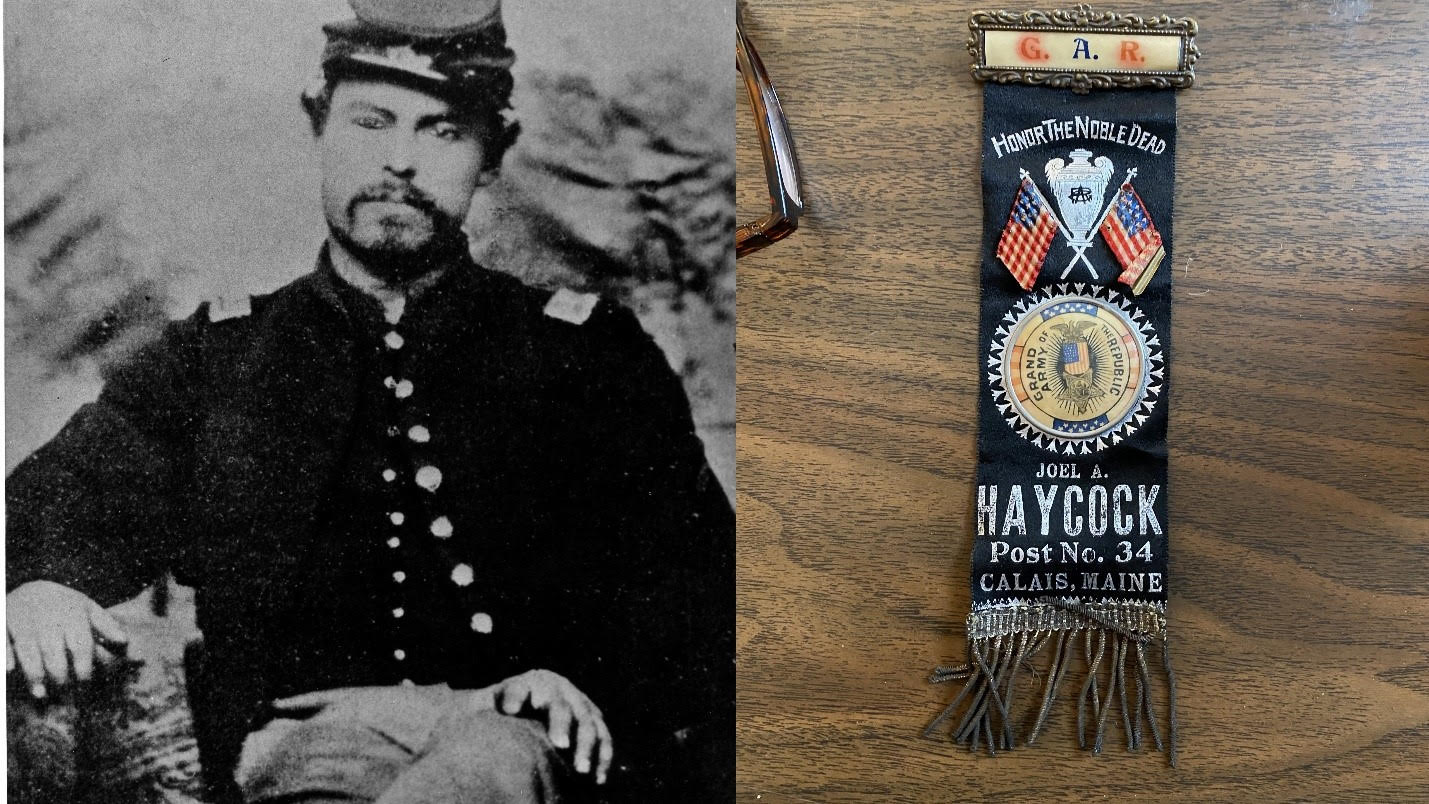
Major Joel Haycock
The Grand Army of the Republic badge shown above was given to the Historical Society by Bonnie Dwelley, formerly Bonnie Burns. It was found in the Burns home on Hinckley Hill, although she does not believe it is associated with her family. It would have been worn by a veteran of the Civil War at local GAR masters in the late 1800s and early 1900s. We do not know the name of the veteran who wore it but all members of the Joel A Haycock post of the GAR would likely have sported an identical badge. The GAR is a rough equivalent of today’s American Legion.
The GAR post was named in Joel Haycock’s honor, not only because he made the ultimate sacrifice for the Union, many others from Calais were casualties of the conflict, but also because of his courage and the high regard in which he was held by his men and his superiors.
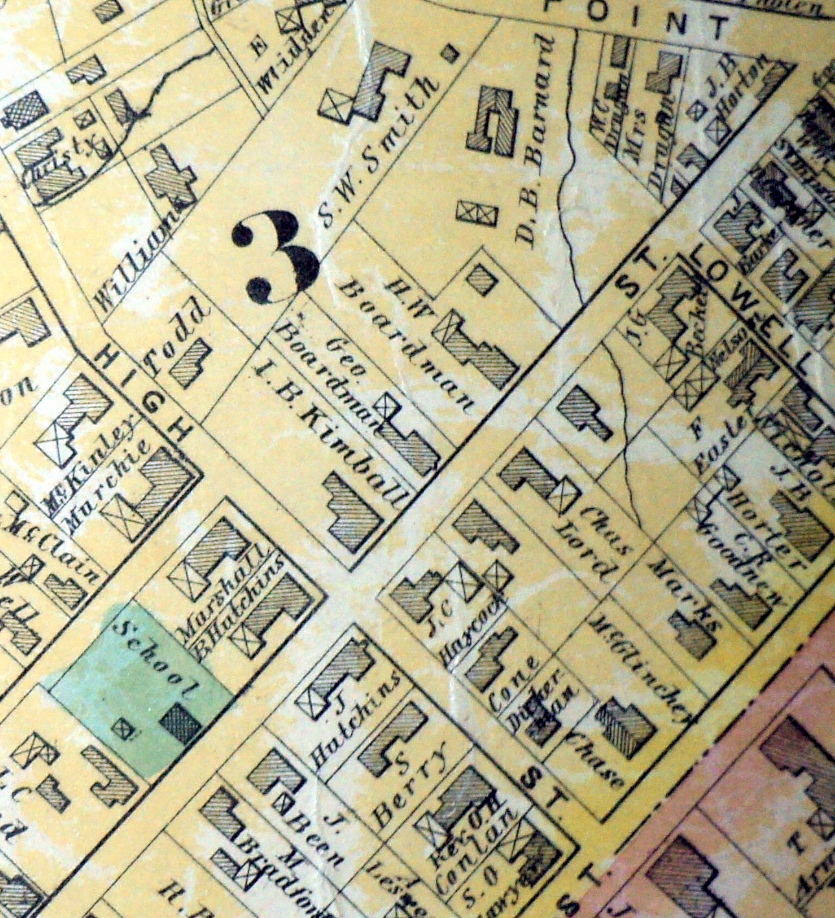
The Haycock family lived on the corner of High Street and Monroe in 1874
Joel Haycock’s father was Jones Coffin Haycock, born in 1809 at Chandler River, Jonesport in 1804. His mother was Lucinda Ames of Mason New Hampshire. Whether the family was living in Calais in 1836 when Joel was born I don’t know but by the 1850’s the family was living on Lafayette Street, just up from Washington Street. They soon moved to High Street near the corner of Monroe and it is probably there that Joel grew up with his brothers and sisters, Mary the oldest, then Joel, Weston, Willis, Fanny and Ernest. Joel attended the Point School located near the bridge. A classmate, George Boardman remembers Joel and other boys at the school many of whom were to fight in the Civil War:
Robert, or “Bob” Smith, as he was popularly called, was possessed of uncommon abilities, and seemed at one time to be the rising man of Calais. Neal Smith and I sat together on the same bench in the Point school for several years. He was a fine fellow, good natured and generous. He would continually copy the sums from my slate after I had laboriously worked them out; but it was not that he was dull, for he was quick-witted and a good scholar ; but it was easier to copy than to plod through a mass of figures. Mr. Samuel Pray was the master, and he afterward taught at the “Sand-Bank Seminary” or Calais High School. Of my other fellow scholars I retain somewhat vivid recollections of Charles ‘Sargent, Benjamin Arnold, and Joel Haycock. What afterwards became of “Charley” I do not know; but poor “Ben” was drowned a little distance down the river while out boating one day. He was an excellent scholar, and at the time of his death had reached the limit of his school days. Joel Haycock I particularly call to mind. He was about the same age as the others I mention, somewhat bashful and retiring, but full of fun, and his dark eyes would flash with good humor during our boyish sports. He was popular among us, and I do not wonder that his fellow soldiers in after years selected him as their officer. However, I can never conjure up in my mind anything of the fierce soldier about Joel.
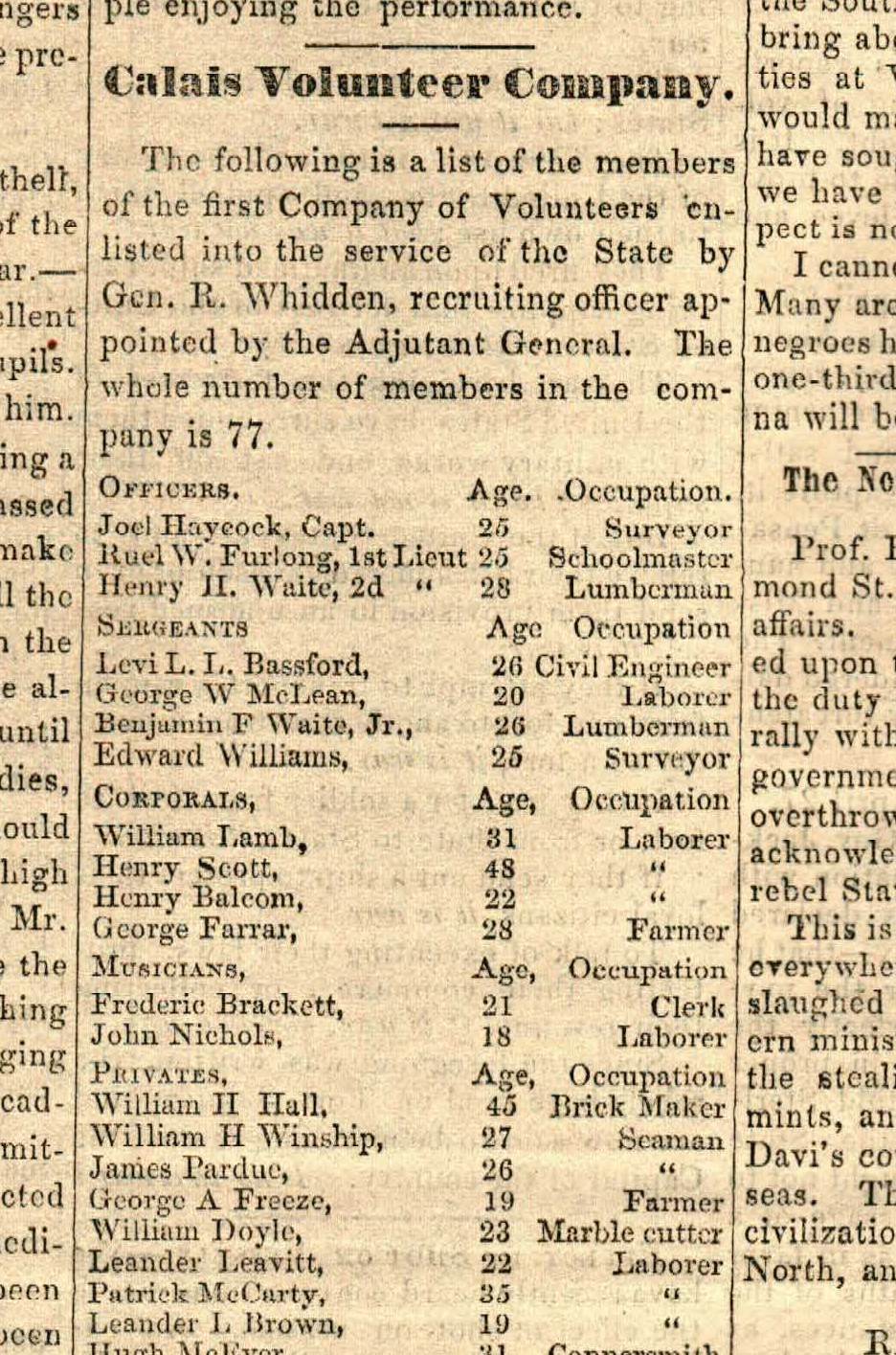
Calais Advertiser May 22, 1861
Within days of the siege of Fort Sumter Calais men such as General Whidden of the local militia began raising money to outfit volunteer units to fight for the Union. Donations poured in from “substantial citizens” as the well off were then known and from millworkers and shop clerks. Young men from all walks of life including many sons of wealthy and influential citizens rushed to volunteer including Joel Haycock and later both his brothers-Weston and Willis Haycock.

Calais Advertiser May 1861
On May 23rd, 1861 the first Calais Volunteer Company left Calais for Fort Sullivan in Eastport where other local units were massing to form what was to become the 6th Maine Infantry Regiment. Haycock and his men became Company D of the regiment. Joel Haycock and the unit’s history is described in Eastern Maine and the Rebellion published in 1888.
MAJOR JOEL A. HAYCOCK.
This gallant officer was born in Calais, January 11th, 1836, and was the first man to enlist in the first company of volunteers raised in his native city. Honest, patriotic and brave, burning with all the untamed ardor of early manhood, he was peculiarly fitted to render acceptable service to his country, in the terrible conflict for which she was buckling on her armor. When he enlisted, he left a lucrative employment, but his was too impulsive and generous a temperament to weigh pecuniary advantages against duty and patriotism.
On the organization of his company, he was chosen Captain, his command rendezvoused at Eastport, and afterwards at Portland, where it was assigned to the Sixth Regiment, as Company D, with which he proceeded to Washington, where they arrived on the 19th of July. Being too late to march into Virginia, and participate in the battle of Bull Run, they were stationed at Chain Bridge, to hold that important approach to the National Capitol in case of disaster. Here the regiment remained until the 1st of September, the interim being devoted to drill and discipline.
About this time, the second general movement of troops into Virginia commenced, under McClellan. Probably no officer in the army more earnestly hoped for an active campaign against the enemy than Capt. Haycock. Instead, however, of an advance, the fall was occupied in lining the south bank of the Potomac with fortifications, in grand reviews and in cautiously advancing from two to eight miles into Virginia. Nothing more was done until the army was set in motion early in the spring of 1862, by the famous War orders of President Lincoln himself.
The Peninsula Campaign (June 1862) which followed, unfortunate and disastrous though it was, was still a glorious struggle for success by the rank and file of the army, and was far more consonant with Capt. Haycock’s patriotic ardor. The Captain fought in command of his company at Lee’s Mills; he skirmished and labored throughout the Siege of Yorktown; he participated in the brilliant and remarkable success of the regiment at Williamsburg; he marched with the command in the advance upon Richmond and bore a conspicuous part in the ceaseless activity and exhaustive labor in front of the rebel capitol. He was foremost in the fight at Garnett’s Farm, and his intrepidity was notable at Savage Station and White Oak Swamp during the Seven Days’ battles, and when the army arrived at Harrison’s Landing, he was specially commended by his commander in official reports, for gallantry in the above-named battles.
When the Army of the Potomac was withdrawn from the Peninsula, he marched with his regiment to succor Pope’s hard-pressed forces at the second battle of Bull Run. (August 1862) They arrived a few hours too late to take part in that desperate struggle. When the rebel hordes invaded Maryland, Capt. H. fought at the battles of Sugar Loaf Mountain, Crampton’s Pass and Antietam. When the Army of the Potomac again marched into Virginia, Capt. Haycock fought with his men at Fredericksburg. This closed the active operations for 1862. His faithful services were rewarded, by his promotion as Major of his regiment, in March 1862, much to the satisfaction of his men. When the campaign resumed in Virginia, in 1863, Gen. Hooker fought the battle of Chancellorsville with the greater part of his forces. The Sixth Corps was assigned to the duty of seizing the rebel position, in front of Fredericksburg. Their path lay right across the “Slaughter Pen,” where Burnside’s forces had been repulsed in December. Foremost among his comrades, Major Haycock rushed forward, to the terrible encounter, and half way across the ” Slaughter Pen” he fell, pierced by a minnie ball, and expired almost instantly, thus sealing his devotion to his country’s cause, by his heart’s blood, The fierce, wild charge of his regiment swept away the opposing enemy, as chaff is swept before the wind, and their colors were planted in triumph upon the ramparts. But even in the first flush of victory, Col. Burnham, the commander of the regiment wept as a child, when he beheld the prostrate and lifeless form of this valiant and true hearted warrior. They buried him where he had fallen, halfway up the green slope, which had drank so deeply of the Nation’s best blood. He fills a soldier’s grave and one ever to be honored.

Marye”s Heights and sunken road today, the stone wall is to the left
The battle in which Joel Haycock lost his life is known in Civil War history as the Battle of Marye’s Heights. Marye’s Heights is in Fredericksburg, Va and the Battle of Marye’s Heights was fought in early May of 1863 during the Second Battle of Fredericksburg. The first Battle of Fredericksburg had been fought a year earlier and had resulted in a defeat for the Union Army.
I have visited the scene of the battle and the national museum which sits at the foot of the heights and I took the photo above. “Heights” does suggest a much higher and steeper hill than the reality although the hill extends several hundred feet in both directions. As the Confederates were well entrenched with substantial forces and artillery at the crest and held the stone wall at the bottom of the Heights, the taking of the Heights was sure to be costly.
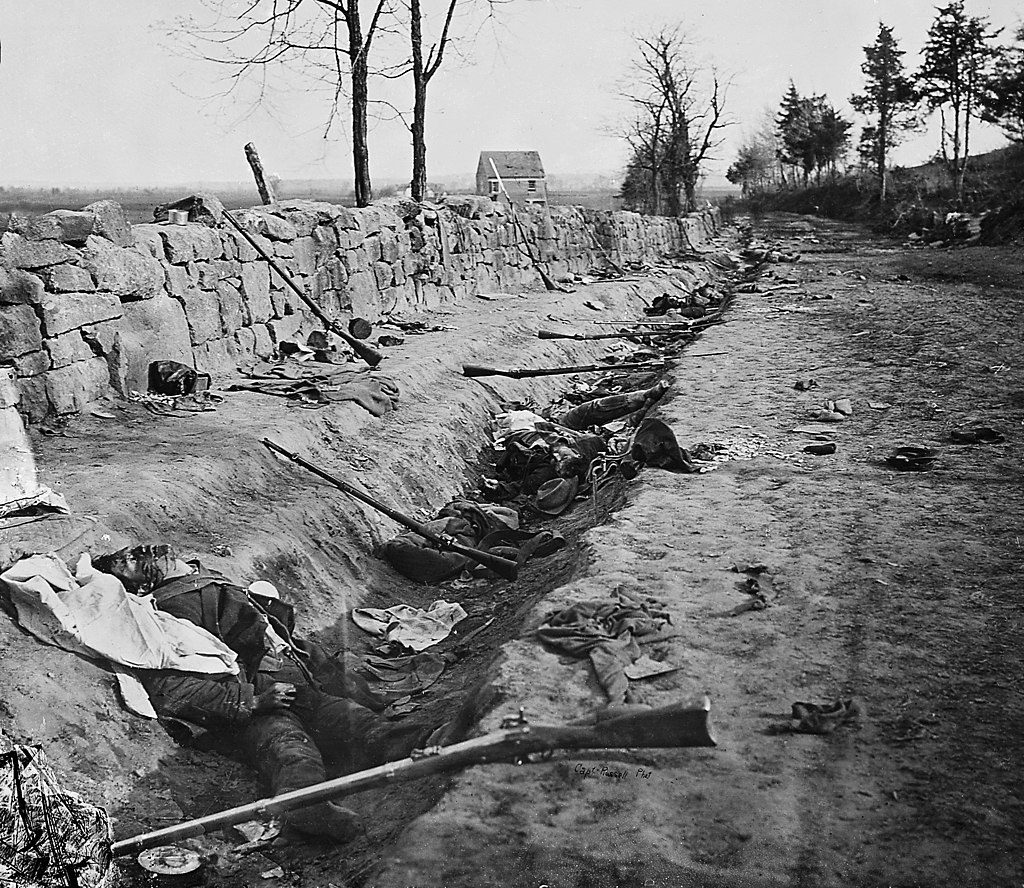
Photo of stone wall hours after the battle, Marye’s Heights is to the right
Before reaching the Heights the Sixth Maine had to drive Confederate forces from the stone wall at the base of the hill. Above is the only photo known to have been taken the day of the battle. The Confederates were behind the wall with the heights to their rear. The photo was captioned:
“Stone wall at the foot of Marye’s Heights, which was gallantly carried by the 6th Maine Infantry.” Confederate dead, Marye’s Heights, Fredericksburg, Virginia. Dead soldiers lying in trench behind stone wall. Etched “Capt. Russell Phot” below rifle in foreground. This photo was taken on May 3, 1863. Shadows indicate it was taken about three hours after the storming of the wall. Scattered rifle muskets are a mix of Enfields and Springfields.
Photographer:
Russell, Andrew J.
The Sixth Maine took the Heights at a tremendous cost. In a matter of a few minutes men from nearly every town in Washington County lost their lives during the battle- Alexander- Martin Perkins, Calais-Joel Haycock, William Scott, Frank Holmes, Abraham Ward, Charlotte John Bridges, Josiah Mclaughlin, Cooper-Stephen Averill, Thomas Brisley, Meddybemps-Justin Bridges, Crawford-Francis Lowe, the list is long and several dozen were wounded or captured and many died later of their wounds.
The death of Frank Holmes is especially poignant for the St. Croix Historical Society. The Holmestead on Main Street belongs to us, a gift from the family of Dr. Job Holmes who built the Holmestead in 1850. Frank was the doctor and his wife Vesta’s beloved son, and his death resulted in the rapid decline of Dr. Holmes who died just a couple of years later.
The reports of the commanders of the assault on the Heights establish beyond and doubt the reputation of Major Haycock. Colonel Hiram Burnham, the brigade commander, is said the have wept over Haycock’s body. His reports reads as follows:
My loss in this charge was 128 officers and men killed and wounded—a fearful rate of mortality, when the short time which we were under fire is considered. Major Haycock, one of the most valued and gallant officers in the regiment, fell among the first, cheering on the men by his example and words. I cannot deplore his loss too deeply. After a halt of a few moments in the formidable works, which our wild charge had so successfully carried, the regiment was pushed on down the plank road in pursuit of the flying enemy, who had fled toward Chancellorsville. Signs of panic and rout were everywhere visible, and many prisoners were captured by our pursuing forces.
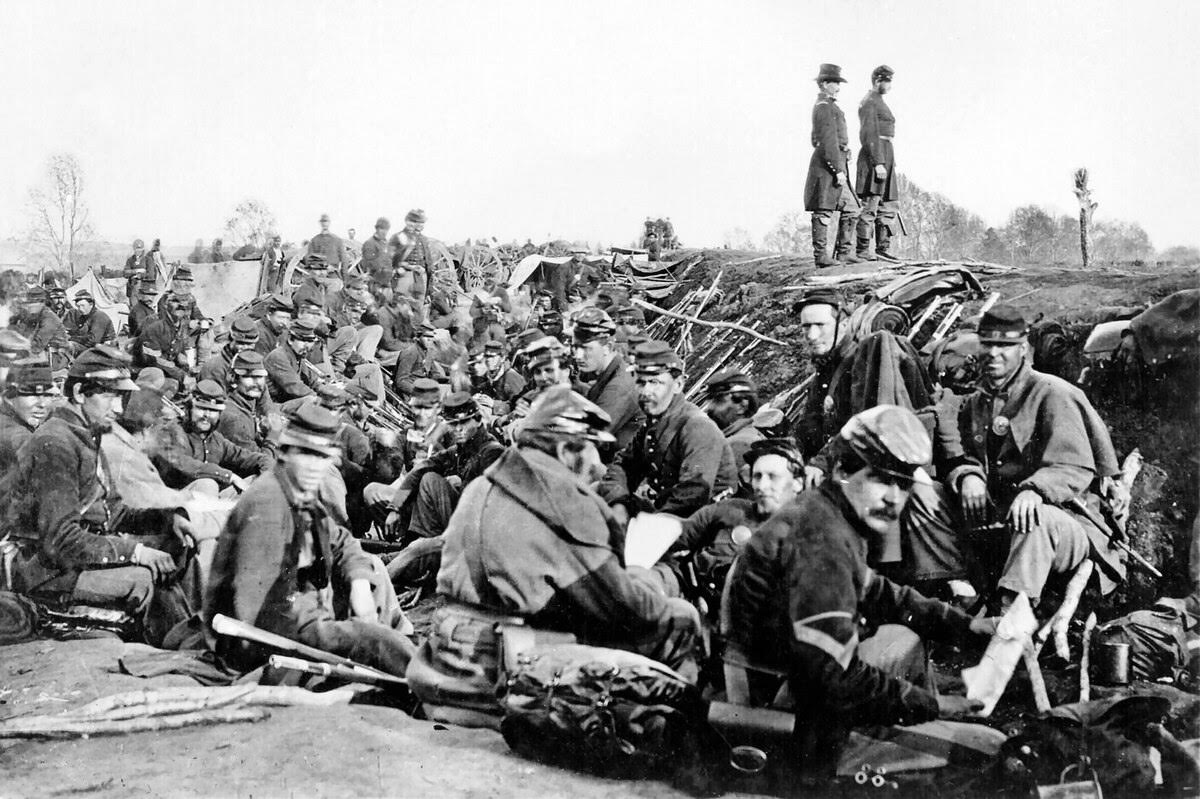
Union Soldiers awaiting the order to assault Marye’s Heights
Maine’s Adjutant General reported:
During the night the regiment was ordered to proceed to Fredericksburg, and soon after daylight it formed in line of battle in front of the Heights of St. Mary’s; and in a few moments after 10 the order to charge was given, and the regiment advanced on the double quick. In this battle the 6th won a reputation that will live with the history of the rebellion. The supporting regiments on the right and left broke under the terrific fire, and the enemy turned his attention to the 6th Maine and 5th Wisconsin. The whole of the enemy’s fire swept through the devoted ranks of the two regiments, but with wild cheers the men rushed on the fortifications and the victory was won in four minutes from the commencement of the attack. The flag of the 6th Maine was the first to wave from the battlements of the enemy’s works. The loss of the regiment in this terrible engagement was one hundred and twenty-eight officers and men killed and wounded, Major Joel Haycock, Captains Young, Gray and Ballinger being killed instantly. During the afternoon of the 3d, the regiment proceeded slowly up the plank road leading out of Fredericksburg, and supported our batteries during the latter part of the battle of Salem Heights.
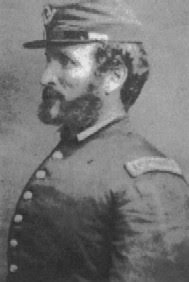
Captain Reuel Furlong
Caption under photo reads
: The Calais giant was found surrounded by the bodies of his enemies at Rappahannock Station.
No man, however, had a closer view of the battle of Marye’s Heights than Captain Reuel Furlong of Milltown, a good friend and second in command behind Joel Haycock. He was to survive Joel Haycock by only a few months. Though in the thick of the battle for Marye’s Heights he survived and wrote two letters to his parents soon after the battle:
Calais Advertiser May 14, 1863:
Letters to parents published in Calais Advertiser May 14, 1863, written the day after the battle and another a day later.
My Dear Parents:
We crossed the Rappahannock May 1st, drove the enemy away that night and the next day May 3rd we camped ar Fredericksburg. In a short time the right division charged the enemy works. The 6th Maine led the charge at a double quick with cheer and yells. We had to go up about 300 yards before we reached their works. We met a storm of grape shot and musketry, but the line never wavered a particle, but kept on although we lost a third of the strength of our Regt. Our loss in officers was severe. The killed were Capt. Haycock, Capt. Gray, Capt. Ballinger, Capt. Young; the wounded were Capt. Roach who loses a leg, Capt. Buck loses an arm and has a wound in his side. Frank Holmes was shot dead. In my company I had Ward killed, Sergt Balcom ugly wound in the arm, Corp Gower slight wound in the hip, Corp Sutherland ugly wound in the shoulder, A. McKeagan ugly wound in the arm, C Foss slight wound in the arm, W. Leavitt bad wound in the arm, J. Glass bad wound in both legs, H.H. Coombs bad wound in one leg, A Rouch slight wound in the hip. Company D was one of the first to enter the works. Our loss was fearful but our victory was complete. We advanced rapidly for five miles met the enemy again and fought him. It was a drawn game. Our loss was heavy and so was that of the enemy. In the meantime they came around our flank and occupied Fredericksburg. Captured our pack mules, mail and some of our baggage. I lost mine. Yesterday they surrounded us or nearly so and we had to withdraw across the river again. We are going up to Hooker now. They left us last night two miles from the ford to cover the retreat. We were close to the pickets. The enemy captured most of our pickets and came after us but we fought him and drove him back and bought our Regt. to the ford. The loss in my company in that engagement was two wounded. J Jamison severely and prisoner; B Spencer slightly wounded and prisoner; five or six more men were missing from the company but were not wounded and will be up in a day or so. We have suffered fearfully but are in the best of spirits. We start in a day or so. I forgot to tell you the Fifth Maine captured eight big guns from the enemy when we charged their works-I can’t write any more this time for we start in a moment. My health is excellent. Love to all.
May 5
I wrote the day before yesterday but couldn’t send it. We are up to Richard’s Ford on the Rappahannock-Hooker is back on the north side of the river again. This fight has been one of the most wicked ones during the war. The Light Division went into it with 2250 effective men and lost out of that number 1050-nearly 50 percent. The loss in our regiment when we charged the height and captured the enemy guns at Fredericksburg was 25 killed and 105 wounded many of them mortally. I suppose some of the wounded men have written home. The men missing from my company and supposed to be prisoners are Daniel Thompson Baring; Geo. Condell Calais; John McLally, Portland; William Doyle Calais; Babcock Bangor; Aaron Hanson, Edwin Mclaughlin, S. Woodman Calais. Some of them may be up in a day or so. Geo. Blanchard is alright. We have lost out of 48 in killed, wounded and missing 21. I will write again soon.
If any local soldier equaled and perhaps exceeded the bravery of Joel Haycock, it was Reuel Furlong of Milltown Maine. Within two months of the Battle of Marye’s Heights Furlong found himself in another battle not far from Fredericksburg.
July 1863:
Early in the afternoon Companies D and I replaced A and F on the skirmish line. In front of Captain Reuel Furlong’s Calais Company was a house from which Rebel sharpshooters were making life on the skirmish more difficult than usual. Someone in authority ordered Furlong to clean out the menace, and he led his twenty-four-man company in a quick dash through the enemy picket line to the right of the house. When they reached the rear of the building, the Calais men fired a volley into the unsuspecting Rebels behind it, killing and wounding several. Unprepared for the sudden appearance of Yankees in their midst, the Rebels fled in all directions. Furlong captured thirty-five Confederates an entire company, including a captain and a lieutenant without suffering one casualty in return.
The giant from Calais sent eight of his men back with the prisoners and, with the other sixteen, barricaded the house. Only when he realized he would be unsupported and was about to be surrounded did he order a retreat. His only casualty was one man suffering from heat prostration. It was a daring and skillful raid by one of the most capable officers in the 6th Maine, and Brigadier David Russell commended Furlong in his official report, calling his actions gallant and highly daring.
He was to live only a few months and died in a desperate attempt to take Rappahannock Station from the Confederates. Ken Ross the preeminent historian of Washington County in the Civil War describes his death:
In the glory and horror of battle, if there is any glory, Captain Reuel W. Furlong, a teacher from Milltown, outdid his Co D predecessor Joel Haycock. Also a bold fighter, at Hagerstown, Maryland he assembled 24 men and attacked an enemy force, killing and wounding 21 and capturing 39 (AG Report, 1864-5, 369-70, 386-8). Rappahannock Station, where he led Co D, gave him an opportunity to repeat the Hagerstown performance on a grand scale. According to eyewitnesses, he “leaped over the enemy’s works, and after employing his revolver, fought with a clubbed musket, swinging it around his head until he fell dead. After the battle his body was found among a pile of dead, several of whom had been killed by the blows of a musket stock” (Hatch, 481).
The death of Reuel Furlong did not, of course, mark the end of the war for the 6th Maine. The war continued for another year and a half and Washington County men continued to suffer casualties at a high rate until the end of the war. The extensive research of Ken Ross compiled for his book Washington County in the Civil War finds almost 700 men died on the battlefield or from disease, 600 lived but were disabled, 750 were wounded, 300 men deserted and 117 were taken prisoner. Disease was an especially effective ally of the grim reaper for those who served on the lower Mississippi River. Historian John Dudley says
Of the 15 men from Alexander, Crawford and Cooper in the 22nd, 7 died of disease, none were killed. This regiment spent its time along the lower Mississippi River. For the Maine 25th, another nine-month unit, it had just 20 die of disease, none killed. They were defending Washington, DC.
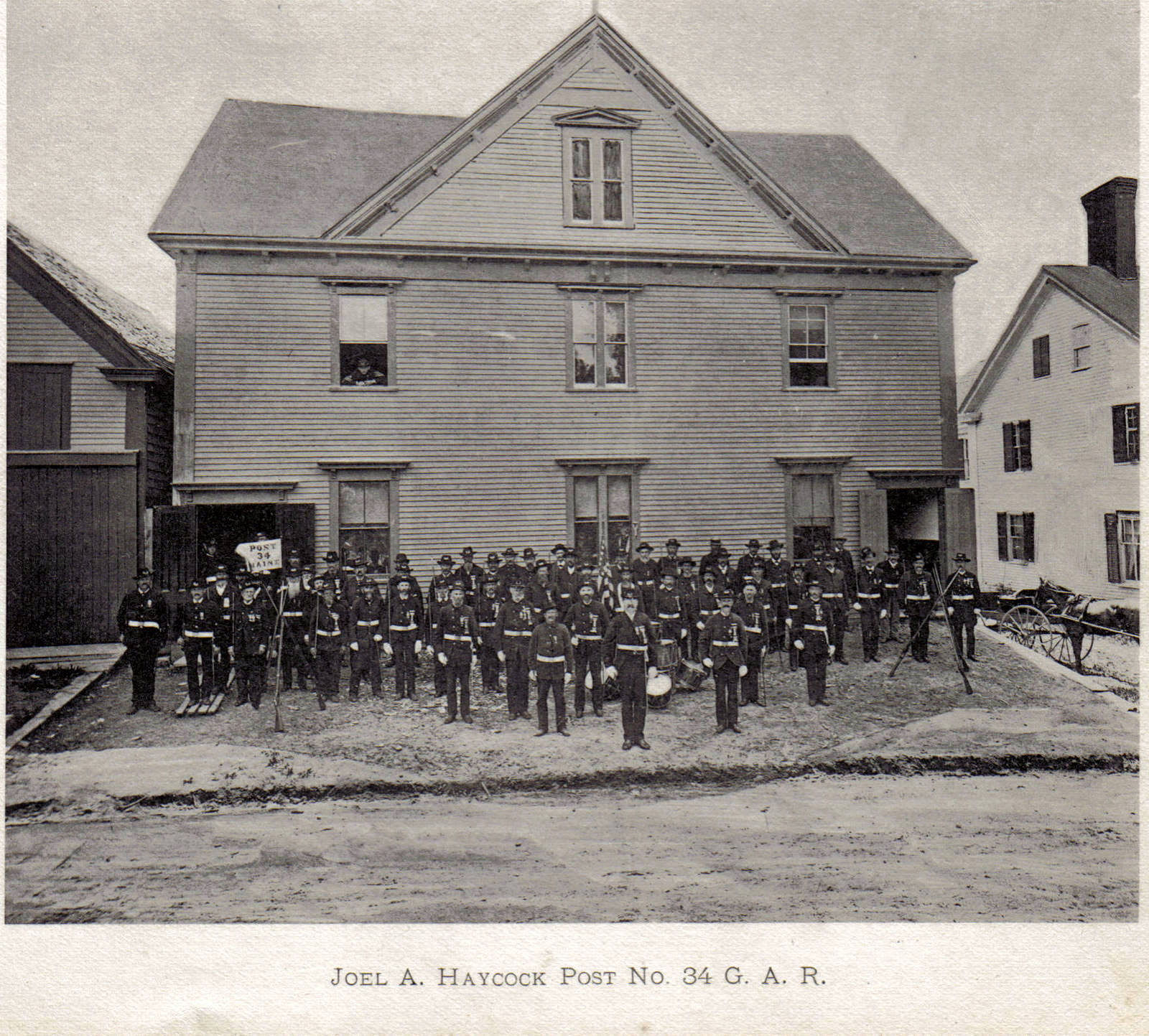
GAR Hall Lowell Street Calais
The hall of the Grand Army of the Republic on Lowell Street was named in honor of Joel Haycock. Reuel Furlong has a stream named after him in Milltown. If this seems a bit unfair, I agree. Both were genuine patriots and heroes who gave their lives for their country but I suppose the same can be said for the hundreds of local men who died and were severely wounded during the war.
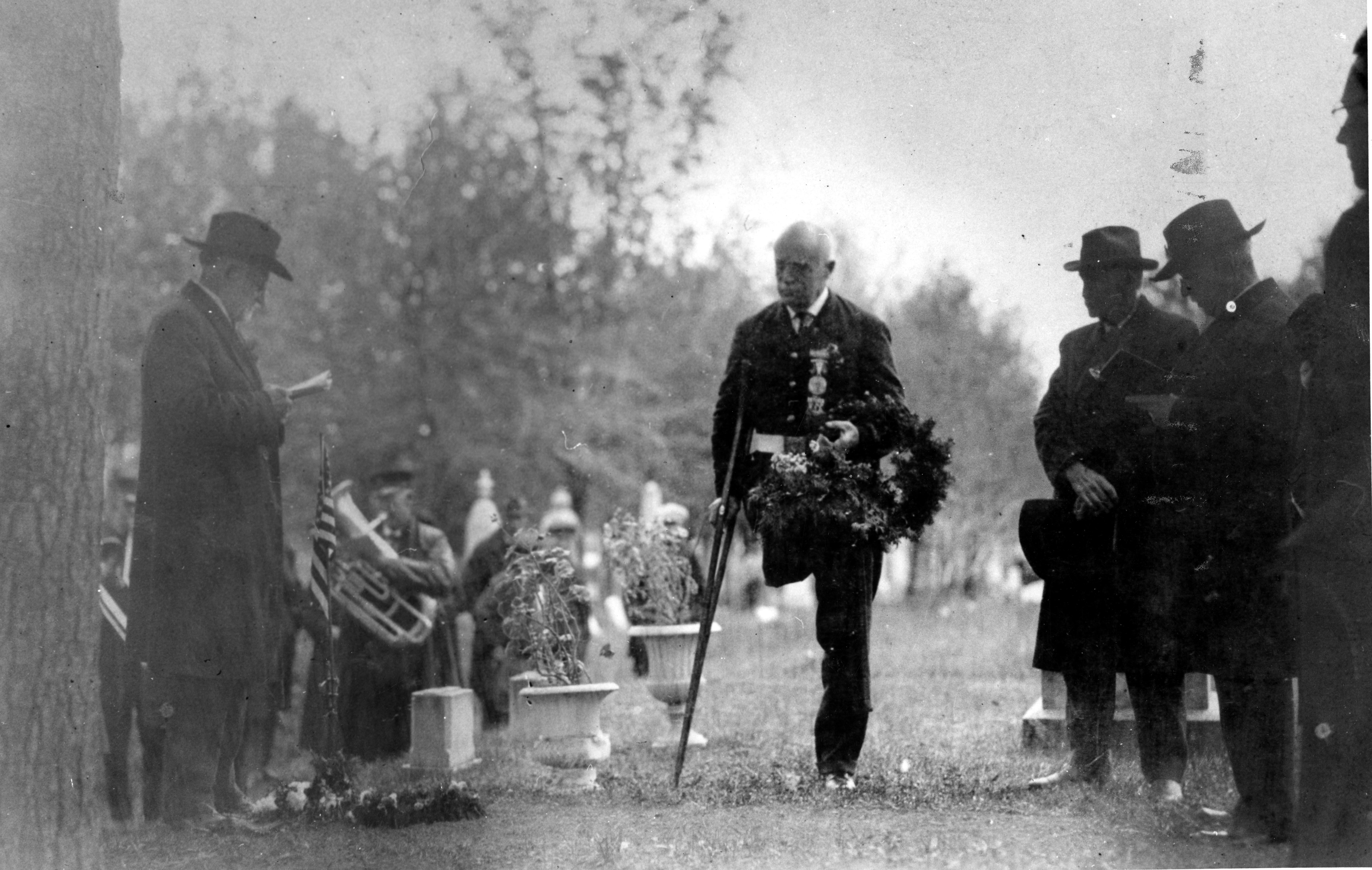
Grand Army of the Republic veterans at Calais Cemetery early 1920s
Few GAR vets were still alive to perform the yearly memorial service in the early 1920’s. Commander Quimby is reading the service. According to Ned Lamb this may be 1915. Burnham Redding and Fred Cochran, the one-legged man are also present as was Ashley St Clair who was the Chaplain. Perhaps it is he rather than Commander Quimby who is reading the service.
The GAR was a powerful social and political force well into the twentieth century. They may have helped Lucinda Haycock, Joel’s mother, with her survivor’s pension application after her husband died in 1874. She applied for a pension on her sons’ service records and lived until 1901. Joel’s brother Willis had survived the war but died of a war related disease in 1883. He had married Ella Young of Bucksport after the war and they had six sons so the Haycock name remained prominent locally. Joel’s brother Weston also served but moved to Wisconsin where his sister Fanny was living. Mary had moved to Michigan. Joel’s youngest brother Ernest was too young to serve in the war, married Lizzie Harmon from Milltown N.B. and moved to Portland where he is listed on the census of 1888 as a traveling salesman.
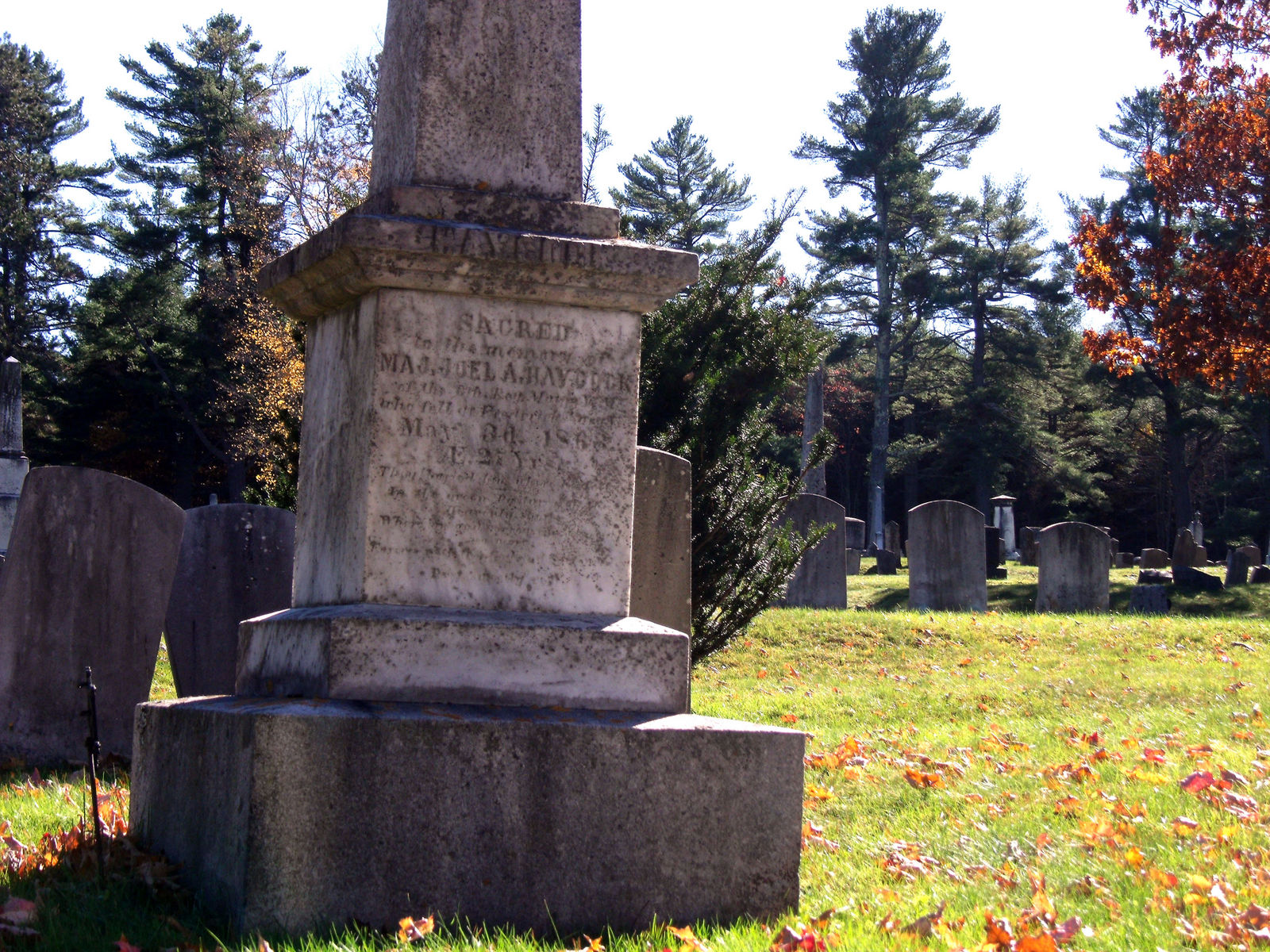
Joel Haycock’s grave Calais Cemetery