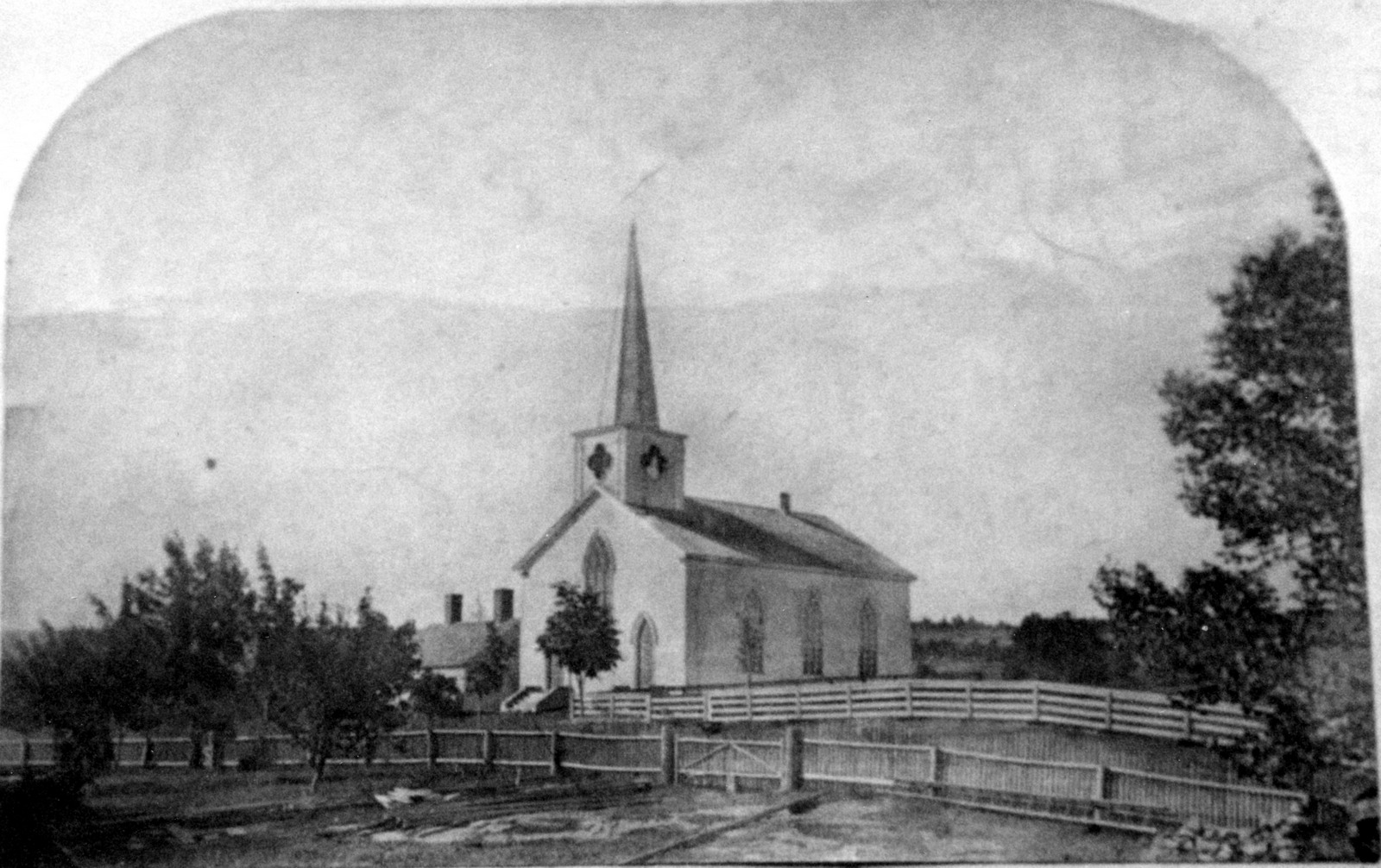
The original Robbinston Congregational Church
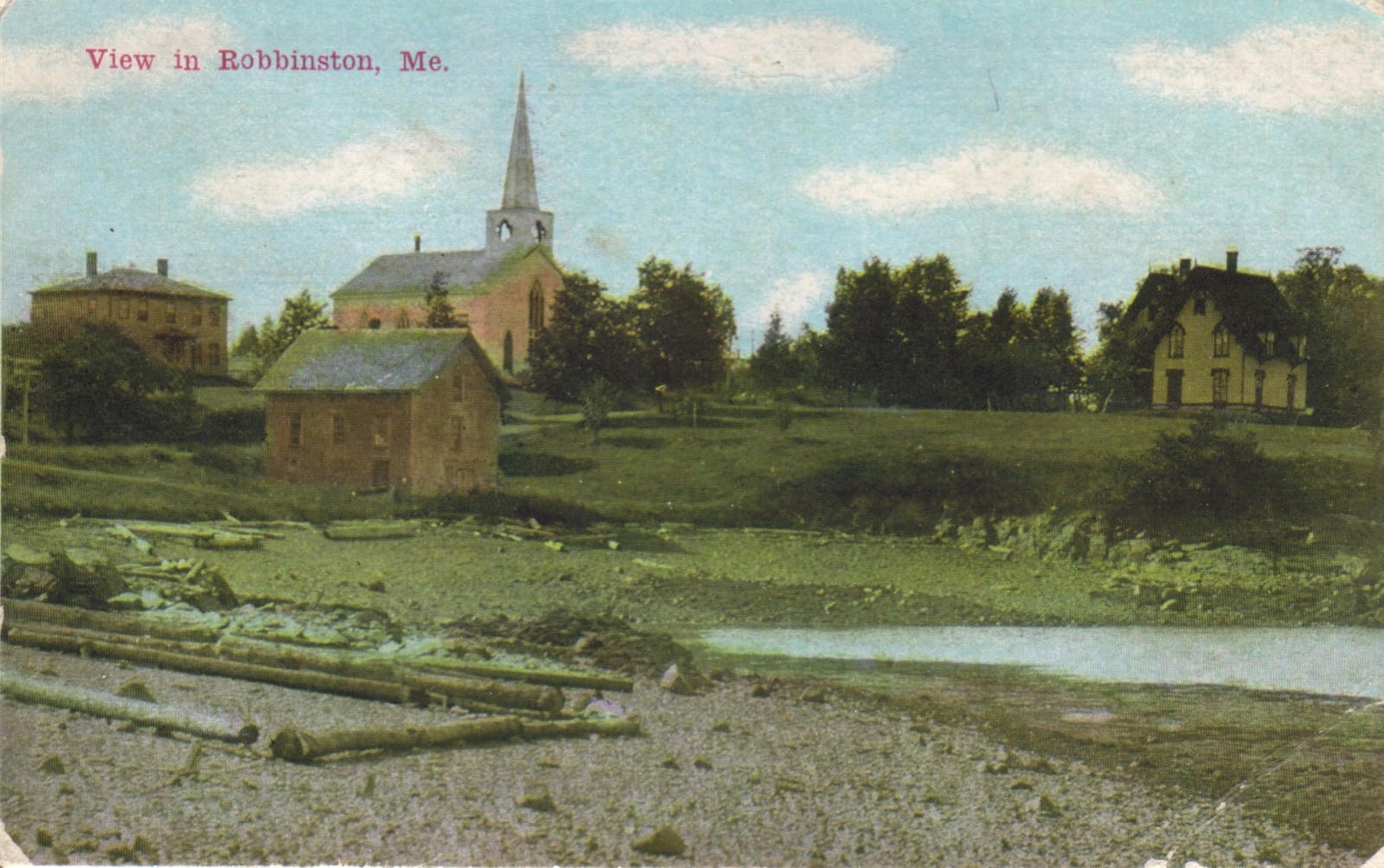
Another view of the Congregational Church which burned in 1910
In Matthew Thornton’s article I stated that the British had bombarded Robbinston during the war of 1812. John Brooks, a knowledgeable and reliable local historian told me many years ago that the Robbinston militia dug pits for gun emplacements on the rise in back of the Congregational Church and placed a couple of cannon there to fend off an attack by redcoats during the War of 1812. He said as a boy the outline of the gun emplacements could still be found and he and friends even found old rusty cannonballs in the area. John said the British arrived by boat and landed in the area of the present boat landing. After an exchange of fire with Brits it soon became apparent that all those weekends of militia training was for nought against a professional army and the militia retreated through the woods toward Machias. The Redcoats briefly occupied the town but soon withdrew. Some years ago I searched the woods in back of the church and there were still irregularities on the land that suggested gun pits.
Tom Moffat, a local historian who now lives in Oak Bay and is very knowledgeable about this era questioned this account and he was correct to do so. While the British did occupy Robbinston briefly it appears they did so without a fight.
From Davis’ book An International Community on the St. Croix
War with England was declared and “persons from this town (Eastport) and Robbinston had been deputed to make known the wishes of the inhabitants, who entertained no fears of invasion from authorized British forces but were apprehensive of predatory excursions from lawless people on the borders.” (Kilby) As a result 2 companies were to be stationed at Eastport and one at Robbinston, then under the command of Thomas Vose, Jr. Kilby also notes that at this time “Robbinston was the military headquarters of the frontier, being the home of General John Brewer, Colonel Thomas Vose, Jr., General Balkam and Major Job Johnson. There was not much stomach at the time in Robbinston or, for that matter, anywhere in the St. Croix Valley for open hostilities with our neighbors on the British side. Robbinston’s economy depended on trade, legal and illegal, with New Brunswick. In fact, there were accusations that John Brewer, Robbinston’s postmaster, had suppressed the dispatches announcing the war and allowed British officers to inspect the mails and forward documents to Fredericton. (Davis)
An account of the 1814 Battle of Robbinston by Robbinston historian Ernest Brown on the dedication of the Robbinston War Memorial after World War Two is certainly close to the truth:
We have met on this occasion to dedicate a monument in memory of the veterans of World Wars I and II. It is fitting and proper that this tablet be erected on this most historic spot in this town of Robbinston. It was on this very spot that the militia was trained under Governor Strong and General Dearborn to resist the British raids in 1812. It was later discovered that the British were interested only in taking the islands of Passamaquoddy Bay. Eastport being an island was captured; but Robbinston, being on the mainland, was not molested. However, the British cruiser “Spartan” was sent up to Robbinston and here captured an American vessel with a prize cargo valued at $15,000. Very soon after this preparations for resistance were begun. Barracks were erected back of the church that stood here, fortifications were built, and the field was used as a training ground for soldiers from this and other sections of the state. On July 11, 1814 a detachment of British soldiers came to Robbinston from Eastport.- then known as Fort Sullivan — and arranged with the American officer in charge there to evacuate Robbinston. Great was the rejoicing when a truce was agreed upon and war was avoided after nearly two years of preparation. Had it not been for this truce signed in 1814 between the British and the Americans, Robbinston would have had a place in history as the scene of a battle. “War was averted by a hair’s breadth” were the words of General Brewer.
The short and long of it appears to be that the British did send a party to capture Robbinston but after landing they met with minimal resistance, retreat being the option elected by the militia. Taking what stores they could carry they retreated to Machias. There wasn’t a lot to fight over in Robbinston in 1814. Of a population of about 375 perhaps half lived in South Robbinston at Mill Cove and a few such as General Brewer and Thomas Vose had moved upriver to what is now the town. The only substantial building in town was Tom Vose’s brick house which is miraculously still standing although the front is bowing out ominously and may someday collapse onto Route 1. The Mansion House was almost certainly not built before the war. John Brewer lived in a small cape on the property which is pictured below until he built the Mansion House. The general consensus is the Mansion House was built around 1816.
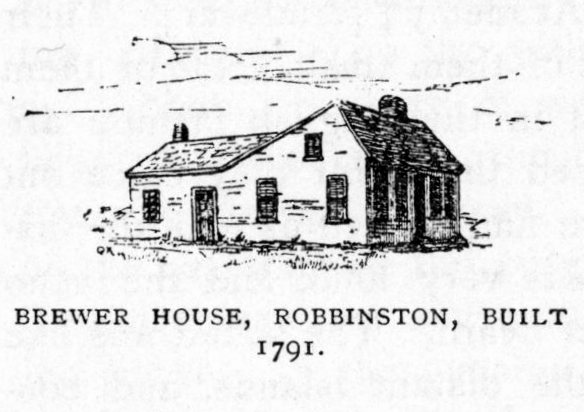
A sketch from Kilby’s Eastport History
