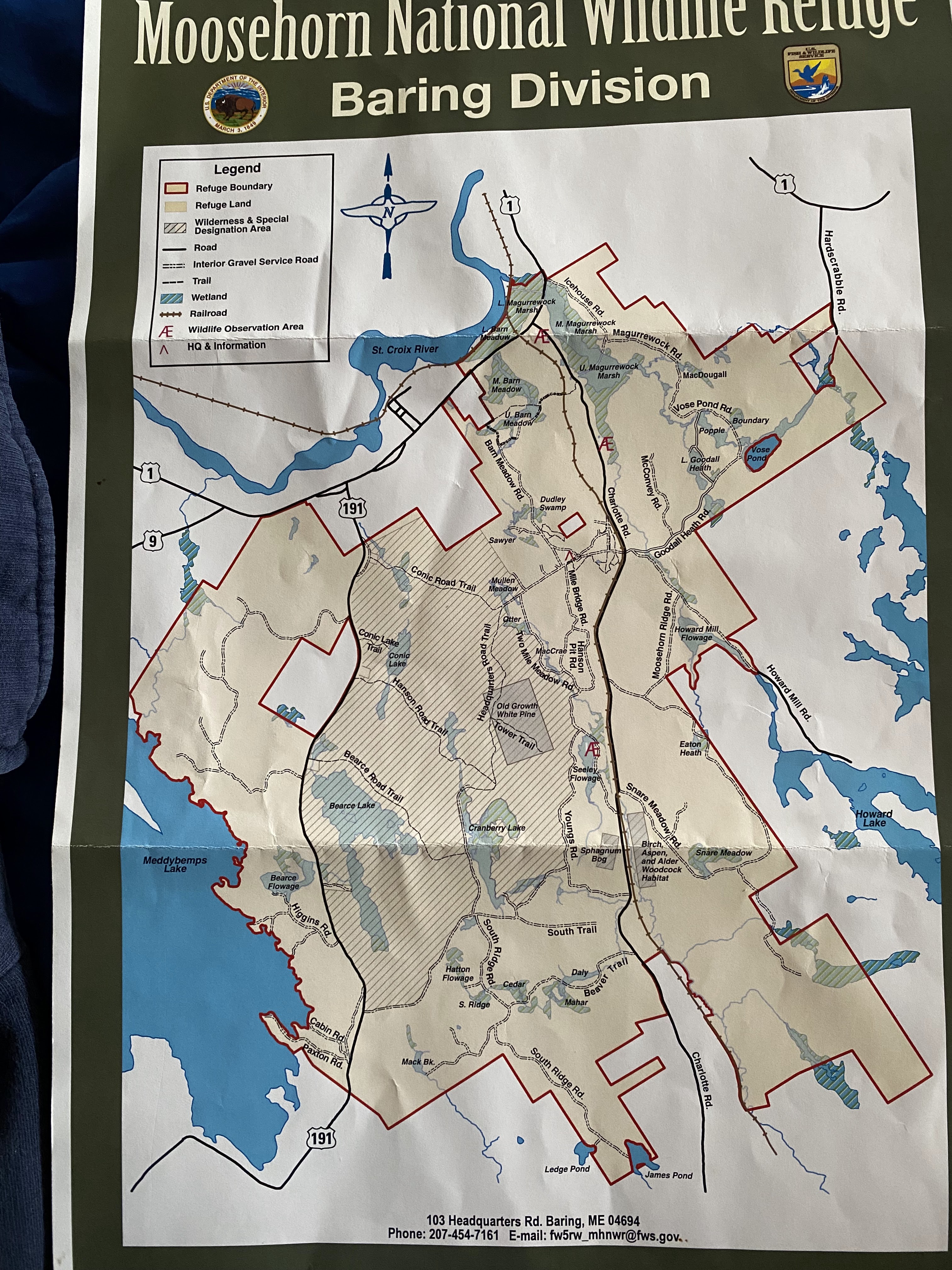
The Moosehorn Calais section at top
The City of Calais has about 31 square miles of territory, making it a fairly large Township. However, only about 13 square miles of the city are known to most residents, the remainder being lakes, ponds, marshes and swamps which lie in back of the steep and rocky ridge which begins at Maguerrowoc Mountain and runs generally parallel with the St. Croix River southwards to Robbinston. The presence of Maguerrwoc Ridge is the reason all the lakes down to Robbinston drain into the St Croix at Maguerrowoc rather than directly into the river, they can’t get across Maguerrwoc Ridge. The only exception is Plaster Mill Stream in Red Beach which had enough water in it to run the Red Beach mills because a costly canal was built from the waters of Maguerrowoc to Beaver Lake which is the source of the Plaster Mills Stream.
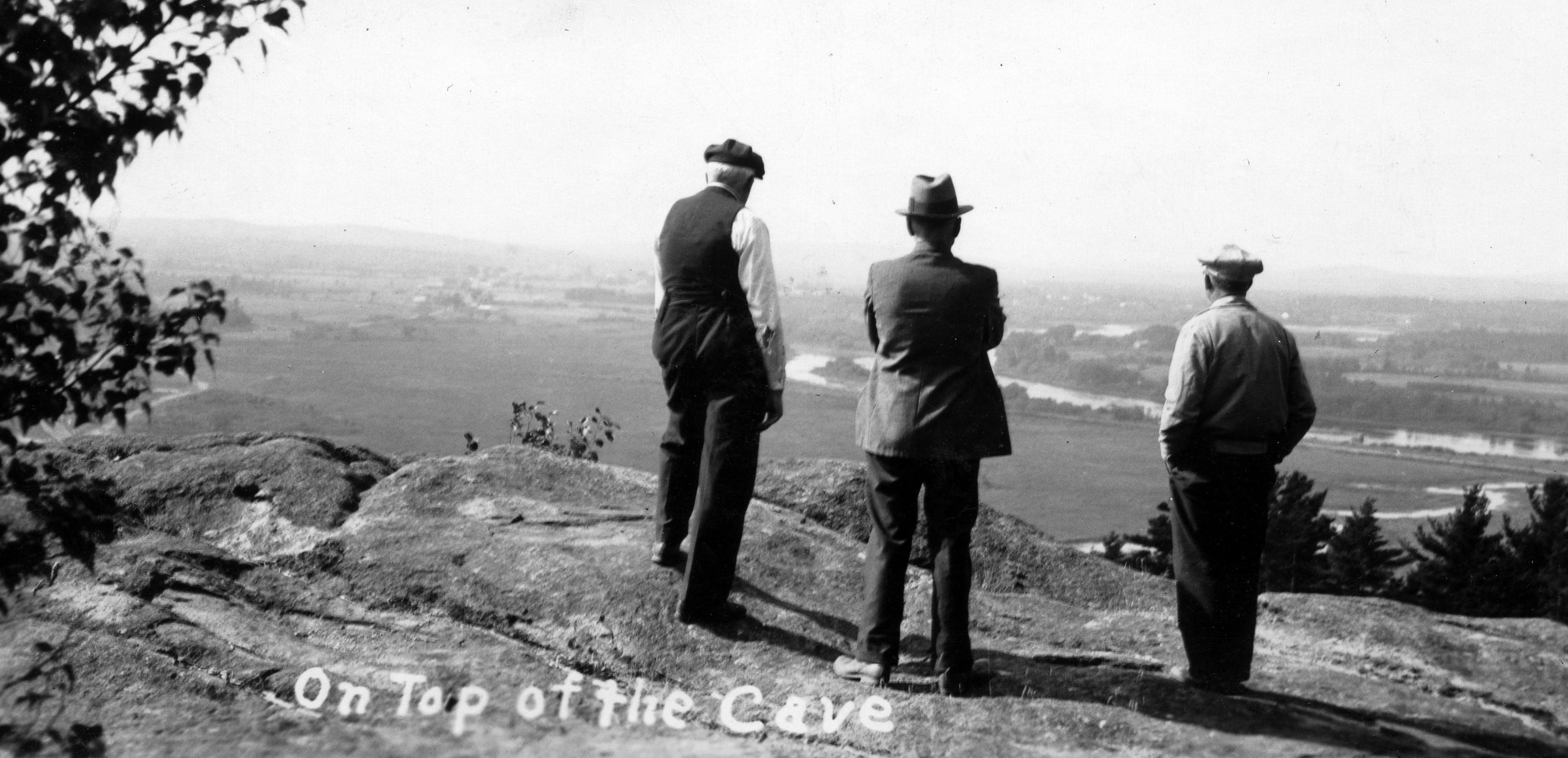
Milltown gents including Historian Ned Lamb left looking over Maguerrowock
Maguerrowoc is famous for its cave, mountain, lakes and marshes which comprise much of the thousands of acres of the Moosehorn National Wildlife Refuge. It has been memorialized in the poetry of Mary Blanchard, born in Calais in 1840, one stanza is shown below on a post card:

From A Story of Psyche, and Other Poems, a book by M. E. Blanchard, Boston, 1885
George Boardman of Calais was renowned in the late 1800s as a naturalist. He collected many samples of local flora and fauna from Maguerrowock which was recognized as a unique ecosystem and often sent these specimens to his good friend Spencer Fullerton Baird, first curator of the Smithsonian. Baird visited Boardman, and they spent days roaming Maguerrowock.
According to historian Ned Lamb the name Maguerrowock is a corruption of the Passamaquoddy name Magalwak-agum which means lake of the caribou. Before the arrival of the white man caribou were plentiful in this area but they were soon hunted to extinction, the last was shot in Charlotte County in 1928. The English name Maguerrowock is spelled with so many variations a newspaper article in the Bangor Daily News in the 1950’s published a lengthy list of imaginative attempts to spell the name.
Maguerrowock has always been a place of mystery and incubator of tall tales and legends. Typical is the Wild Man of Maguerrowock as told by local historian Ned Lamb nearly 100 years ago:
The Wild Man of Maguerrowock
The early settlers of the region were not the type to create legends. When they were not trying to “save the Country” from the other political party, their talk was mostly about how many logs were cut, how many boards the old muley sawed or how many laths they would have had cut, “if that-belt hadn’t broke.” But there is one story that should be retold, because it seems incredible that a man could exist under such conditions.
In the early days of the War there came to Bog Brook a young man by the name of Whittredge. His home seems to have been somewhere along the Kennebec River. He obtained work in the settlement but in June was stricken with typhoid fever and was very sick with the disease. One day, as the patient seemed resting quietly, the nurse left the room for a moment. He had just left when the sound of a window being opened was heard. Rushing back into the room, the bed was found empty and not a trace of the patient. The alarm was spread and a thorough search made but without results. The supposition was that the sick man in his delirium had either died in the woods or had been drowned. Three months passed and the fate of Whittredge had almost ceased to be a topic of conversation when one day a man on the Canadian side of the river saw a naked man on the American shore whom he recognized as Whittredge. Crossing as quickly as he could get a boat, he spread the news and a wider search was started. The whole section was aroused and parties spread out so that each man was in view of the others on each side and the whole county was thoroughly combed but the results were the same as before. Many people were frightened and women and children kept within doors as much as possible. Gardens were found raided and the only clue would be the print of a naked foot. It was thought that the crazed man must have surely perished during the winter yet in the spring a girl who had come out from Ireland, and was working in the field, saw a naked man coming out of the woods. She screamed with fright and the man ran up to her and struck her across her face with a switch and disappeared into the woods again. Later William Gephard was walking through the country between East and West Maguerrowock lakes when his dog brought him a bone which he had done some butchering, he knew did not belong to an animal. The dog led him to a clump of bushes where he found most of a skeleton which must have been that of Whittredge as a neckband of a nightshirt was found around the neck. The remains were given a Christian burial but the mystery of where he had been hidden was not discovered for some time, it was customary to cut all the hay on the meadows and make great stacks of it and leave them until wanted. On removing one of the stacks there was found, inside, the nest where Whittredge had stayed the winter, but how he lived will always be a mystery.
Of course, all lakes or marshes have their aquatic monster and Maguerrowock’s was especially fearsome.

MAGUERRAWOCK MONSTER.
It is evident that the vacation season is near at hand and that the keepers of the summer hotels are commencing to get in their advertising, otherwise: it would be somewhat difficult to account for the following story which is published in the Calais Advertiser as received from its Red Beach correspondent: Joseph Curtis, Phillie Smith and Robert McDonald were looking over some property, skirting the shores of Lake Maguerrawock, they saw what appeared to be a good sized steamer crossing the lake.
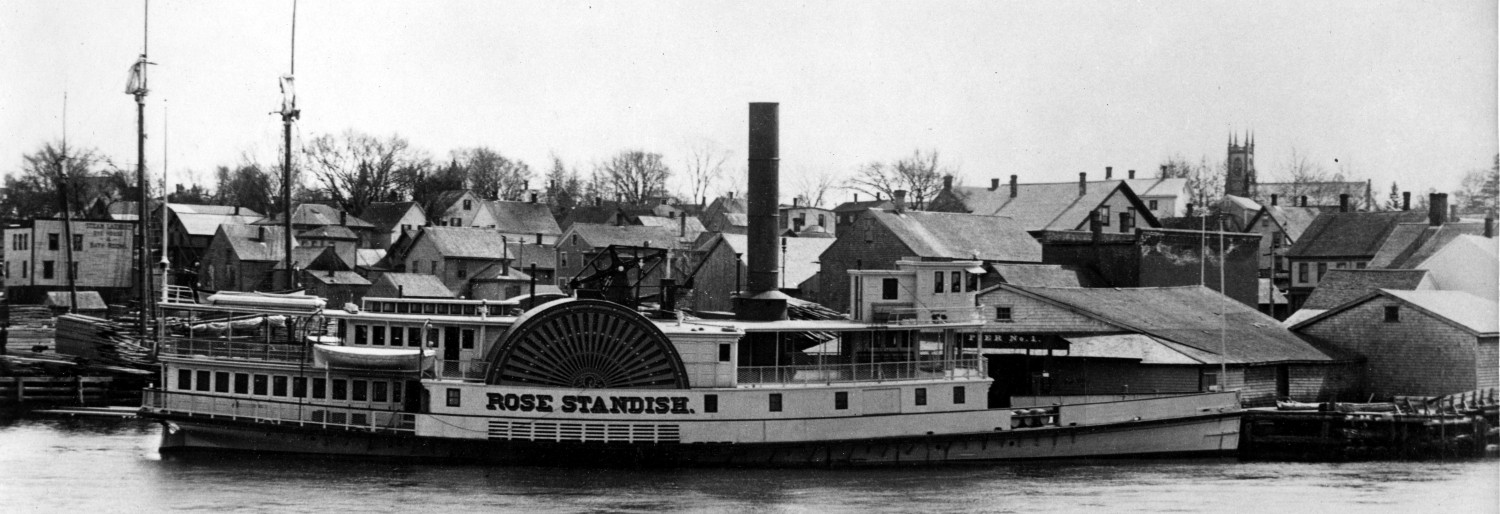
When first noticed the object appeared about a mile distant and coming towards them. They could see great paddle wheels churning the water and great quantities of spray flying over what looked like the bow of a boat. As they watched, a large waterspout shot out of the lake, apparently right ahead of the object and a tremendous roar echoed and re-echoed over the lake and through the woods. Every minute the thing was coming closer. It made straight for the shore, and when 50 yards away, the sight almost froze the blood in their bodies. Terror stricken they turned to flee.
Gaining the top of a hill, they turned in time to see a tail as large as the light house on Doucet’s Island disappear in the heaving waters of the lake. The gentlemen agree in saying the object was at least two hundred feet long, 30 feet wide and a head which beggars description. Place the heads of 50 horses on large steam engine and you have some idea of the description they give, Every head and eye and all moving rapidly. What is it? How did it get there? Is the dreaded sea serpent a captive in the waters of Maguerrawuck?
And no place of mystery is worth its salt unless somewhere beneath its surface lies treasure, preferably gold. According to articles published in the late 1800’s and early 1900’s there was plenty of glitter in Maguerrowoc:

Maguerrowock Cave was said to end in Robbinston
From an article in the Bath Times Record September 3, 1887
While excavating near Maguerrewock Mountain a man dislodged a piece of peculiar rock which bears small indications of gold. The place where the discovery was made is quite near Maguerrewock cave. Strange to write the interior of this marvelous cave is little known to the very people who have lived near it for years. This may be accounted for by the fact that the entrance is very difficult, being a small passage about eighteen inches high, quite long and devious. The surprising and interesting sights which greet the eyes of the adventurer who braves the horrors of the long passage will abundantly repay him on his final entrance. The walls are irregular and angular as nature formed them, but high up above the reach of the men of our day and age, are strange characters and quaint figures cut in the rock. These novel figures are all in relief and not rudimentary, but well defined and clear. Their great distance from the floor and other indications, show that men of Cyclopean stature were once indigenous to this region of wonders. Of all the travelers who have visited this strange cavern, none yet can account for the dazzling light illuminating the interior both day and night and which is almost blinding by its brilliancy and power. Some have attributed it to the phosphorescent properties of the rock. But whatever the cause, it is a weird and awesome sight. More people have visited the place since the discovery of gold than for some years. The earth and rock is of the same color and appearance as in the gold “diggings” in California. A stranger has visited the place in the interest of a wealthy mining syndicate but the men at work are so strict in regard to the find, that it was with difficulty he could learn any of the particulars. The gentleman who owns the land is quite elated. It is known among a few that he has refused a large sum of money for the land in the vicinity of the cave. The men are digging in the vicinity of the cave industriously for material for the highways yet are casting about sharply for nuggets. Later developments clearly show that there is considerable money in the discovery.
As a result of these and other “discoveries” a group of locals from Milltown formed the Maguerawock Mine and Mineral Company, George Trynor President. George was a machinist at the Cotton Mill. The group announced:
A tunnel will be run into the mountain five hundred feet; this will surely strike the rich vein, and the company have made it a rule not to sell stock at any price. The mineral spring has been in operation for the past year and the output has been just about equal to the demand. The demands which are now pouring in for this particular brand of national aperient have necessitated a large increase in the plant’s capacity, and a large building will be erected immediately and a team put on to supply the rapidly increasing trade.
George wisely held on to his job at the Cotton Mill.
Besides the tales of lost gold strikes in the Maguerrowock region, there are even stranger tales of unmarked graves- perhaps lost gold seekers- and the mummified corpses of the bogman or corpses of bogmen preserved in the moss and peat of the swamp. These tales seem to center on Howard Lake. The tale of the bogman even spawned a movie, beneath the frost line. The movie was based on tales of the bogman that the film’s creator, Andy Davis, had heard from his grandfather.

Fishermen on Howard Lake
Fred Keene who grew up in the early 1900s in Red Beach has written “It was considered a mark of toughness and adventure to leave the local ponds and go over to Maguerrawock” and he had many adventures and not a few encounters with game wardens. He describes one such encounter in his book “Keene on Red Beach”.
Fishing, however, had no such qualms of conscience with me and there was not a brook or lake that was not canvassed twelve months in the year. On one occasion I had a narrow escape from trouble, when fishing through the ice on Maguerrowock for pickerel. I may have had too many lines but at any rate there came along a game and fish warden in a swift team, and I had barely time enough to get on snowshoes and leave for the timber. The warden took the lines and probably the fish, also other articles that were needed in the fishing game like a package of lunch, and an axe. When he was well out of gunshot I took a couple of hurried shots with an old rifle, in his direction, intending to frighten the horse and then put for home.
More serious gunplay at Maguerrowock is related in an article written by Milltown Historian Ned Lamb nearly 100 years ago:
The lower reaches of Maguerrowock meadows have been favorite hunting grounds for muskrats and on quiet spring evenings the bang of guns could be heard almost continually. Some of the boys going on to the railroad bridge and some up to the road bridge. One afternoon a party went up the track. The list was about as follows with their guns: Morton (Babe) Kelley had a 38-56 Winchester; Silas (Cy) Kelsey a 38-40 Marlin; Dr. William (Brogle) Hanson a 45-90; James (Jim) McCluskey had a 12 gauge shot gun that used to came apart when it was fired; Stephen (Cotton Top) Knowles a 44 Winchester; Wallace (Pickey) Purrington a 45-70; Edward (Brooksie) Brooks a 45-70 Winchester; George (Bulger) Scott had a rifle but the caliber is not known. The ones on the road bridge were Seth Scott. Walter (Beetler) McKay, Frank Irving, Finley Frost, Ralph Tracy, Lemuel Groves, John Averill and Stephen Pineo. These were all armed but the sizes of their gone are not known.
History has not recorded who started it, but one of the boys took a about to see how near he could come to the crowd on the other bridge without hitting anyone. The fire was returned and then there was a scramble to get behind the rocks on the road bridge and the bank on the railroad. Shot followed shot. There was a ring as a bullet struck a rail or the dull thud as one hit a rock, or the zip as they passed overhead toward Mount Sewall or left the country for a trip to Canada. Every bullet had to pass over Maguerrowock stream at least six times before it reached the other bridge. But the spirit that watches over such things kept good guard until all the ammunition was used up and the muskrats while they might not have rested in peace that night, all answered to the roll call the next morning.

1954 – The water was still rising

Baring in the distance, sometimes the only way across was by canoe
Until recently the bridge over the marsh on Route One between Milltown and Baring was often underwater. As noted above the Maguerrowock Mountain ridge prevented any drainage from the streams and lakes in the backcountry into the St. Croix except through Maguerrowock. This was more than a matter of inconvenience although people sometimes drowned in their vehicles attempting to cross the marsh when it was in flood including Elton Seamans of South Princeton in 1949.
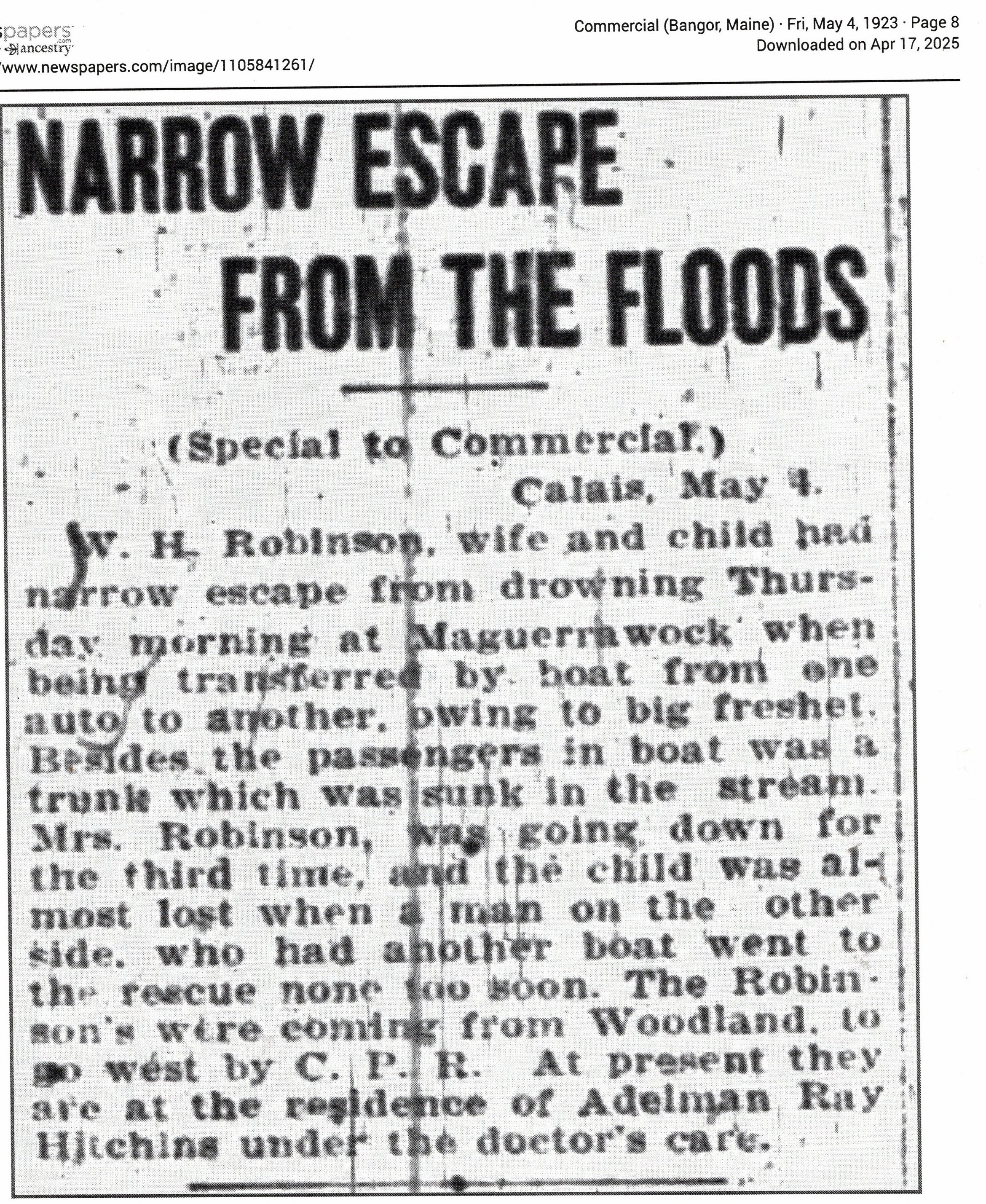
Others had close calls including the Robinson family in 1923.
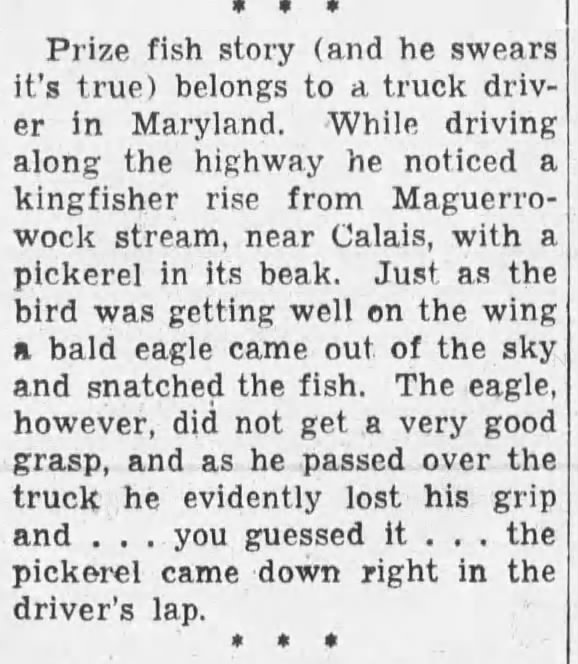
I will leave you with a more uplifting story from the Southwest Wave of Los Angeles California in 1938: