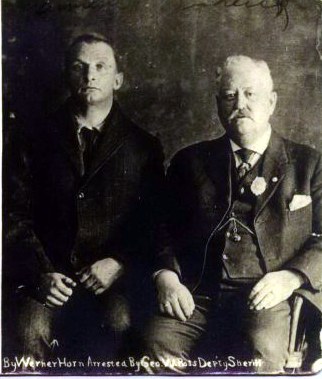
Photo taken soon after George Ross arrested German saboteur Werner Horne
The above photo of Werner Van Horne, German saboteur and Washington County Deputy Sheriff George Ross taken in Vanceboro in February 1915 was published in newspapers throughout the United States and Canada. In the early morning hours of February 2, 1915. Horne had attempted to destroy the railroad bridge between Vanceboro, Maine and McAdam, New Brunswick, thereby interrupting the flow of munitions and other wartime supplies destined for the Allies in Europe. While the United States was not yet in the war the sympathies of the country and its politicians was decidedly against Germany. The attempted sabotage was big news; a search on newspapers.com finds over 6000 articles in our national press concerning the event and in many much was made of the arresting officer George W. Ross of Vanceboro. I have written about the incident (https://stcroixhistorical.com/german-sabotage-at-vanceboro-1915/) as has Lyn Brown of the Vanceboro Historical Society (https://vanceborohistorical.org/articles/) so the sabotage itself requires little further description. Those unfamiliar with the attempted sabotage can find the details in the links above.
In short Horne was sent from New York to destroy the bridge. He arrived with a sufficient supply of dynamite to accomplish the task but due to bitter cold and interruptions while setting the charges under the Canadian side of the bridge the explosion caused only minor damage. Nearly frozen, he gave up any idea of escape and returned to the Vanceboro hotel from which he had just checked out and went to sleep while awaiting his arrest. The arresting officer was the local sheriff George W. Ross to whom he would have submitted peacefully except Ross was accompanied by two Canadian Mounties. Fearing he was to be turned over to the Canadian authorities and hanged, a likely outcome, he tried to get his pistol from his coat pocket. Ross and he struggled briefly while a Mountie secured the pistol. After the arrest Deputy Ross became an instant celebrity, sought after by reporters. Being the only law in the area Ross was also much involved in the tricky question of what charges to file against Horne.
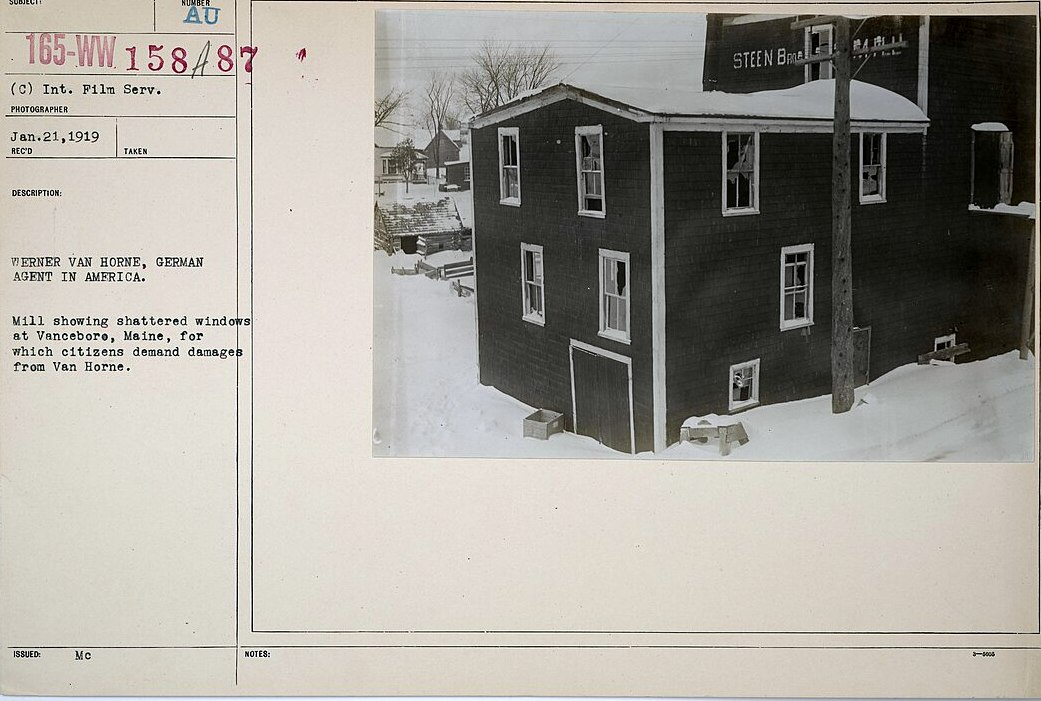
The windows shattered by the blast in Vanceboro, the only crime Horne committed in Maine

The Vanceboro Exchange Hotel were Horne was arrested by Deputy Ross
In the end the only law Horne had broken in Vanceboro was the breaking of windows in town near the bridge. To this charge Horne pled guilty and received a 30-day sentence to the Washington County Jail. Before he was released the U.S authorities charged him with illegal transportation of dynamite and a long legal odyssey began for Horne. The Canadian badly wanted him but when they eventually did get Horne two years later they didn’t hang him. After some time in New Brunswick’s Dorchester prison, he was declared insane and allowed to return to Germany. At least one account claims George Ross was one of the chief advocates for his release.
After I wrote the article on the sabotage of the Vanceboro bridge I didn’t give much thought to George W. Ross. I assumed this small-town Maine deputy sheriff had achieved his 15 minutes of fame and had vanished into the obscurity which is the fate of most local deputy sheriffs. However, as I did research on other topics, George Ross of Vanceboro kept popping up and not only in connection with Werner Horne. In fact, it soon became evident that George W. Ross was a true Downeast character, an original who was well known even before he arrested Werner Horne. In the late 1800’s Bangor and Portland papers often reported that George W. Ross, lawman or game warden had passed through town on his way to some destination, a recognition of his reputation throughout the state. I typed George’s name into Newspapers. Com and found hundreds of references to Sheriff George Ross, Warden George W. Ross and Deputy George W. Ross, all before Werner Horne attempted to blow up the Vanceboro bridge.

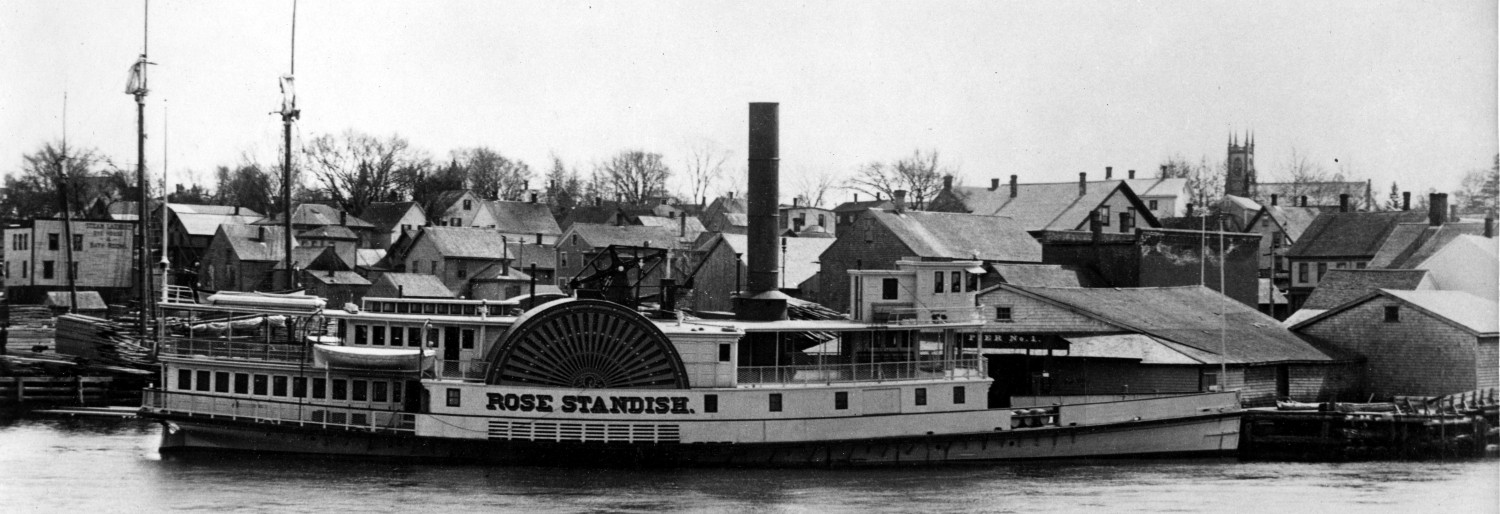
Vanceboro and McAdam Railroad hotels
I also found that my knowledge of Vanceboro history was sadly lacking. For many decades Vanceboro was a very important town in Maine. The railroad connecting Canada from the United States crossed in Vanceboro, Maine to McAdam, New Brunswick and both towns bustled with activity similar to that of many larger border towns. The line connected much of the United States with the ports in both New Brunswick and Nova Scotia. Two large hotels graced the towns, and the magnificent McAdam Station still stands, beautifully restored and well worth a visit. Thousands of travelers could pass on any given day and many spent time in town waiting for connections; were delayed while their papers were scrutinized by Immigration officials or needed to process customs paperwork. In the 1880’s George Ross was the proprietor of the dining room at the Vanceboro station and according to the newspapers he ran a first-rate establishment.
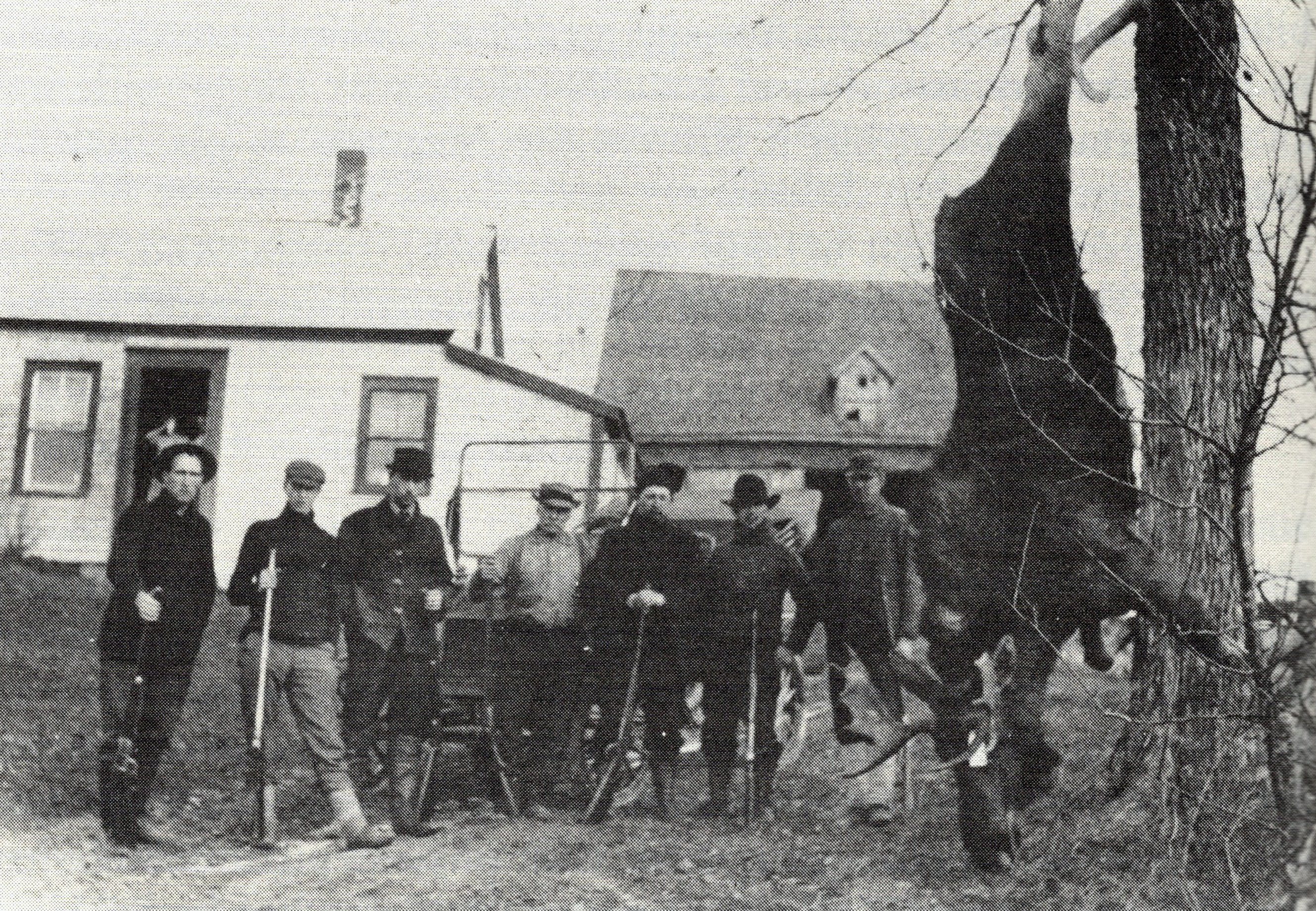
A graphic of this photo is the front cover of Downeast Game Wars. Magoon in center
George Ross first gained fame as a game warden. He is often mentioned in Edward Ives book, “George Magoon and the Downeast Games Wars” which is still available on Amazon for $30.00 and is as interesting a read as any local history book ever published. George Ross was George Magoon’s chief antagonist and often had Magoon before the courts for fish and game violations along with Magoon’s friend the notorious fish and game felon Wilbur Day. Warden Ross won nearly all his cases as he was highly respected by the judiciary for his professionalism and integrity, which was not the case with many game wardens of the era. He did lose one notable case against Wilbur Day at a session of court in Calais but even then the poacher did not escape the rough justice of the day. While waiting for the train at Calais after the trial Wilbur Day, the victorious defendant, had words with George Ross and his fellow warden, Oscar “Rip” Bowers. Bowers proceeded to:
strike Wilbur Day diverse blows upon his body and head and forehead and temple and other parts of his head and struck the plaintiff diverse grievous blows upon the chest stomach and abdomen in other parts of the body and choked and dragged the plaintiff and violently threw him to the ground and kicked him upon the body and legs and jumped upon his stomach and chest and thereby bruised and moved his head and forehead and body… (Civil Case-Washington County Day v. Bowers 1904)
George Ross did not intervene even though as an officer of the law he had an obligation to do so. It should be said few in those days would have expected him to do so.
In 1899 a number of wardens were investigated by the Commissioner of Fish and Game Commission. While some were found to have been unprofessional or worse, a complaint against George Ross was dismissed by the board. The investigating board commented that Warden Ross was a man of good repute and “Warden Ross is one of the head wardens of Washington County and it would be hard to make the Commissioner believe him to be remiss in his duties as he is considered a good and fearless officer being an intelligent man of good physique.” In this same year he made many arrests including Joe Lacoote, the partner of George Glidden then described by the Biddeford-Saco journal as the “King of the Poachers.”
Ross was also a successful horseman and farmer, raising hogs and racing horses. An 1888 Bangor Commercial article titled “Horse Flesh Downeast. Some Good Ones Owned by G.W. Ross at Vanceboro” extolled the virtues of “Messenger Boy” a trotting horse owned by Ross. The article also says that Ross is the owner of both the Vanceboro and McAdam railroad hotels. The hog business was not a great success as the “Hog Cholera” killed nearly all of his 115 hogs in 1890.
By the late 1880’s Ross had been appointed a state detective and in 1893 the Maine Central Railroad appointed him a railroad detective because as a deputy sheriff he “has succeeded in making Vanceboro one of the most orderly stations along the road.” His arrests included card sharpers who were arrested for cheating innocent rubes during the train trip. In 1894 he busted some rather inept counterfeiters and although provided with a very poor description arrested a thief from St. John fleeing the authorities there. A Bangor newspaper commented:
Not many criminals get passed Vanceboro when Ross is after them. This station formerly had a hard name as a refuge for lawbreakers but now it is one of the quietest and most orderly on the road.

1900 was another good year for Ross’ reputation as a lawman. In addition to the above on December 4th Ross managed the extrajudicial extradition of one H.W Reynolds, a clerk at the Lubec bank who had stolen a large sum of money and disappeared. Initially believed to have drowned in a Lubec pond, Detective Ross found him hiding in the toilet room of a train at the McAdam N.B. station and brought him back to the United States for prosecution. Another bank clerk who had stolen funds from his bank in St. John was arrested while fleeing through Vanceboro by Ross in 1906.

Howe’s London Shows 1921
The picture we have of George Ross is that of a tough, no nonsense Downeaster, a one-dimensional sort of good old boy, happy roaming the lakes and forests of his beloved Washington County and a man who would be entirely out of his element in the big cities of the United States. It might then surprise you to learn that in the summers, George ran away to join the circus. From as early as 1903 until the 1920’s George Ross worked as the head of security for some of the most well known circuses in the United States.
Graphic Winnipeg London circus
1921 Winnipeg Free Press:
W. ROSS ON THE ROAD AGAIN
Crowds Think He Owns the Circus When He Heads Parade.
The Free Press Evening Bulletin of Winnipeg, Manitoba, has complimentary article concerning George W. Ross of Vanceboro, Maine, one of the best-known detectives and deputy sheriffs in Maine, who is with the Howe Great London cirque this season, the article being in part as follows:
There are a great number of very interesting features that might be given as publicity for the Howe Great London Circus and Van Amburg’s Trained Wild Animal Shows, which comes to Winnipeg Sunday morning preparatory to its two-day engagement, but none are more interesting than George W. Ross, the chief detective with the big circus combination.
Mr. Ross has a number of relatives living in Winnipeg. whom he has never met and who undoubtedly know of him as the man who captured Werner Horn, the first German spy to be captured in America, after the attempt to blow up the C. P. R. bridge opposite Vanceboro, Maine, but on the Canadian side. Fortunately, Mr. Ross gave the Ottawa government the information that Horn was about to be released from the American federal prison at Atlanta and when the spy stepped forth from the gates to what he thought was liberty, the Canadian government officials were on hand and the culprit is now serving a sentence of 15 years in Kingston penitentiary.
Mr. Ross has many arduous duties to perform with the circus and has three able and experienced detectives under his personal supervision, who protect the public from any petty attempts to commit a felony.
He thinks the “circus life” the most fascinating profession to travel and has a host of funny experiences to tell regarding criminals who try to “put it over” the circus. This genial old man with his snow-white moustache and his 60 odd years looks to be in the prime of life and enjoys the hardships of continual travel with all the stamina of a n middle-aged man. On Monday morning, when the big parade passes along the principal streets of Winnipeg, the spectator is very apt to believe that the gentleman riding in the big automobile “at the head end” is none other than Colonel Howe, but do not be mistaken, for the distinguished one is none other than George W. Ross, the chief detective with the Howe Circus and should any criminals happen to see the old gentleman, it is an even wager that they will give the show a wide berth.

Lexington Kentucky Herald August 1921
It was also in 1921 that a banquet was held in Lexington Kentucky attended by 700 people honoring George Ross for his years of service to the circus and his role in both the capture and release of Werner Horne.
Lexington Kentucky Herald August 14, 1921
CIRCUS MAN WHO WAS HERE GOT SPY
George Ross, Of Howe-Van Amburg Shows, Later Secured Werner Horn’s Freedom-Received Message of Thanks While In Lexington.
It became known Saturday night that George W. Ross, chief detective with the Howe-Van circus which exhibited here was the man who captured Werner Horn, German spy, later aided Horn to secure his freedom. While in Lexington, Mr. Ross received a message from Horn, then in New York, which said: “I return home, my captor and friend, thanks to you.”
In the dining tent of the circus at Louisville Saturday night a banquet was given Mr. Ross in honor of the sixth anniversary of his capture of Horn, the first German spy to be taken prisoner in America. Horn was the man who blew up the Dominion end of the Canadian Pacific Railway bridge at Vanceboro, Maine. The banquet was given Mr. Ross by Dan Odom, manager of the circus, his executive staff and department heads and, while it was an anniversary affair, it is also an expression of regard for Ross as well, for he is the friend, the true friend, of every one of the 700 people with the big troupe.
Mr. Ross makes his home in the winter at Vanceboro, where he holds reins on a force of State detectives patrolling the border. The capture of Horn, although it won the circus man much renown, meant little to him as an accomplishment, for Ross has a name up in rockbound Maine for getting his man. Ross is sixty years of age, but he looks only forty-eight or fifty, and he is alert, strong, quick with the vim and nerve of a lad.
Not long ago he learned that Horn was losing his mind in his prison at Ottawa. When the Howe’s Great London Show was on its Canadian tour this spring, Ross made a trip to see Horn. He found the man’s reason tottering, his general condition critical. That was enough for the circus man. He went to the powers of the Dominions government and made representations for Horn’s deportation and return to Germany. He succeeded and Horn’s message quoted above was a result.
It would not seem at all out of character for Ross to support Werner Horne’s release from prison and Horne’s return to Germany. While the article above claimed Ross had warned the Canadian authorities Horn was soon to be released from his U.S. prison and suggested they take action to take custody of Horn before he could return to Germany, this seems somewhat unlikely. The U.S and Canadian authorities were in nearly constant negotiations over Horne and would not have released him without informing the Canadians. Further it is well known Ross liked Horne and treated him with both decency and kindness while in his custody. A 1941 article in the Bangor Daily News had this to say about Ross delivering Horn to the authorities in Bangor in 1915 a few days after Horne’s attempt on the bridge:
Deputy Ross, who seemed to have conceived a liking for his prisoner, said the trip to Bangor had been uneventful although crowds surrounded every railroad station. Just before the train left Vanceboro, however, there was one rather interesting episode. A Canadian,name not specified, went to Ross and asked him to take Horne to the international bridge, then let him go. “Just turn him loose; we’ll look after him,” the Canadian volunteered.
“I guess not!” the deputy responded. “What will you do if a crowd of us come over after him?” the questioner persisted. “You’ll take him over my dead body,” said Ross without the slightest effort to be melodramatic. “Bring on your crowd!” The Canadian left, and that was the end of it. “I rather wish he’d started something,” the deputy remarked.
Ironically when Werner Horne was released from U.S. custody and turned over to the Canadian authorities it was George W. Ross who escorted Horne to Canada, over the Vanceboro bridge Horne had attempted to destroy. Horne was placed in the custody of Sheriff Hawkins of Fredericton, New Brunswick.
I do not know how long George Ross continued to travel with the circus in the summer but as late as 1929 he received his commission as a game warden and as deputy sheriff. He remained a deputy until his death in 1933. More about his final years can be found on the Vanceboro Historical Society website provided above. There are many other articles on the site which will interest those who enjoy history.
His obituary from the Bangor Daily News: September 14, 1933
EVENTFUL AND USEFUL LIFE COMES TO END
George W. Ross Succumbs to Heart Trouble at Vanceboro Home
WAS WIDELY KNOWN
Terror to Lawless- Captured German Spy- Deputy Sheriff for 40 Years
Special the Bangor Daily News)
VANCEBORO – The death of George W. Ross, 75, occurred shortly after noon today of angina pectoris. His health had been seriously impaired for the past three years. The funeral will be at the residence at 2 o’clock on Friday afternoon.
The passing of Mr. Ross marks the end of a long, eventful and honorable career of one of the best-known residents of Eastern Maine, an outstanding citizen of this community and Washington county.
He was born in Orono, the son of Charles and Harriet Ross and came to Vanceboro 56 years ago when he was employed by his uncle Michael Ross in the Station Hotel and later became the proprietor for a time. He then entered the service of the Pullman Company, as parlor car conductor between Bangor and Vanceboro.
For the past 40 years he had been a deputy sheriff of Washington County serving through many changes in sheriffs but he was always reappointed to office and held the office at the time of his death. He had a taste for criminal investigation, was a state detective, long chief game warden of the county, also serving 20 years as postmaster.
His many thrilling adventures in running down the lawless as well as other like incidents, would make a large and decidedly interesting book. He worked up many cases by clever detective work.
Perhaps the outstanding chapter in his career was the capture of the German Reservist Werner Horne, who on Feb. 2, 1915, dynamited the international bridge here. Horne was traced and arrested by Mr. Ross, the case attracting worldwide attention at the time.
For many summer seasons Mr. Ross traveled with circuses all over the country as legal adjuster and was widely known to showmen. He had been with the Frank A. Robbins Circus, Howe’s Great London, John Robinson’s, Gentry Bros., and other shows.
When failing health demanded less activity he opened the first ice cream parlor here, and later a filling station which he conducted up to the time of his death. Since the death of his wife, Mrs. Mary Bishop Ross, 13 years ago, he has made his home with his only daughter, Mrs. Marion R. McIver. He was a Mason and member of Vanceboro lodge, K. of P.
Many, all over the country will regret the passing of Mr. Ross as a personal loss. His was a kindly and genial nature, always loyal to his friends and conscientious in the discharging of his duties.